
Recent from talks
Quantal response equilibrium
Knowledge base stats:
Talk channels stats:
Members stats:
Quantal response equilibrium
Quantal response equilibrium (QRE) is a solution concept in game theory. First introduced by Richard McKelvey and Thomas Palfrey, it provides an equilibrium notion with bounded rationality. QRE is not an equilibrium refinement, and it can give significantly different results from Nash equilibrium. QRE is only defined for games with discrete strategies, although there are continuous-strategy analogues.
In a quantal response equilibrium, players are assumed to make errors in choosing which pure strategy to play. The probability of any particular strategy being chosen is positively related to the payoff from that strategy. In other words, very costly errors are unlikely.
The equilibrium arises from the realization of beliefs. A player's payoffs are computed based on beliefs about other players' probability distribution over strategies. In equilibrium, a player's beliefs are correct.
When analyzing data from the play of actual games, particularly from laboratory experiments with the matching pennies game, Nash equilibrium can be unforgiving. Any non-equilibrium move can appear equally "wrong", but realistically should not be used to reject a theory. QRE allows every strategy to be played with non-zero probability, and so any data is possible (though not necessarily reasonable).
The most common specification for QRE is logit equilibrium (LQRE). In a logit equilibrium, player's strategies are chosen according to the probability distribution:
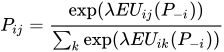
is the probability of player choosing strategy . is the expected utility to player of choosing strategy under the belief that other players are playing according to the probability distribution . Note that the "belief" density in the expected payoff on the right side must match the choice density on the left side. Thus computing expectations of observable quantities such as payoff, demand, output, etc., requires finding fixed points as in mean field theory.


Of particular interest in the logit model is the non-negative parameter λ (sometimes written as 1/μ). λ can be thought of as the rationality parameter. As λ→0, players become "completely non-rational", and play each strategy with equal probability. As λ→∞, players become "perfectly rational", and play approaches a Nash equilibrium.
Hub AI
Quantal response equilibrium AI simulator
(@Quantal response equilibrium_simulator)
Quantal response equilibrium
Quantal response equilibrium (QRE) is a solution concept in game theory. First introduced by Richard McKelvey and Thomas Palfrey, it provides an equilibrium notion with bounded rationality. QRE is not an equilibrium refinement, and it can give significantly different results from Nash equilibrium. QRE is only defined for games with discrete strategies, although there are continuous-strategy analogues.
In a quantal response equilibrium, players are assumed to make errors in choosing which pure strategy to play. The probability of any particular strategy being chosen is positively related to the payoff from that strategy. In other words, very costly errors are unlikely.
The equilibrium arises from the realization of beliefs. A player's payoffs are computed based on beliefs about other players' probability distribution over strategies. In equilibrium, a player's beliefs are correct.
When analyzing data from the play of actual games, particularly from laboratory experiments with the matching pennies game, Nash equilibrium can be unforgiving. Any non-equilibrium move can appear equally "wrong", but realistically should not be used to reject a theory. QRE allows every strategy to be played with non-zero probability, and so any data is possible (though not necessarily reasonable).
The most common specification for QRE is logit equilibrium (LQRE). In a logit equilibrium, player's strategies are chosen according to the probability distribution:
is the probability of player choosing strategy . is the expected utility to player of choosing strategy under the belief that other players are playing according to the probability distribution . Note that the "belief" density in the expected payoff on the right side must match the choice density on the left side. Thus computing expectations of observable quantities such as payoff, demand, output, etc., requires finding fixed points as in mean field theory.
Of particular interest in the logit model is the non-negative parameter λ (sometimes written as 1/μ). λ can be thought of as the rationality parameter. As λ→0, players become "completely non-rational", and play each strategy with equal probability. As λ→∞, players become "perfectly rational", and play approaches a Nash equilibrium.