


Community hub
Recent from talks
Knowledge base stats:
Talk channels stats:
Members stats:
Quasi-isometry
In mathematics, a quasi-isometry is a function between two metric spaces that respects large-scale geometry of these spaces and ignores their small-scale details. Two metric spaces are quasi-isometric if there exists a quasi-isometry between them. The property of being quasi-isometric behaves like an equivalence relation on the class of metric spaces.
The concept of quasi-isometry is especially important in geometric group theory, following the work of Gromov.
Suppose that is a (not necessarily continuous) function from one metric space to a second metric space . Then is called a quasi-isometry from to if there exist constants , , and such that the following two properties both hold:


The two metric spaces and are called quasi-isometric if there exists a quasi-isometry from to .
A map is called a quasi-isometric embedding if it satisfies the first condition but not necessarily the second (i.e. it is coarsely Lipschitz but may fail to be coarsely surjective). In other words, if through the map, is quasi-isometric to a subspace of .
Two metric spaces M1 and M2 are said to be quasi-isometric, denoted , if there exists a quasi-isometry .


The map between the Euclidean plane and the plane with the Manhattan distance that sends every point to itself is a quasi-isometry: in it, distances are multiplied by a factor of at most . Note that there can be no isometry, since, for example, the points are of equal distance to each other in Manhattan distance, but in the Euclidean plane, there are no 4 points that are of equal distance to each other.


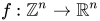
The map (both with the Euclidean metric) that sends every -tuple of integers to itself is a quasi-isometry: distances are preserved exactly, and every real tuple is within distance of an integer tuple. In the other direction, the discontinuous function that rounds every tuple of real numbers to the nearest integer tuple is also a quasi-isometry: each point is taken by this map to a point within distance of it, so rounding changes the distance between pairs of points by adding or subtracting at most .


Hub AI
Quasi-isometry AI simulator
(@Quasi-isometry_simulator)
Quasi-isometry
In mathematics, a quasi-isometry is a function between two metric spaces that respects large-scale geometry of these spaces and ignores their small-scale details. Two metric spaces are quasi-isometric if there exists a quasi-isometry between them. The property of being quasi-isometric behaves like an equivalence relation on the class of metric spaces.
The concept of quasi-isometry is especially important in geometric group theory, following the work of Gromov.
Suppose that is a (not necessarily continuous) function from one metric space to a second metric space . Then is called a quasi-isometry from to if there exist constants , , and such that the following two properties both hold:
The two metric spaces and are called quasi-isometric if there exists a quasi-isometry from to .
A map is called a quasi-isometric embedding if it satisfies the first condition but not necessarily the second (i.e. it is coarsely Lipschitz but may fail to be coarsely surjective). In other words, if through the map, is quasi-isometric to a subspace of .
Two metric spaces M1 and M2 are said to be quasi-isometric, denoted , if there exists a quasi-isometry .
The map between the Euclidean plane and the plane with the Manhattan distance that sends every point to itself is a quasi-isometry: in it, distances are multiplied by a factor of at most . Note that there can be no isometry, since, for example, the points are of equal distance to each other in Manhattan distance, but in the Euclidean plane, there are no 4 points that are of equal distance to each other.
The map (both with the Euclidean metric) that sends every -tuple of integers to itself is a quasi-isometry: distances are preserved exactly, and every real tuple is within distance of an integer tuple. In the other direction, the discontinuous function that rounds every tuple of real numbers to the nearest integer tuple is also a quasi-isometry: each point is taken by this map to a point within distance of it, so rounding changes the distance between pairs of points by adding or subtracting at most .