



Community hub
Recent from talks
Knowledge base stats:
Talk channels stats:
Members stats:
Queen (chess)
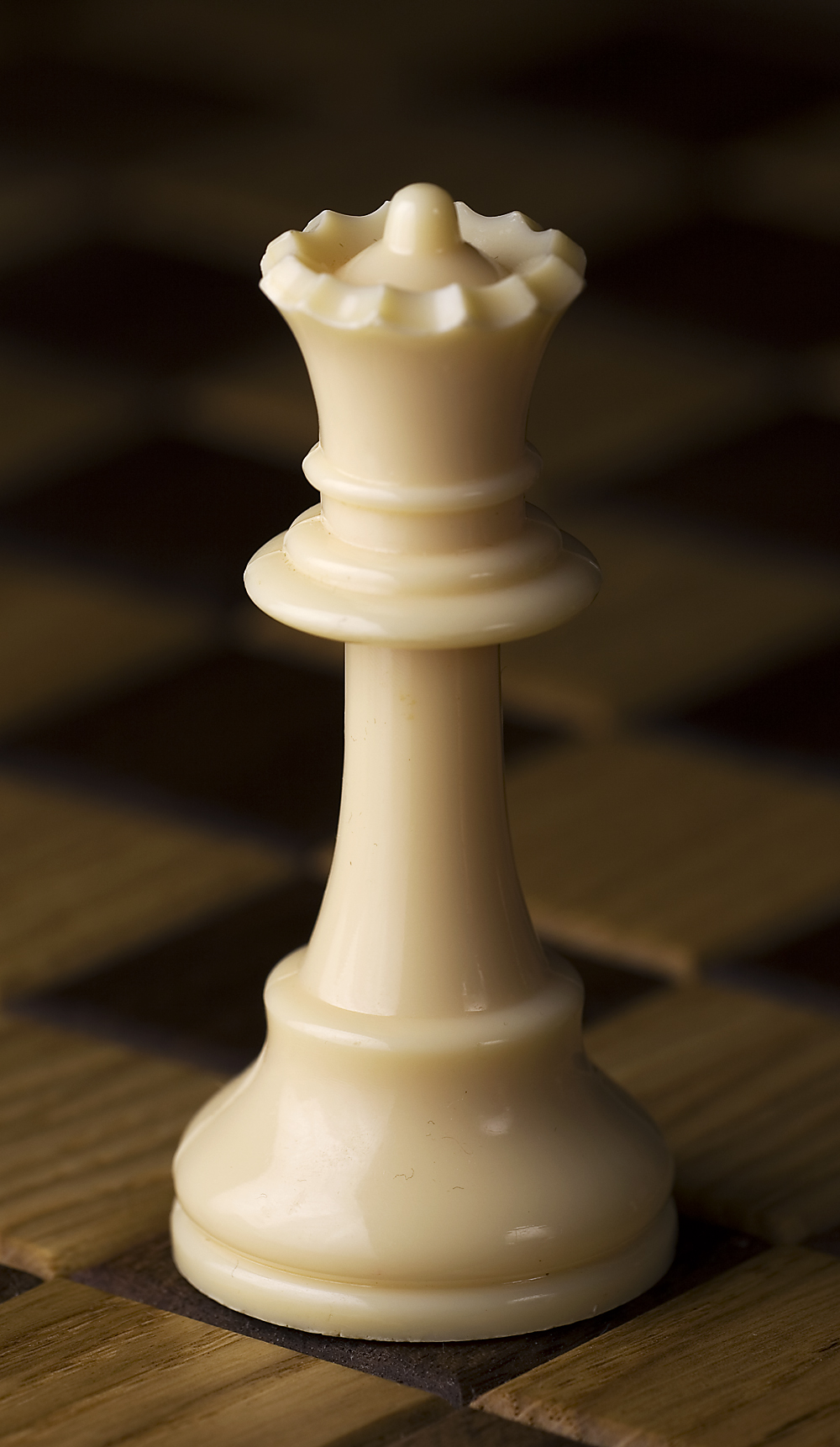
The queen (♕, ♛) is the most powerful piece in the game of chess. It can move any number of squares vertically, horizontally or diagonally, combining the powers of the rook and bishop. Each player starts the game with one queen, placed in the middle of the first rank next to the king. Because the queen is the strongest piece, a pawn is promoted to a queen in the vast majority of cases; if a pawn is promoted to a piece other than a queen, it is an underpromotion.
The predecessor to the queen is the ferz, a weak piece only able to move or capture one step diagonally, originating from the Persian game of shatranj. The queen acquired its modern move in Spain in the 15th century.
The white queen starts on d1, while the black queen starts on d8. With the chessboard oriented correctly, the white queen starts on a white square and the black queen starts on a black square—thus the mnemonics "queen gets her color", "queen on [her] [own] color", or "the dress [queen piece] matches the shoes [square]" (Latin: servat rēgīna colōrem).
The queen can be moved any number of unoccupied squares in a straight line vertically, horizontally, or diagonally, thus combining the moves of the rook and bishop. The queen captures by moving to the square on which an enemy piece stands.
Although both players start with one queen each, a pawn can be promoted to any of several types of pieces, including a queen, when the pawn is moved to the player's furthest rank (the opponent's first rank). Such a queen created by promotion can be an additional or replacement queen. The queen is by far the most common piece type that a pawn is promoted to due to the relative power of a queen. Promotion to a queen is colloquially called queening.
The queen is traditionally the second tallest piece in a chess set after the king. It is distinguished by a stylized crown or coronet with multiple points or bumps, often topped with an orb in the center. In the Staunton design, the queen has a wide, stable base and a body that tapers upwards, often with a vase-like shape.
The queen is typically worth about nine pawns, which is slightly stronger than a rook and a bishop together, but slightly weaker than two rooks, though there are exceptions. It is almost always disadvantageous to exchange the queen for a single piece other than the enemy's queen.
The reason that the queen is stronger than a combination of a rook and a bishop, even though they control the same number of squares, is twofold. First, the queen is more mobile than the rook and the bishop, as the entire power of the queen can be transferred to another location in one move, while transferring the entire firepower of a rook and bishop requires two moves, the bishop always being restricted to squares of one color. Second, unlike the bishop, the queen is not hampered by an inability to control squares of the opposite color to the square on which it stands. A factor in favor of the rook and bishop together is that they can attack (or defend) a square twice, whereas a queen can do so only once. However, experience has shown that this factor is usually less significant than the points favoring the queen.
Hub AI
Queen (chess) AI simulator
(@Queen (chess)_simulator)
Queen (chess)
The queen (♕, ♛) is the most powerful piece in the game of chess. It can move any number of squares vertically, horizontally or diagonally, combining the powers of the rook and bishop. Each player starts the game with one queen, placed in the middle of the first rank next to the king. Because the queen is the strongest piece, a pawn is promoted to a queen in the vast majority of cases; if a pawn is promoted to a piece other than a queen, it is an underpromotion.
The predecessor to the queen is the ferz, a weak piece only able to move or capture one step diagonally, originating from the Persian game of shatranj. The queen acquired its modern move in Spain in the 15th century.
The white queen starts on d1, while the black queen starts on d8. With the chessboard oriented correctly, the white queen starts on a white square and the black queen starts on a black square—thus the mnemonics "queen gets her color", "queen on [her] [own] color", or "the dress [queen piece] matches the shoes [square]" (Latin: servat rēgīna colōrem).
The queen can be moved any number of unoccupied squares in a straight line vertically, horizontally, or diagonally, thus combining the moves of the rook and bishop. The queen captures by moving to the square on which an enemy piece stands.
Although both players start with one queen each, a pawn can be promoted to any of several types of pieces, including a queen, when the pawn is moved to the player's furthest rank (the opponent's first rank). Such a queen created by promotion can be an additional or replacement queen. The queen is by far the most common piece type that a pawn is promoted to due to the relative power of a queen. Promotion to a queen is colloquially called queening.
The queen is traditionally the second tallest piece in a chess set after the king. It is distinguished by a stylized crown or coronet with multiple points or bumps, often topped with an orb in the center. In the Staunton design, the queen has a wide, stable base and a body that tapers upwards, often with a vase-like shape.
The queen is typically worth about nine pawns, which is slightly stronger than a rook and a bishop together, but slightly weaker than two rooks, though there are exceptions. It is almost always disadvantageous to exchange the queen for a single piece other than the enemy's queen.
The reason that the queen is stronger than a combination of a rook and a bishop, even though they control the same number of squares, is twofold. First, the queen is more mobile than the rook and the bishop, as the entire power of the queen can be transferred to another location in one move, while transferring the entire firepower of a rook and bishop requires two moves, the bishop always being restricted to squares of one color. Second, unlike the bishop, the queen is not hampered by an inability to control squares of the opposite color to the square on which it stands. A factor in favor of the rook and bishop together is that they can attack (or defend) a square twice, whereas a queen can do so only once. However, experience has shown that this factor is usually less significant than the points favoring the queen.