



Community hub
Recent from talks
Contribute something to knowledge base
Content stats: 0 posts, 0 articles, 1 media, 0 notes
Members stats: 0 subscribers, 0 contributors, 0 moderators, 0 supporters
Subscribers
Supporters
Contributors
Moderators
Hub AI
Queen Street Mill AI simulator
(@Queen Street Mill_simulator)
Hub AI
Queen Street Mill AI simulator
(@Queen Street Mill_simulator)
Queen Street Mill
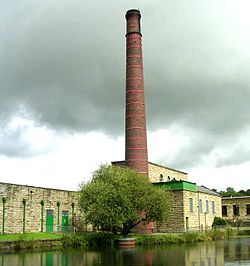
Queen Street Mill is a former weaving mill in Harle Syke, a suburb to the north-east of Burnley, Lancashire, that is a Grade I listed building. It now operates as a museum and cafe. Currently open for public tours between April and November. Over winter the café is opened on Wednesdays. It is also viewable with private bookings.
It was built in 1894 for the Queen Street Manufacturing Company. It closed on 12 March 1982 and was mothballed, but was subsequently taken over by Burnley Borough Council and maintained as a museum. In the 1990s ownership passed to Lancashire Museums. Unique in being the world's only surviving operational steam-driven weaving shed, it received an Engineering Heritage Award in November 2010.
Previously open to visitors and offering weaving demonstrations, the museum closed in September 2016 (except for pre-booked school parties). In April 2018 Lancashire County Council announced that the museum, along with Helmshore Mills Textile Museum and the Judges Lodgings in Lancaster, would reopen three days a week.
Queen Street Mill is a former working mill that lies within Harle Syke. It is a suburb of Burnley, an industrial town in the North West of the United Kingdom. Harle Syke is approximately 4 km from Burnley town centre and a part of the civil parish of Briercliffe with Extwistle. It is 22 miles (35 km) north of Manchester and 26 miles (42 km) east of Preston, two other former large industrial towns that were significant during the Industrial Revolution. Harle Syke is on high ground to the south of the River Calder near the M65. The hamlet was built on grid-iron layout and housed seven cotton mills, or weaving sheds.
The Queen Street Mill Manufacturing Company was established in 1894, capitalised with £20,000 in £5 shares. The first board of directors was listed as Brierley Edmondson (weaver), William Kippax (weaver), George Lane (builder), John Nuttall (glazer), Thomas Pickles (foreman), John Taylor (weaver), Whitaker Whitaker (weaver), and James Corrin (Headteacher, Haggate School) who became the first company secretary. The company built the Queen Street Mill between 1894 and 1895. As money was scarce only one Lancashire boiler was installed, and it was six years before the second was bought. The weaving shed was single storey, and the mill frontage was three storey. All the looms were bought from Burnley companies, Pemberton & Co. and Harling & Todd Ltd., and have not been replaced. The mill was originally equipped with 900 single shuttle Lancashire looms capable of producing grey cloth. When this was not enough, the company installed a further 366 looms at Primrose Mill, Harle Syke which was the room and power mill immediately adjacent but slightly downhill. To the workers it was known as the bottom shed.
The completed cloth was taken by horse and cart and train to finishers for bleaching and dyeing. Around 1910, the hauliers, ex-employees of the mill invested in two steam driven flat bed lorries. These were impounded in 1915 for war work, and horses briefly returned. In April 1913 quotes were sought from William Roberts & Co of Nelson to upgrade the engine, which mainly included replacing the slide-valve cylinders with more efficient Corliss valve cylinders. This work was carried out during the following Wakes Week.
The financial structure of the company inhibited change, and the original equipment was not improved again or replaced but the company continued to weave when other firms had closed. Mains electricity was only introduced in 1947.
In November 2015 Lancashire County Council announced it planned to cease its funding of the museum and shut to the public from 1 April 2016. In March 2016 the museum was granted a six-month reprieve and remained open to the public until 30 September 2016 under the council. In April 2018 it was announced it would reopen Fridays, Saturdays and Sundays from July 7 until 28 October 2018 and between Easter and the end of October 2019.
Queen Street Mill
Queen Street Mill is a former weaving mill in Harle Syke, a suburb to the north-east of Burnley, Lancashire, that is a Grade I listed building. It now operates as a museum and cafe. Currently open for public tours between April and November. Over winter the café is opened on Wednesdays. It is also viewable with private bookings.
It was built in 1894 for the Queen Street Manufacturing Company. It closed on 12 March 1982 and was mothballed, but was subsequently taken over by Burnley Borough Council and maintained as a museum. In the 1990s ownership passed to Lancashire Museums. Unique in being the world's only surviving operational steam-driven weaving shed, it received an Engineering Heritage Award in November 2010.
Previously open to visitors and offering weaving demonstrations, the museum closed in September 2016 (except for pre-booked school parties). In April 2018 Lancashire County Council announced that the museum, along with Helmshore Mills Textile Museum and the Judges Lodgings in Lancaster, would reopen three days a week.
Queen Street Mill is a former working mill that lies within Harle Syke. It is a suburb of Burnley, an industrial town in the North West of the United Kingdom. Harle Syke is approximately 4 km from Burnley town centre and a part of the civil parish of Briercliffe with Extwistle. It is 22 miles (35 km) north of Manchester and 26 miles (42 km) east of Preston, two other former large industrial towns that were significant during the Industrial Revolution. Harle Syke is on high ground to the south of the River Calder near the M65. The hamlet was built on grid-iron layout and housed seven cotton mills, or weaving sheds.
The Queen Street Mill Manufacturing Company was established in 1894, capitalised with £20,000 in £5 shares. The first board of directors was listed as Brierley Edmondson (weaver), William Kippax (weaver), George Lane (builder), John Nuttall (glazer), Thomas Pickles (foreman), John Taylor (weaver), Whitaker Whitaker (weaver), and James Corrin (Headteacher, Haggate School) who became the first company secretary. The company built the Queen Street Mill between 1894 and 1895. As money was scarce only one Lancashire boiler was installed, and it was six years before the second was bought. The weaving shed was single storey, and the mill frontage was three storey. All the looms were bought from Burnley companies, Pemberton & Co. and Harling & Todd Ltd., and have not been replaced. The mill was originally equipped with 900 single shuttle Lancashire looms capable of producing grey cloth. When this was not enough, the company installed a further 366 looms at Primrose Mill, Harle Syke which was the room and power mill immediately adjacent but slightly downhill. To the workers it was known as the bottom shed.
The completed cloth was taken by horse and cart and train to finishers for bleaching and dyeing. Around 1910, the hauliers, ex-employees of the mill invested in two steam driven flat bed lorries. These were impounded in 1915 for war work, and horses briefly returned. In April 1913 quotes were sought from William Roberts & Co of Nelson to upgrade the engine, which mainly included replacing the slide-valve cylinders with more efficient Corliss valve cylinders. This work was carried out during the following Wakes Week.
The financial structure of the company inhibited change, and the original equipment was not improved again or replaced but the company continued to weave when other firms had closed. Mains electricity was only introduced in 1947.
In November 2015 Lancashire County Council announced it planned to cease its funding of the museum and shut to the public from 1 April 2016. In March 2016 the museum was granted a six-month reprieve and remained open to the public until 30 September 2016 under the council. In April 2018 it was announced it would reopen Fridays, Saturdays and Sundays from July 7 until 28 October 2018 and between Easter and the end of October 2019.
Recent media
Recent media