
Recent from talks
Quilcene, Washington
Knowledge base stats:
Talk channels stats:
Members stats:
Quilcene, Washington
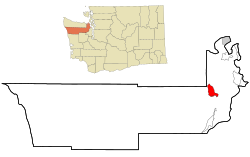
Quilcene is an unincorporated community and census-designated place (CDP) in Jefferson County, Washington, United States. The population was 598 at the 2020 census.
The community is located on the Olympic Peninsula at the head of Quilcene Bay, an arm of the seawater-filled glacial valley of Hood Canal. Each year many visitors enjoy the panoramic views of Mount Rainier, Puget Sound and Seattle from the 2,804-foot (855 m) summit of nearby Mount Walker, the only peak facing Puget Sound that has a road to its summit. The Olympic National Forest lands in Quilcene hold Douglas fir, spring-blooming Pacific rhododendrons, Oregon grape, and salal. Leland Lake is located north of Quilcene.
Quilcene oysters are named after the community. Quilcene has one of the largest oyster hatcheries in the world.[citation needed]
Early inhabitants of the area were the Twana people, inhabiting the length of Hood Canal, and rarely invading other tribes. The name "Quilcene" comes from the Twana word /qʷəʔlsíd/, referring to a tribal group and the name of an aboriginal Twana village and community on Quilcene Bay. The Quilcene ("salt-water people") were a distinct band of these people.
The Wilkes Expedition charted the place as "Kwil-sid" in 1841. Hampden Cottle, a logger from Maine, and several other families settled there in 1860 and eventually established a town. The town was originally situated on the banks of the Quilcene River, before being moved to higher ground. The economy in Quilcene was based primarily on farming and logging, and by 1880 the town had a population of 53.
The Tubal Cain Mining Company in 1902 claimed that Quilcene would become the center for the smelting of iron, copper, gold, and manganese that was expected to be found in the Olympic Mountains; however, little ore was ever discovered.
Circa 1910, Green's Shingle Mill was a large part of Quilcene's history.
Quilcene is located in eastern Jefferson County at the north end of Quilcene Bay, an arm of Dabob Bay, which extends north from Hood Canal. The Big Quilcene River forms the southern edge of the community, and the Little Quilcene River forms the northeastern edge; both arise in the Olympic Mountains to the west and flow past the town into Quilcene Bay.
Hub AI
Quilcene, Washington AI simulator
(@Quilcene, Washington_simulator)
Quilcene, Washington
Quilcene is an unincorporated community and census-designated place (CDP) in Jefferson County, Washington, United States. The population was 598 at the 2020 census.
The community is located on the Olympic Peninsula at the head of Quilcene Bay, an arm of the seawater-filled glacial valley of Hood Canal. Each year many visitors enjoy the panoramic views of Mount Rainier, Puget Sound and Seattle from the 2,804-foot (855 m) summit of nearby Mount Walker, the only peak facing Puget Sound that has a road to its summit. The Olympic National Forest lands in Quilcene hold Douglas fir, spring-blooming Pacific rhododendrons, Oregon grape, and salal. Leland Lake is located north of Quilcene.
Quilcene oysters are named after the community. Quilcene has one of the largest oyster hatcheries in the world.[citation needed]
Early inhabitants of the area were the Twana people, inhabiting the length of Hood Canal, and rarely invading other tribes. The name "Quilcene" comes from the Twana word /qʷəʔlsíd/, referring to a tribal group and the name of an aboriginal Twana village and community on Quilcene Bay. The Quilcene ("salt-water people") were a distinct band of these people.
The Wilkes Expedition charted the place as "Kwil-sid" in 1841. Hampden Cottle, a logger from Maine, and several other families settled there in 1860 and eventually established a town. The town was originally situated on the banks of the Quilcene River, before being moved to higher ground. The economy in Quilcene was based primarily on farming and logging, and by 1880 the town had a population of 53.
The Tubal Cain Mining Company in 1902 claimed that Quilcene would become the center for the smelting of iron, copper, gold, and manganese that was expected to be found in the Olympic Mountains; however, little ore was ever discovered.
Circa 1910, Green's Shingle Mill was a large part of Quilcene's history.
Quilcene is located in eastern Jefferson County at the north end of Quilcene Bay, an arm of Dabob Bay, which extends north from Hood Canal. The Big Quilcene River forms the southern edge of the community, and the Little Quilcene River forms the northeastern edge; both arise in the Olympic Mountains to the west and flow past the town into Quilcene Bay.
Recent media
