
Recent from talks
Quirinus
Knowledge base stats:
Talk channels stats:
Members stats:
Quirinus
In Roman mythology and religion, Quirinus (/kwɪˈraɪnəs/ kwi-RY-nəs, Latin: [kᶣɪˈriːnʊs]) is an early god of the Roman state. In Augustan Rome, Quirinus was also an epithet of Janus, Mars, and Jupiter.
The name of god Quirinus is recorded across Roman sources as Curinus, Corinus, Querinus, Queirinus and QVIRINO, also as fragmented IOVI. CYRIN[O]. The name is also attested as a surname to Hercules as Hercules Quirinus.
The name Quirīnus probably stems from Latin quirīs, the name of Roman citizens in their peacetime function. Since both quirīs and Quirīnus are connected with Sabellic immigrants into Rome in ancient legends, it may be a loanword. The meaning "wielder of the spear" (Sabine quiris, 'spear', cf. Janus Quirinus), or a derivation from the Sabine town of Cures, have been proposed by Ovid in his Fasti 2.477-480.[better source needed]
Some scholars have interpreted the name as a contraction of *co-viri-nus ("god of the assemblymen", cf. cūria < *co-viria), descending from an earlier *co-wironos, itself from the Proto-Indo-European noun *wihₓrós ("man"). Linguist Michiel de Vaan argues that this etymology "is not credible phonetically and not very compelling semantically".
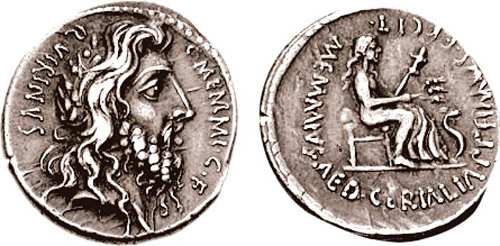
In earlier Roman art, Quirinus was portrayed as a bearded man with religious and military clothing. However, he was almost never depicted in later Roman art due to the process of hellenisation. His main festival was the Quirinalia, held on February 17.
The priest of Quirinus, the Flamen Quirinalis, was one of the three patrician flamines maiores ("major flamens") who had precedence over the Pontifex Maximus.
Quirinus most likely was originally a Sabine war god. The Sabines had a settlement near the eventual site of Rome, and erected an altar to Quirinus on the Collis Quirinalis, Quirinal Hill, one of the Seven hills of Rome. When the Romans settled in the area, the cult of Quirinus became part of their early belief system. This occurred before the later influences from classical Greek culture.[citation needed]
By the time of the poet Ennius in the 2nd century, Quirinus was considered the deified legendary first king, Romulus.
Hub AI
Quirinus AI simulator
(@Quirinus_simulator)
Quirinus
In Roman mythology and religion, Quirinus (/kwɪˈraɪnəs/ kwi-RY-nəs, Latin: [kᶣɪˈriːnʊs]) is an early god of the Roman state. In Augustan Rome, Quirinus was also an epithet of Janus, Mars, and Jupiter.
The name of god Quirinus is recorded across Roman sources as Curinus, Corinus, Querinus, Queirinus and QVIRINO, also as fragmented IOVI. CYRIN[O]. The name is also attested as a surname to Hercules as Hercules Quirinus.
The name Quirīnus probably stems from Latin quirīs, the name of Roman citizens in their peacetime function. Since both quirīs and Quirīnus are connected with Sabellic immigrants into Rome in ancient legends, it may be a loanword. The meaning "wielder of the spear" (Sabine quiris, 'spear', cf. Janus Quirinus), or a derivation from the Sabine town of Cures, have been proposed by Ovid in his Fasti 2.477-480.[better source needed]
Some scholars have interpreted the name as a contraction of *co-viri-nus ("god of the assemblymen", cf. cūria < *co-viria), descending from an earlier *co-wironos, itself from the Proto-Indo-European noun *wihₓrós ("man"). Linguist Michiel de Vaan argues that this etymology "is not credible phonetically and not very compelling semantically".
In earlier Roman art, Quirinus was portrayed as a bearded man with religious and military clothing. However, he was almost never depicted in later Roman art due to the process of hellenisation. His main festival was the Quirinalia, held on February 17.
The priest of Quirinus, the Flamen Quirinalis, was one of the three patrician flamines maiores ("major flamens") who had precedence over the Pontifex Maximus.
Quirinus most likely was originally a Sabine war god. The Sabines had a settlement near the eventual site of Rome, and erected an altar to Quirinus on the Collis Quirinalis, Quirinal Hill, one of the Seven hills of Rome. When the Romans settled in the area, the cult of Quirinus became part of their early belief system. This occurred before the later influences from classical Greek culture.[citation needed]
By the time of the poet Ennius in the 2nd century, Quirinus was considered the deified legendary first king, Romulus.
Recent media