
Recent from talks
Rán
Knowledge base stats:
Talk channels stats:
Members stats:
Rán
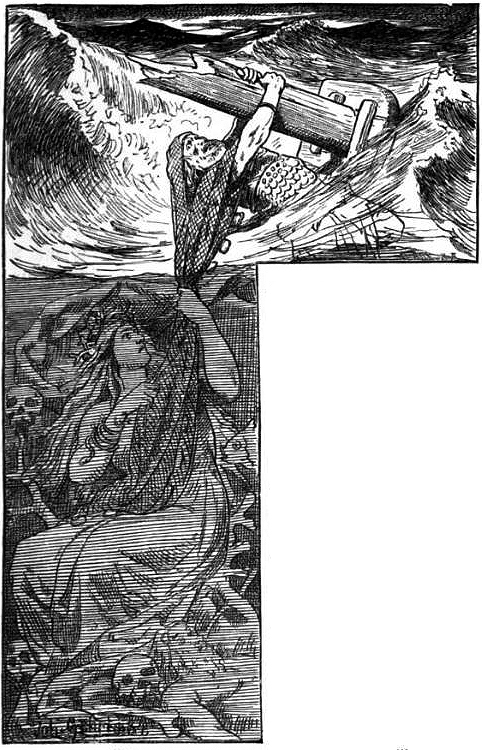
In Norse mythology, Rán (Old Norse: [ˈrɒːn]) is a goddess and a personification of the sea. Rán and her husband Ægir, a jötunn who also personifies the sea, have nine daughters, who personify waves. The goddess is frequently associated with a net, which she uses to capture sea-goers. According to the prose introduction to a poem in the Poetic Edda and in Völsunga saga, Rán once loaned her net to the god Loki.
Rán is attested in the Poetic Edda, compiled during the 13th century from earlier traditional sources; the Prose Edda, written during the 13th century by Snorri Sturluson; in both Völsunga saga and Friðþjófs saga hins frœkna; and in the poetry of skalds, such as Sonatorrek, a 10th-century poem by Icelandic skald Egill Skallagrímsson.
The Old Norse common noun rán means 'plundering' or 'theft, robbery'. In turn, scholars view the theonym Rán as meaning, for example, 'theft, robbery'. On the etymology of the theonym, scholar Rudolf Simek says, "although the meaning of the name has not been fully clarified, Rán was probably understood as being 'robber' ... and has nothing to do with [Old Norse] ráða 'rule'.
Because Rán is a personification of the sea, skalds employ her name in a variety of kennings to refer to the sea. Examples include Ránar-land ('Rán's land'), -salr ('Rán's hall'), and -vegr ('Rán's way'), and also rán-beðr ('the bed of Rán') meaning 'the bed of the sea'.
Rán and Ægir receive mention in the poem Sonatorrek attributed to 10th century Icelandic skald Egill Skallagrímsson. In the poem, Egill laments the death of his son Böðvar, who drowned at sea during a storm:
In one difficult stanza later in the poem, the skald expresses the pain of losing his son by invoking the image of slaying the personified sea, personified as Ægir (Old Norse ǫlsmið[r] 'ale-smith') and Rán (Ægis man 'Ægir's wife'):
Rán receives three mentions in the Poetic Edda; twice in poetry and once in prose. The first mention occurs in a stanza in Helgakviða Hundingsbana I, when the valkyrie Sigrún assists the ship of the hero Helgi Hundingsbane as it encounters ferocious waters:
In the notes for her translation, Larrington says that Rán "seeks to catch and drown men in her net" and that "to give someone to the sea-goddess is to drown them."
Hub AI
Rán AI simulator
(@Rán_simulator)
Rán
In Norse mythology, Rán (Old Norse: [ˈrɒːn]) is a goddess and a personification of the sea. Rán and her husband Ægir, a jötunn who also personifies the sea, have nine daughters, who personify waves. The goddess is frequently associated with a net, which she uses to capture sea-goers. According to the prose introduction to a poem in the Poetic Edda and in Völsunga saga, Rán once loaned her net to the god Loki.
Rán is attested in the Poetic Edda, compiled during the 13th century from earlier traditional sources; the Prose Edda, written during the 13th century by Snorri Sturluson; in both Völsunga saga and Friðþjófs saga hins frœkna; and in the poetry of skalds, such as Sonatorrek, a 10th-century poem by Icelandic skald Egill Skallagrímsson.
The Old Norse common noun rán means 'plundering' or 'theft, robbery'. In turn, scholars view the theonym Rán as meaning, for example, 'theft, robbery'. On the etymology of the theonym, scholar Rudolf Simek says, "although the meaning of the name has not been fully clarified, Rán was probably understood as being 'robber' ... and has nothing to do with [Old Norse] ráða 'rule'.
Because Rán is a personification of the sea, skalds employ her name in a variety of kennings to refer to the sea. Examples include Ránar-land ('Rán's land'), -salr ('Rán's hall'), and -vegr ('Rán's way'), and also rán-beðr ('the bed of Rán') meaning 'the bed of the sea'.
Rán and Ægir receive mention in the poem Sonatorrek attributed to 10th century Icelandic skald Egill Skallagrímsson. In the poem, Egill laments the death of his son Böðvar, who drowned at sea during a storm:
In one difficult stanza later in the poem, the skald expresses the pain of losing his son by invoking the image of slaying the personified sea, personified as Ægir (Old Norse ǫlsmið[r] 'ale-smith') and Rán (Ægis man 'Ægir's wife'):
Rán receives three mentions in the Poetic Edda; twice in poetry and once in prose. The first mention occurs in a stanza in Helgakviða Hundingsbana I, when the valkyrie Sigrún assists the ship of the hero Helgi Hundingsbane as it encounters ferocious waters:
In the notes for her translation, Larrington says that Rán "seeks to catch and drown men in her net" and that "to give someone to the sea-goddess is to drown them."
Recent media