




Community hub
Recent from talks
Contribute something to knowledge base
Content stats: 0 posts, 0 articles, 1 media, 0 notes
Members stats: 0 subscribers, 0 contributors, 0 moderators, 0 supporters
Subscribers
Supporters
Contributors
Moderators
RAF Odiham
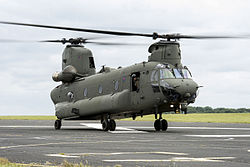
Royal Air Force Odiham or more simply RAF Odiham (IATA: ODH, ICAO: EGVO) is a Royal Air Force station situated a little to the south of the village of Odiham in Hampshire, England. It is the home of the Royal Air Force's heavy lift helicopter, the Boeing Chinook, and of The King's Helicopter Flight (TKHF). Its current station commander is Group Captain Sarah Moorehead.
Aircraft operations began from the site in 1925 but it was not until October 1937 that it was opened as a permanent airfield.
During the Second World War North American Mustangs and Hawker Typhoons were flown out of the base. After the Allied invasion of Europe the site became a prisoner of war camp.
Following the end of the War RAF Fighter Command assumed control of the base. No. 247 Squadron was re-equipped with de Havilland Vampires in June 1946, while No. 54 Squadron and No. 72 Squadron were both re-equipped with Vampires in July 1946. No. 54 Squadron and No. 247 Squadron both converted to night fighter units equipped with Gloster Meteor F.8s in 1951. As part of her coronation celebrations the Queen reviewed the Royal Air Force at Odiham in 1953.
No. 46 Squadron was re-formed at RAF Odiham on 15 August 1954 as a night fighter unit equipped with Meteor NF.12s and 14s. In 1955 No. 54 Squadron and No. 247 Squadron started receiving Hawker Hunters and, in 1956, No. 46 Squadron began converting to Gloster Javelins with the first arriving in February. Odiham closed as a fighter base in 1959.
After a short period in "care and maintenance" status the base was reopened as part of Transport Command in 1960. In this role No. 72 Squadron was re-equipped with Bristol Belvedere HC.1 helicopters in 1961 and then with Westland Wessex HC.2 helicopters in 1964. The Westland helicopters were joined by the Pumas of No. 33 Squadron and No. 230 Squadron in 1971.
The first Chinook HC.1s arrived at Odiham in 1981. No. 7 Squadron RAF reformed in 1982. The HC. 1 variants were replaced by the Chinook HC.2 in 1993. The RAF ordered the Chinook HC.3, a special forces variant, in 1995. After being in storage for eight years due to avionics certification problems, the HC.3 airframes were retro-fitted with HC.2 avionics during 2009 and 2010, to enable them to finally enter RAF service. The Mk6, which incorporates a new Digital Automatic Flight Control System (DAFCS), is a new buy of 14 aircraft which arrived in 2013.
No. 618 Volunteer Gliding Squadron arrived in July 2000. The Unit operated the Vigilant T Mk 1 self-launching glider, providing basic flying and gliding training to members of the Air Cadet Organisation. Due to a fleet-wide airworthiness issue, the Vigilant (and its cousin, the Viking conventional glider) were grounded in April 2014. No. 618 Volunteer Gliding Squadron was subsequently disbanded.
RAF Odiham
Royal Air Force Odiham or more simply RAF Odiham (IATA: ODH, ICAO: EGVO) is a Royal Air Force station situated a little to the south of the village of Odiham in Hampshire, England. It is the home of the Royal Air Force's heavy lift helicopter, the Boeing Chinook, and of The King's Helicopter Flight (TKHF). Its current station commander is Group Captain Sarah Moorehead.
Aircraft operations began from the site in 1925 but it was not until October 1937 that it was opened as a permanent airfield.
During the Second World War North American Mustangs and Hawker Typhoons were flown out of the base. After the Allied invasion of Europe the site became a prisoner of war camp.
Following the end of the War RAF Fighter Command assumed control of the base. No. 247 Squadron was re-equipped with de Havilland Vampires in June 1946, while No. 54 Squadron and No. 72 Squadron were both re-equipped with Vampires in July 1946. No. 54 Squadron and No. 247 Squadron both converted to night fighter units equipped with Gloster Meteor F.8s in 1951. As part of her coronation celebrations the Queen reviewed the Royal Air Force at Odiham in 1953.
No. 46 Squadron was re-formed at RAF Odiham on 15 August 1954 as a night fighter unit equipped with Meteor NF.12s and 14s. In 1955 No. 54 Squadron and No. 247 Squadron started receiving Hawker Hunters and, in 1956, No. 46 Squadron began converting to Gloster Javelins with the first arriving in February. Odiham closed as a fighter base in 1959.
After a short period in "care and maintenance" status the base was reopened as part of Transport Command in 1960. In this role No. 72 Squadron was re-equipped with Bristol Belvedere HC.1 helicopters in 1961 and then with Westland Wessex HC.2 helicopters in 1964. The Westland helicopters were joined by the Pumas of No. 33 Squadron and No. 230 Squadron in 1971.
The first Chinook HC.1s arrived at Odiham in 1981. No. 7 Squadron RAF reformed in 1982. The HC. 1 variants were replaced by the Chinook HC.2 in 1993. The RAF ordered the Chinook HC.3, a special forces variant, in 1995. After being in storage for eight years due to avionics certification problems, the HC.3 airframes were retro-fitted with HC.2 avionics during 2009 and 2010, to enable them to finally enter RAF service. The Mk6, which incorporates a new Digital Automatic Flight Control System (DAFCS), is a new buy of 14 aircraft which arrived in 2013.
No. 618 Volunteer Gliding Squadron arrived in July 2000. The Unit operated the Vigilant T Mk 1 self-launching glider, providing basic flying and gliding training to members of the Air Cadet Organisation. Due to a fleet-wide airworthiness issue, the Vigilant (and its cousin, the Viking conventional glider) were grounded in April 2014. No. 618 Volunteer Gliding Squadron was subsequently disbanded.
Recent media
Recent media