


Community hub
Recent from talks
Contribute something to knowledge base
Content stats: 0 posts, 0 articles, 1 media, 0 notes
Members stats: 0 subscribers, 0 contributors, 0 moderators, 0 supporters
Subscribers
Supporters
Contributors
Moderators
Hub AI
RAF Ridgewell AI simulator
(@RAF Ridgewell_simulator)
Hub AI
RAF Ridgewell AI simulator
(@RAF Ridgewell_simulator)
RAF Ridgewell
Royal Air Force Ridgewell or more simply RAF Ridgewell is a former Royal Air Force station located at Ridgewell, 7.5 miles (12.1 km) north west of Halstead, Essex, England.
During the Second World War, the airfield was used by the Royal Air Force and the United States Army Air Forces Eighth Air Force.
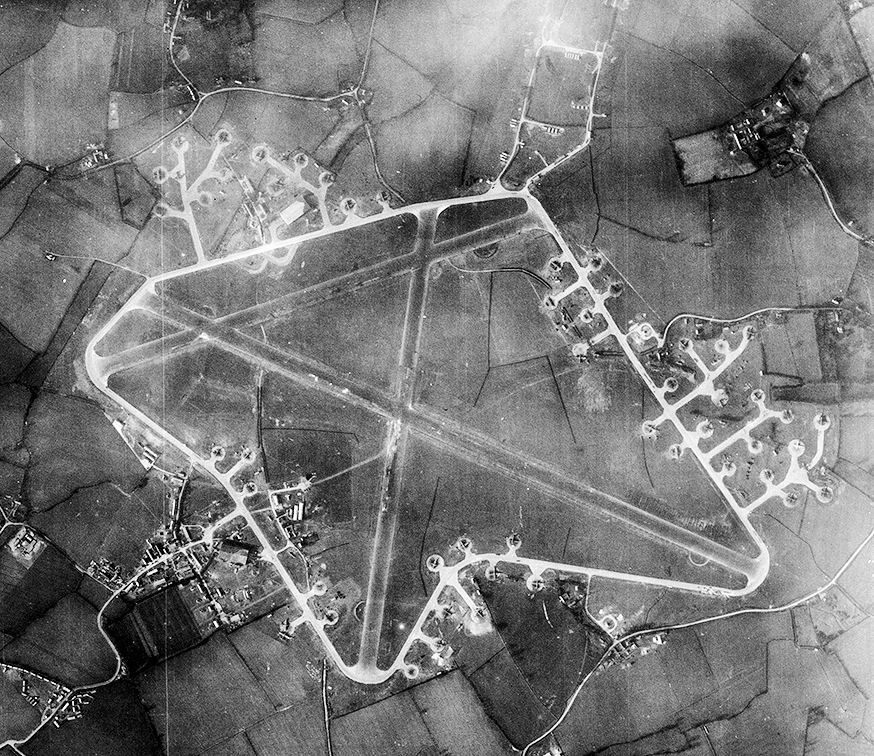
RAF Ridgewell was an early example of stations completed to Class A heavy bomber airfield design for the RAF, and had three intersecting runways of 6,500 ft each in length, thirty-six hardstands, two T-2 hangars and accommodation for 2,900 men in temporary buildings.
The airfield was opened in December 1942 and was first used by No. 90 Squadron of RAF Bomber Command, equipped with Short Stirling Bombers until May 1943, the station being at that time a satellite of RAF Stradishall.
RAF Ridgewell was the only long-term heavy bomber airfield of the Eighth Air Force in Essex. For United States Army Air Forces (USAAF) use, the number of hardstandings was increased to the fifty required by a US bomb group. The station was part of the 1st Combat Wing establishment of the 1st Division and was the furthest east of its thirteen heavy bomber stations. It was assigned USAAF designation Station 167, station code "RD".
From 30 June 1943 the airfield was used by the USAAF 381st Bombardment Group (Heavy), arriving from Pueblo AAB, Colorado. Its tail code was Triangle-L. The 381st Bomb Group consisted of the following operational squadrons and fuselage codes:
After V-E Day, the 381st Bomb Group returned to Sioux Falls AAF, South Dakota in July 1945 and was inactivated on 28 August.
After the war, RAF Ridgewell was used for bomb storage from 15 July 1945 to 31 March 1957. It was then disposed of and sold. The United States Air Force retained the old aircraft hangars which were used by units from nearby RAF Wethersfield and RAF Alconbury for storage until both airfields were closed in the early 1990s.
RAF Ridgewell
Royal Air Force Ridgewell or more simply RAF Ridgewell is a former Royal Air Force station located at Ridgewell, 7.5 miles (12.1 km) north west of Halstead, Essex, England.
During the Second World War, the airfield was used by the Royal Air Force and the United States Army Air Forces Eighth Air Force.
RAF Ridgewell was an early example of stations completed to Class A heavy bomber airfield design for the RAF, and had three intersecting runways of 6,500 ft each in length, thirty-six hardstands, two T-2 hangars and accommodation for 2,900 men in temporary buildings.
The airfield was opened in December 1942 and was first used by No. 90 Squadron of RAF Bomber Command, equipped with Short Stirling Bombers until May 1943, the station being at that time a satellite of RAF Stradishall.
RAF Ridgewell was the only long-term heavy bomber airfield of the Eighth Air Force in Essex. For United States Army Air Forces (USAAF) use, the number of hardstandings was increased to the fifty required by a US bomb group. The station was part of the 1st Combat Wing establishment of the 1st Division and was the furthest east of its thirteen heavy bomber stations. It was assigned USAAF designation Station 167, station code "RD".
From 30 June 1943 the airfield was used by the USAAF 381st Bombardment Group (Heavy), arriving from Pueblo AAB, Colorado. Its tail code was Triangle-L. The 381st Bomb Group consisted of the following operational squadrons and fuselage codes:
After V-E Day, the 381st Bomb Group returned to Sioux Falls AAF, South Dakota in July 1945 and was inactivated on 28 August.
After the war, RAF Ridgewell was used for bomb storage from 15 July 1945 to 31 March 1957. It was then disposed of and sold. The United States Air Force retained the old aircraft hangars which were used by units from nearby RAF Wethersfield and RAF Alconbury for storage until both airfields were closed in the early 1990s.
Recent media
Recent media