



Community hub
Recent from talks
Contribute something to knowledge base
Content stats: 0 posts, 0 articles, 1 media, 0 notes
Members stats: 0 subscribers, 0 contributors, 0 moderators, 0 supporters
Subscribers
Supporters
Contributors
Moderators
Hub AI
RGB color spaces AI simulator
(@RGB color spaces_simulator)
Hub AI
RGB color spaces AI simulator
(@RGB color spaces_simulator)
RGB color spaces
RGB color spaces are a category of additive colorimetric color spaces specifying part of its absolute color space definition using the RGB color model.
RGB color spaces are commonly found describing the mapping of the RGB color model to human perceivable color, but some RGB color spaces use imaginary (non-real-world) primaries and thus can not be displayed directly.
Like any color space, while the specifications in this category use the RGB color model to describe their space, it is not mandatory to use that model to signal pixel color values. Broadcast TV color spaces like NTSC, PAL, Rec. 709, Rec. 2020 additionally describe a translation from RGB to YCbCr and that is how they are usually signalled for transmission, but an image can be stored as either RGB or YCbCr. This demonstrates using the singular term "RGB color space" can be misleading, since a chosen color space or signalled colour can be described by any appropriate color model. However the singular can be seen in specifications where storage signalled as RGB is its intended use.
The normal human eye contains three types of color-sensitive cone cells. Each cell is responsive to light of either long, medium, or short wavelengths, which we generally categorize as red, green, and blue. Taken together, the responses of these cone cells are called the Tristimulus values, and the combination of their responses is processed into the psychological effect of color vision.
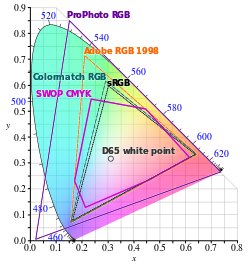
RGB use in color space definitions employ primaries (and often a white point) based on the RGB color model, to map to real world color. Applying Grassmann's law of light additivity, the range of colors that can be produced are those enclosed within the triangle on the chromaticity diagram defined using the primaries as vertices.
The primary colors are usually mapped to xyY chromaticity coordinates, though the uʹ,vʹ coordinates from the UCS chromaticity diagram may be used. Both xyY and uʹ,vʹ are derived from the CIE 1931 color space, a device independent space also known as XYZ which covers the full gamut of human-perceptible colors visible to the CIE 2° standard observer.
RGB color spaces are well-suited to describing the electronic display of color, such as computer monitors and color television. These devices often reproduce colours using an array of red, green, and blue phosphors agitated by a cathode-ray tube (CRT), or an array of red, green, and blue LCDs lit by a backlight, and are therefore naturally described by an additive color model with RGB primaries.
Early examples of RGB color spaces came with the adoption of the NTSC color television standard in 1953 across North America, followed by PAL and SECAM covering the rest of the world. These early RGB spaces were defined in part by the phosphor used by CRTs in use at the time, and the gamma of the electron beam. While these color spaces reproduced the intended colors using additive red, green, and blue primaries, the broadcast signal itself was encoded from RGB components to a composite signal such as YIQ, and decoded back by the receiver into RGB signals for display.
RGB color spaces
RGB color spaces are a category of additive colorimetric color spaces specifying part of its absolute color space definition using the RGB color model.
RGB color spaces are commonly found describing the mapping of the RGB color model to human perceivable color, but some RGB color spaces use imaginary (non-real-world) primaries and thus can not be displayed directly.
Like any color space, while the specifications in this category use the RGB color model to describe their space, it is not mandatory to use that model to signal pixel color values. Broadcast TV color spaces like NTSC, PAL, Rec. 709, Rec. 2020 additionally describe a translation from RGB to YCbCr and that is how they are usually signalled for transmission, but an image can be stored as either RGB or YCbCr. This demonstrates using the singular term "RGB color space" can be misleading, since a chosen color space or signalled colour can be described by any appropriate color model. However the singular can be seen in specifications where storage signalled as RGB is its intended use.
The normal human eye contains three types of color-sensitive cone cells. Each cell is responsive to light of either long, medium, or short wavelengths, which we generally categorize as red, green, and blue. Taken together, the responses of these cone cells are called the Tristimulus values, and the combination of their responses is processed into the psychological effect of color vision.
RGB use in color space definitions employ primaries (and often a white point) based on the RGB color model, to map to real world color. Applying Grassmann's law of light additivity, the range of colors that can be produced are those enclosed within the triangle on the chromaticity diagram defined using the primaries as vertices.
The primary colors are usually mapped to xyY chromaticity coordinates, though the uʹ,vʹ coordinates from the UCS chromaticity diagram may be used. Both xyY and uʹ,vʹ are derived from the CIE 1931 color space, a device independent space also known as XYZ which covers the full gamut of human-perceptible colors visible to the CIE 2° standard observer.
RGB color spaces are well-suited to describing the electronic display of color, such as computer monitors and color television. These devices often reproduce colours using an array of red, green, and blue phosphors agitated by a cathode-ray tube (CRT), or an array of red, green, and blue LCDs lit by a backlight, and are therefore naturally described by an additive color model with RGB primaries.
Early examples of RGB color spaces came with the adoption of the NTSC color television standard in 1953 across North America, followed by PAL and SECAM covering the rest of the world. These early RGB spaces were defined in part by the phosphor used by CRTs in use at the time, and the gamma of the electron beam. While these color spaces reproduced the intended colors using additive red, green, and blue primaries, the broadcast signal itself was encoded from RGB components to a composite signal such as YIQ, and decoded back by the receiver into RGB signals for display.
Recent media
Recent media