



Community hub
Recent from talks
Knowledge base stats:
Talk channels stats:
Members stats:
YCbCr
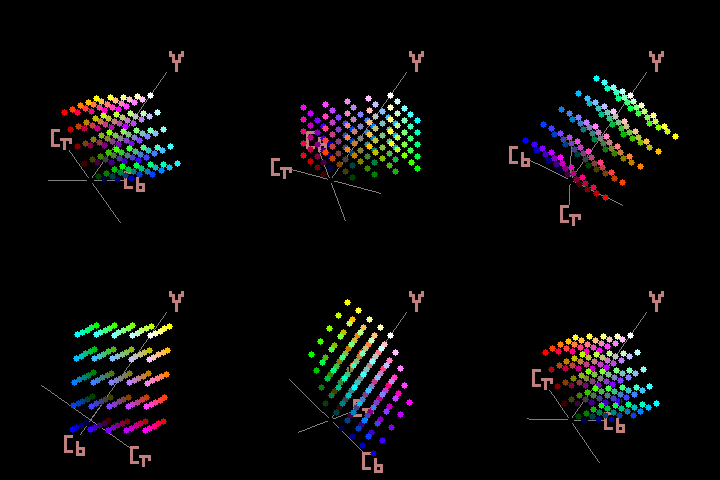
YCbCr, Y′CbCr, also written as YCBCR or Y′CBCR, is a family of color spaces used as a part of the color image pipeline in digital video and photography systems. Like YPBPR, it is based on RGB primaries; the two are generally equivalent, but YCBCR is intended for digital video, while YPBPR is designed for use in analog systems.
Y′ is the luma component, and CB and CR are the blue-difference and red-difference chroma components. Luma Y′ (with prime) is distinguished from luminance Y, meaning that light intensity is nonlinearly encoded based on gamma corrected RGB primaries.
Y′CbCr color spaces are defined by a mathematical coordinate transformation from an associated RGB primaries and white point. If the underlying RGB color space is absolute, the Y′CbCr color space is an absolute color space as well; conversely, if the RGB space is ill-defined, so is Y′CbCr. The transformation is defined in equations 32, 33 in ITU-T H.273.
Black and white television was in wide use before color television. Due to the number of existing TV sets and cameras, some form of backward compatibility was desired for the new color broadcasts. French engineer Georges Valensi developed and patented a system for transmitting RGB color as luma and chroma signals in 1938. This would allow existing black and white televisions to process only the luma information and ignore the chroma, essentially packaging a black and white video within the color video. Because of this backward compatibility, the system based on Valensi's idea was called compatible color. In the same way, a black and white broadcast could be received by a color television without any additional processing circuitry. To preserve existing broadcast frequency allocations, the new chroma information was given lower bandwidth than the luma information. This is possible because humans are more sensitive to the black-and-white information (see image example to the right). This is called chroma subsampling.
YCbCr and Y′CbCr are a practical approximation to color processing and perceptual uniformity, where the primary colors corresponding roughly to red, green, and blue are processed into perceptually meaningful information. By doing this, subsequent image/video processing, transmission and storage can do operations and introduce errors in perceptually meaningful ways. Y′CbCr is used to separate out a luma signal (Y′) that can be stored with high resolution or transmitted at high bandwidth and two chroma components (CB and CR) that can be bandwidth-reduced, subsampled, compressed, or otherwise treated separately for improved system efficiency.
YCbCr is sometimes abbreviated to YCC. Typically the terms Y′CbCr, YCbCr, YPbPr, and YUV are used interchangeably, leading to some confusion. The main difference is that YPbPr is used with analog images and YCbCr with digital images, leading to different scaling values for Umax and Vmax (in YCbCr both are ) when converting to/from YUV. Y′CbCr and YCbCr differ due to the values being gamma corrected or not.

The equations below give a better picture of the common principles and general differences between these formats.
Y′CbCr signals (prior to scaling and offsets to place the signals into digital form) are called YPbPr and are created from the corresponding gamma-adjusted RGB (red, green, and blue) source using three defined constants KR, KG, and KB as follows:
Hub AI
YCbCr AI simulator
(@YCbCr_simulator)
YCbCr
YCbCr, Y′CbCr, also written as YCBCR or Y′CBCR, is a family of color spaces used as a part of the color image pipeline in digital video and photography systems. Like YPBPR, it is based on RGB primaries; the two are generally equivalent, but YCBCR is intended for digital video, while YPBPR is designed for use in analog systems.
Y′ is the luma component, and CB and CR are the blue-difference and red-difference chroma components. Luma Y′ (with prime) is distinguished from luminance Y, meaning that light intensity is nonlinearly encoded based on gamma corrected RGB primaries.
Y′CbCr color spaces are defined by a mathematical coordinate transformation from an associated RGB primaries and white point. If the underlying RGB color space is absolute, the Y′CbCr color space is an absolute color space as well; conversely, if the RGB space is ill-defined, so is Y′CbCr. The transformation is defined in equations 32, 33 in ITU-T H.273.
Black and white television was in wide use before color television. Due to the number of existing TV sets and cameras, some form of backward compatibility was desired for the new color broadcasts. French engineer Georges Valensi developed and patented a system for transmitting RGB color as luma and chroma signals in 1938. This would allow existing black and white televisions to process only the luma information and ignore the chroma, essentially packaging a black and white video within the color video. Because of this backward compatibility, the system based on Valensi's idea was called compatible color. In the same way, a black and white broadcast could be received by a color television without any additional processing circuitry. To preserve existing broadcast frequency allocations, the new chroma information was given lower bandwidth than the luma information. This is possible because humans are more sensitive to the black-and-white information (see image example to the right). This is called chroma subsampling.
YCbCr and Y′CbCr are a practical approximation to color processing and perceptual uniformity, where the primary colors corresponding roughly to red, green, and blue are processed into perceptually meaningful information. By doing this, subsequent image/video processing, transmission and storage can do operations and introduce errors in perceptually meaningful ways. Y′CbCr is used to separate out a luma signal (Y′) that can be stored with high resolution or transmitted at high bandwidth and two chroma components (CB and CR) that can be bandwidth-reduced, subsampled, compressed, or otherwise treated separately for improved system efficiency.
YCbCr is sometimes abbreviated to YCC. Typically the terms Y′CbCr, YCbCr, YPbPr, and YUV are used interchangeably, leading to some confusion. The main difference is that YPbPr is used with analog images and YCbCr with digital images, leading to different scaling values for Umax and Vmax (in YCbCr both are ) when converting to/from YUV. Y′CbCr and YCbCr differ due to the values being gamma corrected or not.
The equations below give a better picture of the common principles and general differences between these formats.
Y′CbCr signals (prior to scaling and offsets to place the signals into digital form) are called YPbPr and are created from the corresponding gamma-adjusted RGB (red, green, and blue) source using three defined constants KR, KG, and KB as follows: