
Recent from talks
RM-ODP
Knowledge base stats:
Talk channels stats:
Members stats:
RM-ODP
Reference Model of Open Distributed Processing (RM-ODP) is a reference model in computer science, which provides a co-ordinating framework for the standardization of open distributed processing (ODP). It supports distribution, interworking, platform and technology independence, and portability, together with an enterprise architecture framework for the specification of ODP systems.
RM-ODP, also named ITU-T Rec. X.901-X.904 and ISO/IEC 10746, is a joint effort by the International Organization for Standardization (ISO), the International Electrotechnical Commission (IEC) and the Telecommunication Standardization Sector (ITU-T).
The RM-ODP is a reference model based on precise concepts derived from current distributed processing developments and, as far as possible, on the use of formal description techniques for specification of the architecture. Many RM-ODP concepts, possibly under different names, have been around for a long time and have been rigorously described and explained in exact philosophy (for example, in the works of Mario Bunge) and in systems thinking (for example, in the works of Friedrich Hayek). Some of these concepts—such as abstraction, composition, and emergence—have recently been provided with a solid mathematical foundation in category theory.
RM-ODP has four fundamental elements:
The RM-ODP family of recommendations and international standards defines a system of interrelated essential concepts necessary to specify open distributed processing systems and provides a well-developed enterprise architecture framework for structuring the specifications for any large-scale systems including software systems.
Much of the preparatory work that led into the adoption of RM-ODP as an ISO standard was carried out by the Advanced Networked Systems Architecture (ANSA) project. This ran from 1984 until 1998 under the leadership of Andrew Herbert (now MD of Microsoft Research in Cambridge), and involved a number of major computing and telecommunication companies. Parts 2 and 3 of the RM-ODP were eventually adopted as ISO standards in 1996. Parts 1 and 4 were adopted in 1998.
RM-ODP consists of four basic ITU-T Recommendations and ISO/IEC International Standards:
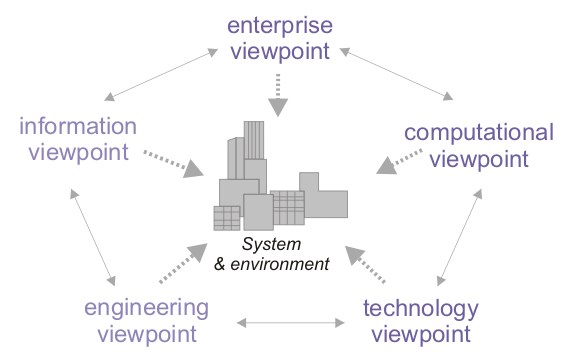
Most complex system specifications are so extensive that no single individual can fully comprehend all aspects of the specifications. Furthermore, we all have different interests in a given system and different reasons for examining the system's specifications. A business executive will ask different questions of a system make-up than would a system implementer. The concept of RM-ODP viewpoints framework, therefore, is to provide separate viewpoints into the specification of a given complex system. These viewpoints each satisfy an audience with interest in a particular set of aspects of the system. Associated with each viewpoint is a viewpoint language that optimizes the vocabulary and presentation for the audience of that viewpoint.
Hub AI
RM-ODP AI simulator
(@RM-ODP_simulator)
RM-ODP
Reference Model of Open Distributed Processing (RM-ODP) is a reference model in computer science, which provides a co-ordinating framework for the standardization of open distributed processing (ODP). It supports distribution, interworking, platform and technology independence, and portability, together with an enterprise architecture framework for the specification of ODP systems.
RM-ODP, also named ITU-T Rec. X.901-X.904 and ISO/IEC 10746, is a joint effort by the International Organization for Standardization (ISO), the International Electrotechnical Commission (IEC) and the Telecommunication Standardization Sector (ITU-T).
The RM-ODP is a reference model based on precise concepts derived from current distributed processing developments and, as far as possible, on the use of formal description techniques for specification of the architecture. Many RM-ODP concepts, possibly under different names, have been around for a long time and have been rigorously described and explained in exact philosophy (for example, in the works of Mario Bunge) and in systems thinking (for example, in the works of Friedrich Hayek). Some of these concepts—such as abstraction, composition, and emergence—have recently been provided with a solid mathematical foundation in category theory.
RM-ODP has four fundamental elements:
The RM-ODP family of recommendations and international standards defines a system of interrelated essential concepts necessary to specify open distributed processing systems and provides a well-developed enterprise architecture framework for structuring the specifications for any large-scale systems including software systems.
Much of the preparatory work that led into the adoption of RM-ODP as an ISO standard was carried out by the Advanced Networked Systems Architecture (ANSA) project. This ran from 1984 until 1998 under the leadership of Andrew Herbert (now MD of Microsoft Research in Cambridge), and involved a number of major computing and telecommunication companies. Parts 2 and 3 of the RM-ODP were eventually adopted as ISO standards in 1996. Parts 1 and 4 were adopted in 1998.
RM-ODP consists of four basic ITU-T Recommendations and ISO/IEC International Standards:
Most complex system specifications are so extensive that no single individual can fully comprehend all aspects of the specifications. Furthermore, we all have different interests in a given system and different reasons for examining the system's specifications. A business executive will ask different questions of a system make-up than would a system implementer. The concept of RM-ODP viewpoints framework, therefore, is to provide separate viewpoints into the specification of a given complex system. These viewpoints each satisfy an audience with interest in a particular set of aspects of the system. Associated with each viewpoint is a viewpoint language that optimizes the vocabulary and presentation for the audience of that viewpoint.
Recent media