
Recent from talks
RNase MRP
Knowledge base stats:
Talk channels stats:
Members stats:
RNase MRP
RNase MRP is an enzymatically active ribonucleoprotein with two distinct roles in eukaryotes. RNase MRP stands for RNase for Mitochondrial RNA Processing. In mitochondria, it plays a direct role in the initiation of mitochondrial DNA replication. In the nucleus, it is involved in precursor rRNA processing, where it cleaves the internal transcribed spacer 1 between 18S and 5.8S rRNAs. Despite distinct functions, RNase MRP has been shown to be evolutionarily related to RNase P. Like eukaryotic RNase P, RNase MRP is not catalytically active without associated protein subunits.
Mutations in the RNA component of RNase MRP cause cartilage–hair hypoplasia, a pleiotropic human disease. Responsible for this disease is a mutation in the RNase MRP RNA gene (RMRP), a non-coding RNA gene. RMRP was the first non-coding nuclear RNA gene found to cause disease.
Human RNase MRP form two sizes of ribonucleoproteins, 12S and 60–80S. The latter do not have RPP25 and RPP20. It appears to lack many protein subunits found in human RNase P.
The yeast RNase MRP is more similar to its RNase P in that it also binds Pop4 (Rpp29), Pop6, Pop7 (Rpp20), Pop8 in addition to these proteins. It also binds Snm1, which is homologous to Rpr2 (Rpp21) in its RNaseP. The protein Rmp1 is unique to the yeast RNase MRP.
RNase MRP and its role in pre-rRNA processing has been previously studied in Yeast cells. RNase MRP has been shown to cleave an internal transcribed spacer, specifically ITS1 at the specific site A3 of the rRNA precursor, leading, after additional trimming, to the formation of the mature 5′-end of 5.8S rRNA. Recent data that has been gathered using several temperature-sensitive RNase MRP mutants that showed that inactivation of RNase MRP leading to severe reduction of the abundance of all early intermediates in the typical rRNA processing pathway. However, the transcription of the rRNA precursor is not affected, thus suggesting that RNase MRP plays a key role in the processing of rRNA beyond the cleavage of the A3 site in ITS1.
Further research in Yeast cell RNase MRP has shown a potential role in the regulation of the cell cycle. RNase MRP mutations led to missegregation of plasmids and caused cell cycle delay at the end of mitosis, followed by a buildup of cyclin B2 (CLB2) protein (resulting from increased CLB2 mRNA concentration that codes for the CLB2 protein). RNase MRP also demonstrated cleavage ability of the 5′-UTR of CLB2 mRNA that allows for rapid 5′-to-3′ degradation by XRN1, an exoribonuclease enzyme.
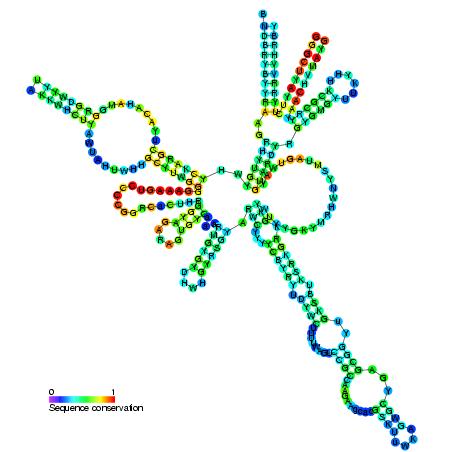
RNase P and RNAse MRP are ribonucleoprotein complexes acting as ribonucleases in RNA processing. The RNA parts of both share a common arrangement of secondary structure in the catalytic (C) domain while their specificity (S) domains differ noticeably. The two C domains share many conserved regions: sequences of the CR-I, CR-V, and CR-IV genes in domain 1 of the P4 helical region are conserved, with the consensus sequence in CR-IV being AGNNNNA for RNAse P and AGNNA for RNase MRP. CR-II and CR-III are also conserved in domain 2 of P RNA. The P3 helix is also conserved in both ribonucleases in all eukaryotes, but the function of this helix is not yet clear.
The similarity in their RNA secondary structure, RNA sequences, and protein partners show that they most likely share a common ancestor. RNase MRP is an eukaryotic innovation, performing a function not seen in any RNase P, which is the conversion of preribosomal RNA into mature rRNA through splicing, modifications, and cleavage. The exact mechanism is described above.
Hub AI
RNase MRP AI simulator
(@RNase MRP_simulator)
RNase MRP
RNase MRP is an enzymatically active ribonucleoprotein with two distinct roles in eukaryotes. RNase MRP stands for RNase for Mitochondrial RNA Processing. In mitochondria, it plays a direct role in the initiation of mitochondrial DNA replication. In the nucleus, it is involved in precursor rRNA processing, where it cleaves the internal transcribed spacer 1 between 18S and 5.8S rRNAs. Despite distinct functions, RNase MRP has been shown to be evolutionarily related to RNase P. Like eukaryotic RNase P, RNase MRP is not catalytically active without associated protein subunits.
Mutations in the RNA component of RNase MRP cause cartilage–hair hypoplasia, a pleiotropic human disease. Responsible for this disease is a mutation in the RNase MRP RNA gene (RMRP), a non-coding RNA gene. RMRP was the first non-coding nuclear RNA gene found to cause disease.
Human RNase MRP form two sizes of ribonucleoproteins, 12S and 60–80S. The latter do not have RPP25 and RPP20. It appears to lack many protein subunits found in human RNase P.
The yeast RNase MRP is more similar to its RNase P in that it also binds Pop4 (Rpp29), Pop6, Pop7 (Rpp20), Pop8 in addition to these proteins. It also binds Snm1, which is homologous to Rpr2 (Rpp21) in its RNaseP. The protein Rmp1 is unique to the yeast RNase MRP.
RNase MRP and its role in pre-rRNA processing has been previously studied in Yeast cells. RNase MRP has been shown to cleave an internal transcribed spacer, specifically ITS1 at the specific site A3 of the rRNA precursor, leading, after additional trimming, to the formation of the mature 5′-end of 5.8S rRNA. Recent data that has been gathered using several temperature-sensitive RNase MRP mutants that showed that inactivation of RNase MRP leading to severe reduction of the abundance of all early intermediates in the typical rRNA processing pathway. However, the transcription of the rRNA precursor is not affected, thus suggesting that RNase MRP plays a key role in the processing of rRNA beyond the cleavage of the A3 site in ITS1.
Further research in Yeast cell RNase MRP has shown a potential role in the regulation of the cell cycle. RNase MRP mutations led to missegregation of plasmids and caused cell cycle delay at the end of mitosis, followed by a buildup of cyclin B2 (CLB2) protein (resulting from increased CLB2 mRNA concentration that codes for the CLB2 protein). RNase MRP also demonstrated cleavage ability of the 5′-UTR of CLB2 mRNA that allows for rapid 5′-to-3′ degradation by XRN1, an exoribonuclease enzyme.
RNase P and RNAse MRP are ribonucleoprotein complexes acting as ribonucleases in RNA processing. The RNA parts of both share a common arrangement of secondary structure in the catalytic (C) domain while their specificity (S) domains differ noticeably. The two C domains share many conserved regions: sequences of the CR-I, CR-V, and CR-IV genes in domain 1 of the P4 helical region are conserved, with the consensus sequence in CR-IV being AGNNNNA for RNAse P and AGNNA for RNase MRP. CR-II and CR-III are also conserved in domain 2 of P RNA. The P3 helix is also conserved in both ribonucleases in all eukaryotes, but the function of this helix is not yet clear.
The similarity in their RNA secondary structure, RNA sequences, and protein partners show that they most likely share a common ancestor. RNase MRP is an eukaryotic innovation, performing a function not seen in any RNase P, which is the conversion of preribosomal RNA into mature rRNA through splicing, modifications, and cleavage. The exact mechanism is described above.
Recent media