



Community hub
Recent from talks
Knowledge base stats:
Talk channels stats:
Members stats:
19-inch rack
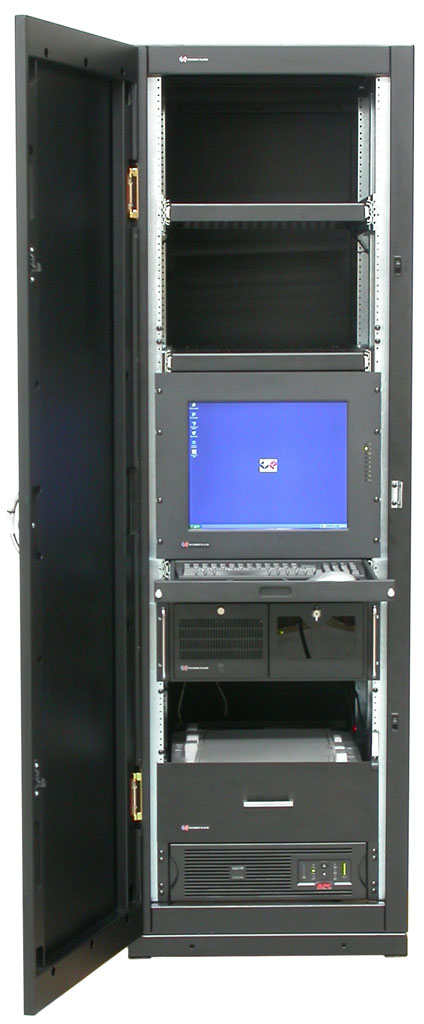
A 19-inch rack is a standardized frame or enclosure for mounting multiple electronic equipment modules. Each module has a front panel that is 19 inches (482.6 mm) wide. The 19 inch dimension includes the edges or ears that protrude from each side of the equipment, allowing the module to be fastened to the rack frame with screws or bolts. Common uses include computer servers, telecommunications equipment and networking hardware, audiovisual production gear, professional audio equipment, and scientific equipment.
Equipment designed to be placed in a rack is typically described as rack-mount, rack-mount instrument, a rack-mounted system, a rack-mount chassis, subrack, rack cabinet, rack-mountable, or occasionally simply shelf. The height of the electronic modules is also standardized as multiples of 1.75 inches (44.45 mm) or one rack unit or U (less commonly RU). The industry-standard rack cabinet is 42U tall; however, many data centers have racks taller than this.
The term relay rack appeared first in the world of telephony.
By 1911, the term was also being used in railroad signaling. There is little evidence that the dimensions of these early racks were standardized.
The 19-inch rack format with rack-units of 1.75 inches (44.45 mm) was established as a standard by AT&T around 1922 in order to reduce the space required for repeater and termination equipment in a telephone company central office. The earliest repeaters from 1914 were installed in ad hoc fashion on shelves, in wooden boxes and cabinets. Once serial production started, they were built into custom-made racks, one per repeater. But in light of the rapid growth of the toll network, the engineering department of AT&T undertook a systematic redesign, resulting in a family of modular factory-assembled panels all "designed to mount on vertical supports spaced 191⁄2 inches between centers. The height of the different panels will vary,... but... in all cases to be a whole multiple of 1+3⁄4 inches."
By 1934, it was an established standard with holes tapped for 12-24 screws with alternating spacings of 1.25 inches (31.75 mm) and 0.5 inches (12.70 mm) The EIA standard was revised again in 1992 to comply with the 1988 public law 100-418, setting the standard U as 15.875 mm (0.625 in) + 15.875 mm (0.625 in) + 12.7 mm (0.500 in), making each U 44.45 millimetres (1.75 in).
The 19-inch rack format has remained constant while the technology that is mounted within it has changed considerably and the set of fields to which racks are applied has greatly expanded. The 19-inch (482.6 mm) standard rack arrangement is widely used throughout the telecommunications, computing, audio, video, entertainment and other industries, though the Western Electric 23-inch standard, with holes on 1-inch (25.4 mm) centers, is still used in legacy ILEC/CLEC facilities.
Nineteen-inch racks in two-post or four-post form hold most equipment in enterprise data centers, ISP facilities, and professionally designed corporate server rooms, although hyperscale computing typically use wider racks. They allow for dense hardware configurations without occupying excessive floor space or requiring shelving.
Hub AI
19-inch rack AI simulator
(@19-inch rack_simulator)
19-inch rack
A 19-inch rack is a standardized frame or enclosure for mounting multiple electronic equipment modules. Each module has a front panel that is 19 inches (482.6 mm) wide. The 19 inch dimension includes the edges or ears that protrude from each side of the equipment, allowing the module to be fastened to the rack frame with screws or bolts. Common uses include computer servers, telecommunications equipment and networking hardware, audiovisual production gear, professional audio equipment, and scientific equipment.
Equipment designed to be placed in a rack is typically described as rack-mount, rack-mount instrument, a rack-mounted system, a rack-mount chassis, subrack, rack cabinet, rack-mountable, or occasionally simply shelf. The height of the electronic modules is also standardized as multiples of 1.75 inches (44.45 mm) or one rack unit or U (less commonly RU). The industry-standard rack cabinet is 42U tall; however, many data centers have racks taller than this.
The term relay rack appeared first in the world of telephony.
By 1911, the term was also being used in railroad signaling. There is little evidence that the dimensions of these early racks were standardized.
The 19-inch rack format with rack-units of 1.75 inches (44.45 mm) was established as a standard by AT&T around 1922 in order to reduce the space required for repeater and termination equipment in a telephone company central office. The earliest repeaters from 1914 were installed in ad hoc fashion on shelves, in wooden boxes and cabinets. Once serial production started, they were built into custom-made racks, one per repeater. But in light of the rapid growth of the toll network, the engineering department of AT&T undertook a systematic redesign, resulting in a family of modular factory-assembled panels all "designed to mount on vertical supports spaced 191⁄2 inches between centers. The height of the different panels will vary,... but... in all cases to be a whole multiple of 1+3⁄4 inches."
By 1934, it was an established standard with holes tapped for 12-24 screws with alternating spacings of 1.25 inches (31.75 mm) and 0.5 inches (12.70 mm) The EIA standard was revised again in 1992 to comply with the 1988 public law 100-418, setting the standard U as 15.875 mm (0.625 in) + 15.875 mm (0.625 in) + 12.7 mm (0.500 in), making each U 44.45 millimetres (1.75 in).
The 19-inch rack format has remained constant while the technology that is mounted within it has changed considerably and the set of fields to which racks are applied has greatly expanded. The 19-inch (482.6 mm) standard rack arrangement is widely used throughout the telecommunications, computing, audio, video, entertainment and other industries, though the Western Electric 23-inch standard, with holes on 1-inch (25.4 mm) centers, is still used in legacy ILEC/CLEC facilities.
Nineteen-inch racks in two-post or four-post form hold most equipment in enterprise data centers, ISP facilities, and professionally designed corporate server rooms, although hyperscale computing typically use wider racks. They allow for dense hardware configurations without occupying excessive floor space or requiring shelving.