



Community hub
Recent from talks
Knowledge base stats:
Talk channels stats:
Members stats:
Radiator (heating)
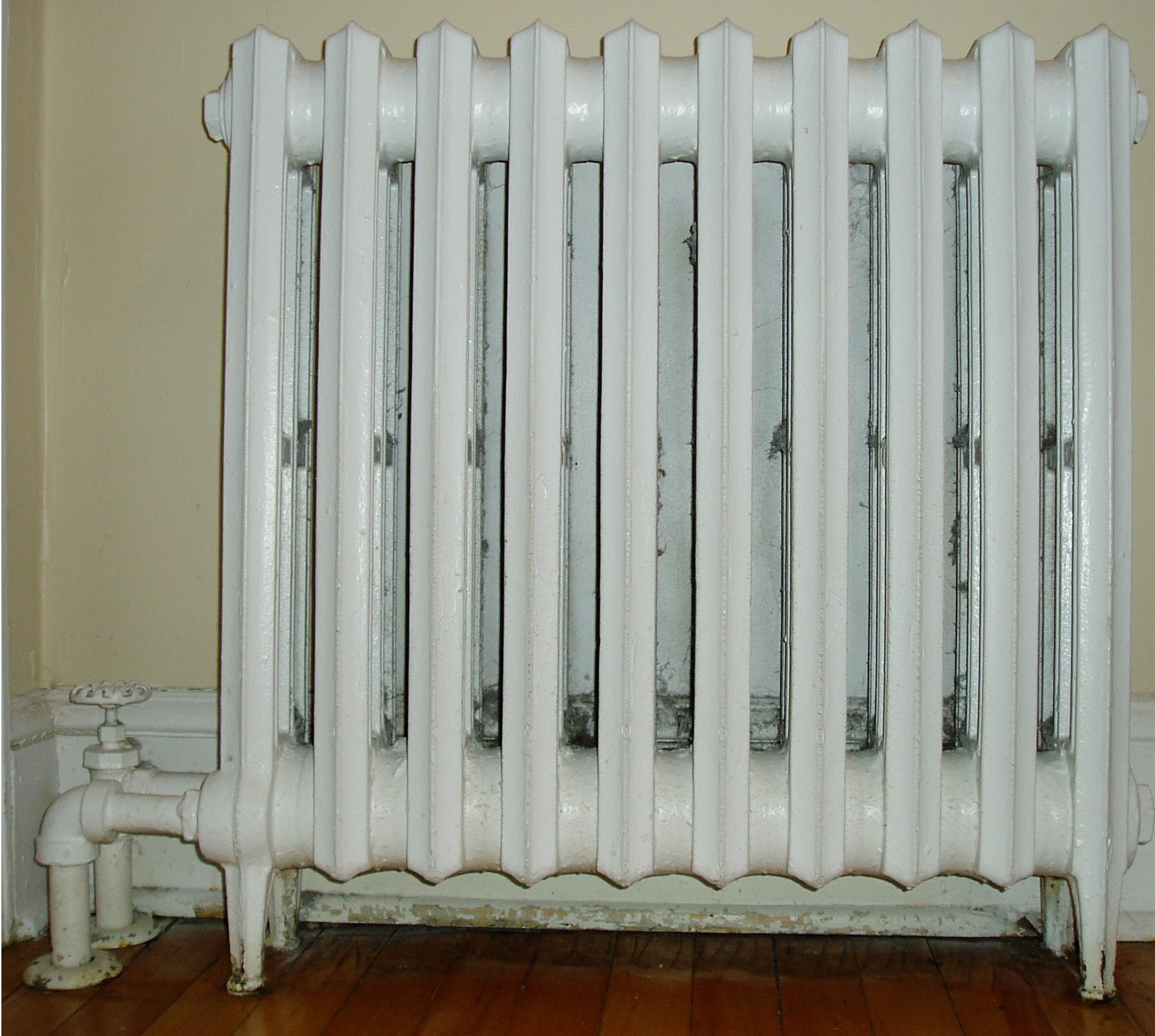
Radiators and convectors are heat exchangers designed to transfer thermal energy from one medium to another for the purpose of space heating.
Denison Olmsted of New Haven, Connecticut, appears to have been the earliest person to use the term 'radiator' to mean a heating appliance in an 1834 patent for a stove with a heat exchanger which then radiated heat. In the patent he wrote that his invention was "a peculiar kind of apparatus, which I call a radiator". The heating radiator was invented by Franz San Galli in 1855, a Kingdom of Prussia-born Russian businessman living in St. Petersburg. In the late 1800s, companies, such as the American Radiator Company, promoted cast iron radiators over previous fabricated steel designs in order to lower costs and expand the market.
A radiator is a device that transfers heat to a medium primarily through thermal radiation. In practice, the term radiator is often applied to any number of devices in which a fluid circulates through exposed pipes (often with fins or other means of increasing surface area), notwithstanding that such devices tend to transfer heat mainly by convection and might logically be called convectors.
The terms convection heater and convector refer to a class of devices in which the source of heat is not directly exposed. As domestic safety and the supply from water heaters keep temperatures relatively low, radiation is inefficient in comparison to convection.[citation needed]
Steam has the advantage of flowing through pipes under its own pressure without the need for pumping. For this reason, it was adopted earlier, before electric motors and pumps became available. Steam is also far easier to distribute than hot water throughout large, tall buildings like skyscrapers. However, the higher temperatures at which steam systems operate make them inherently less efficient, as unwanted heat loss is inevitably greater.
Steam pipes and radiators are prone to producing banging sounds called steam hammer. The bang is created when some of the steam condenses into water in a horizontal section of the steam piping. Subsequently, steam picks up the water, forms a "slug" and hurls it at high velocity into a pipe fitting, creating a loud hammering noise and greatly stressing the pipe. This condition is usually caused by a poor condensate drainage strategy and is often caused by buildings settling and the resultant pooling of condensate in pipes and radiators that no longer tilt slightly back towards the boiler.[citation needed]
A hot-water radiator consists of a sealed hollow metal container filled with hot water from a boiler or other heating device by gravity feed, a pump, or natural convection. As it gives out heat, the hot water cools and sinks to the bottom of the radiator and is forced out of a pipe at the other end. Anti-hammer devices are often installed to prevent or minimize knocking in hot water radiator pipes.
Unlike steam or hot water systems which receive heat from a boiler, electric radiators produce heat from electricity at the location of the radiator. This heat may be transferred to a fluid (such as oil) inside the radiator. The oil circulates inside the radiator by convection, which distributes the heat from the heating element to the surface of the radiator. Smaller electric radiators have the advantage of being portable, as they do not need to be connected to pipework. Some electric radiators can also use hot water; this is particularity common for heated towel rails, where the radiator uses hot water when the central heating system is running but switches to electricity when heating the whole building is not required.
Hub AI
Radiator (heating) AI simulator
(@Radiator (heating)_simulator)
Radiator (heating)
Radiators and convectors are heat exchangers designed to transfer thermal energy from one medium to another for the purpose of space heating.
Denison Olmsted of New Haven, Connecticut, appears to have been the earliest person to use the term 'radiator' to mean a heating appliance in an 1834 patent for a stove with a heat exchanger which then radiated heat. In the patent he wrote that his invention was "a peculiar kind of apparatus, which I call a radiator". The heating radiator was invented by Franz San Galli in 1855, a Kingdom of Prussia-born Russian businessman living in St. Petersburg. In the late 1800s, companies, such as the American Radiator Company, promoted cast iron radiators over previous fabricated steel designs in order to lower costs and expand the market.
A radiator is a device that transfers heat to a medium primarily through thermal radiation. In practice, the term radiator is often applied to any number of devices in which a fluid circulates through exposed pipes (often with fins or other means of increasing surface area), notwithstanding that such devices tend to transfer heat mainly by convection and might logically be called convectors.
The terms convection heater and convector refer to a class of devices in which the source of heat is not directly exposed. As domestic safety and the supply from water heaters keep temperatures relatively low, radiation is inefficient in comparison to convection.[citation needed]
Steam has the advantage of flowing through pipes under its own pressure without the need for pumping. For this reason, it was adopted earlier, before electric motors and pumps became available. Steam is also far easier to distribute than hot water throughout large, tall buildings like skyscrapers. However, the higher temperatures at which steam systems operate make them inherently less efficient, as unwanted heat loss is inevitably greater.
Steam pipes and radiators are prone to producing banging sounds called steam hammer. The bang is created when some of the steam condenses into water in a horizontal section of the steam piping. Subsequently, steam picks up the water, forms a "slug" and hurls it at high velocity into a pipe fitting, creating a loud hammering noise and greatly stressing the pipe. This condition is usually caused by a poor condensate drainage strategy and is often caused by buildings settling and the resultant pooling of condensate in pipes and radiators that no longer tilt slightly back towards the boiler.[citation needed]
A hot-water radiator consists of a sealed hollow metal container filled with hot water from a boiler or other heating device by gravity feed, a pump, or natural convection. As it gives out heat, the hot water cools and sinks to the bottom of the radiator and is forced out of a pipe at the other end. Anti-hammer devices are often installed to prevent or minimize knocking in hot water radiator pipes.
Unlike steam or hot water systems which receive heat from a boiler, electric radiators produce heat from electricity at the location of the radiator. This heat may be transferred to a fluid (such as oil) inside the radiator. The oil circulates inside the radiator by convection, which distributes the heat from the heating element to the surface of the radiator. Smaller electric radiators have the advantage of being portable, as they do not need to be connected to pipework. Some electric radiators can also use hot water; this is particularity common for heated towel rails, where the radiator uses hot water when the central heating system is running but switches to electricity when heating the whole building is not required.