
Recent from talks
Raid on Choiseul
Knowledge base stats:
Talk channels stats:
Members stats:
Raid on Choiseul
The Raid on Choiseul (Operation Blissful) was a small unit engagement that occurred from 28 October to 3 November 1943, during the Solomon Islands campaign of the Pacific War. The raid was launched to divert the Japanese from the Allied landings at Cape Torokina on Bougainville Island.
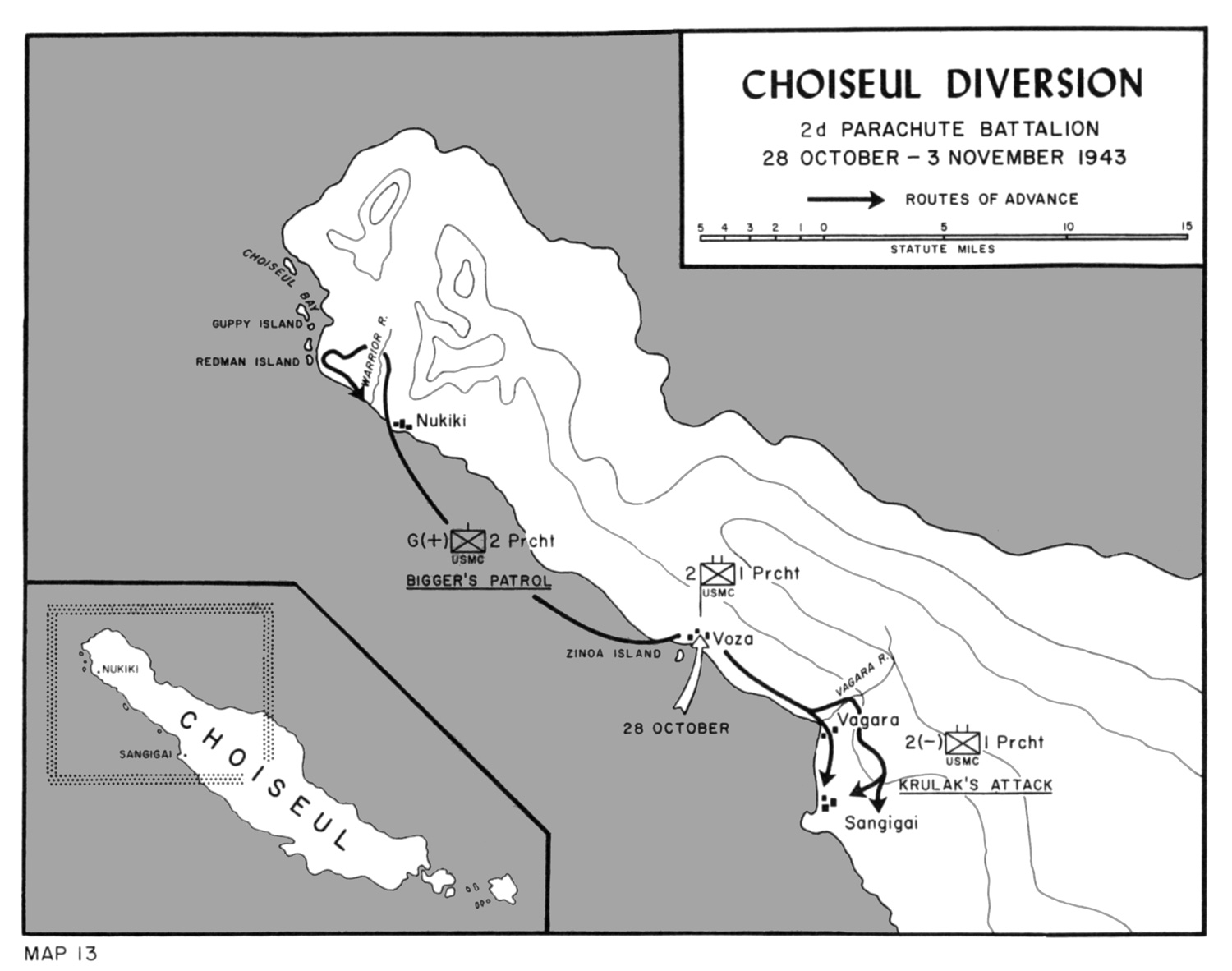
United States Marines from the 2nd Parachute Battalion landed on Japanese-occupied Choiseul in the northern Solomon Islands and carried out raids on Japanese army and navy forces over a 25-mile (40 km) area over the course of seven days with the assistance of local Choiseul islanders and an Australian coastwatchers. The force was withdrawn back to Vella Lavella by landing craft following the successful lodgment of US troops on Bougainville.
Choiseul Island is located about 45 miles (72 km) southeast of Bougainville Island and northwest of Santa Isabel. Approximately 75 miles (121 km) in length, the island varies in width, up to 25 miles (40 km) at its broadest point. At the time of the battle the island's local population consisted of around 5,000 Melanesians, who were located mainly along the coast. Prior to the war the island had been administered by the Australian government, and in the early part of the war, the island had been captured by the Japanese. Local support largely favored the Allies, and two coastwatchers—Charles J. Waddell and Sub-Lieutenant Carden Seton—had operated on the island to gather information about Japanese shipping and troop movements in support of the Guadalcanal campaign.
Following the conclusion of the fighting on Guadalcanal and the Allied capture of the New Georgia islands, the Allies began preparations to advance north towards Bougainville. To support this, a series of diversionary actions were planned in the Treasury Islands and on Choiseul.
Allied staff from Lieutenant General Alexander Vandegrift's I Marine Amphibious Corps had initially considered Choiseul for their main attack in the northern Solomons, but eventually this had shifted towards the west coast of Bougainville. After this, operations on Choiseul were recast to divert Japanese attention from the planned landings at Cape Torokina, inside Empress Augusta Bay. The Allies hoped that the raid would cause the Japanese to believe the landings would be on the east side of Bougainville.
During September 1943, several reconnaissance patrols were sent to Choiseul by the Allies including New Zealanders and US Marines and US Navy personnel. These patrols operated over several days in the southwestern part of the island and in the north to gather intelligence on Japanese dispositions, force concentrations, and patrol activity. They also contacted coastwatchers on the island and sought to locate suitable sites for airfields and beaches capable of supporting landing operations. Reconnaissance confirmed that the terrain was unsuited to dropping troops by air and that instead an amphibious operation was necessary. Coral reefs prevented landing in most locations, with Voza, an abandoned village south of Choiseul Bay and north of Vagara, judged the most suitable. In many areas the beaches were narrow, giving way to thick jungle that was considered impenetrable, while in other locations the coast consisted of cliffs exposed to the sea. Thick jungle and rugged mountainous terrain dominated the interior of the island and made movement across the island difficult; as a result Allied planners chose to limit the size of the raiding force to a single battalion.
Throughout early October, information from Seton confirmed that the Japanese were using Choiseul as a staging base for troops withdrawing from the central Solomons and New Georgia towards Bougainville, estimating that there were around 3,000 Japanese troops in several dispersed locations between Choiseul Bay and Sangigai. They were reported to be demoralized and short on rations. On October 22, Allied planning staff confirmed the operation, assigning it the designation of Operation Blissful; tactical commanders were summoned to Guadalcanal for initial briefing and then returned to Vella Levalla by air to commence planning the raid.
The raid involved 656–725 men from the US 2nd Parachute Battalion, led by Lieutenant Colonel Victor Krulak. On 27 October at Vella Levalla, the attacking force embarked on eight LCM landing craft before being transferred to four high speed transports—McKean, Crosby, Kilty, and Ward—that had just been released from supporting the landing of New Zealand troops on the Treasury Islands. Japanese troops on the island numbered between 3,000 and 7,000 and were under the command of Major General Minoru Sasaki. The majority of these troops were based around Kakasa and around Choiseul Bay where a small harbor was maintained for several barges. Escorted by the destroyer USS Conway, the convoy carrying the US raiding party proceeded through the night towards Choiseul; en route it was attacked by a single Japanese aircraft, with near miss being scored on one of the transport ships. Just prior to midnight, the convoy reached the assembly area about 2,000 yards (1,800 m) offshore of the chosen landing site at Voza, on the northwest side of the island. An advance reconnaissance party was sent ashore in rubber dinghies, and then Companies F and G led the Marines ashore. They landed unopposed early on 28 October. During the landing, Conway was attacked by a Japanese aircraft with several bombs. These bombs missed, and the destroyer held its fire so that it would not draw attention to the landing operations.
Hub AI
Raid on Choiseul AI simulator
(@Raid on Choiseul_simulator)
Raid on Choiseul
The Raid on Choiseul (Operation Blissful) was a small unit engagement that occurred from 28 October to 3 November 1943, during the Solomon Islands campaign of the Pacific War. The raid was launched to divert the Japanese from the Allied landings at Cape Torokina on Bougainville Island.
United States Marines from the 2nd Parachute Battalion landed on Japanese-occupied Choiseul in the northern Solomon Islands and carried out raids on Japanese army and navy forces over a 25-mile (40 km) area over the course of seven days with the assistance of local Choiseul islanders and an Australian coastwatchers. The force was withdrawn back to Vella Lavella by landing craft following the successful lodgment of US troops on Bougainville.
Choiseul Island is located about 45 miles (72 km) southeast of Bougainville Island and northwest of Santa Isabel. Approximately 75 miles (121 km) in length, the island varies in width, up to 25 miles (40 km) at its broadest point. At the time of the battle the island's local population consisted of around 5,000 Melanesians, who were located mainly along the coast. Prior to the war the island had been administered by the Australian government, and in the early part of the war, the island had been captured by the Japanese. Local support largely favored the Allies, and two coastwatchers—Charles J. Waddell and Sub-Lieutenant Carden Seton—had operated on the island to gather information about Japanese shipping and troop movements in support of the Guadalcanal campaign.
Following the conclusion of the fighting on Guadalcanal and the Allied capture of the New Georgia islands, the Allies began preparations to advance north towards Bougainville. To support this, a series of diversionary actions were planned in the Treasury Islands and on Choiseul.
Allied staff from Lieutenant General Alexander Vandegrift's I Marine Amphibious Corps had initially considered Choiseul for their main attack in the northern Solomons, but eventually this had shifted towards the west coast of Bougainville. After this, operations on Choiseul were recast to divert Japanese attention from the planned landings at Cape Torokina, inside Empress Augusta Bay. The Allies hoped that the raid would cause the Japanese to believe the landings would be on the east side of Bougainville.
During September 1943, several reconnaissance patrols were sent to Choiseul by the Allies including New Zealanders and US Marines and US Navy personnel. These patrols operated over several days in the southwestern part of the island and in the north to gather intelligence on Japanese dispositions, force concentrations, and patrol activity. They also contacted coastwatchers on the island and sought to locate suitable sites for airfields and beaches capable of supporting landing operations. Reconnaissance confirmed that the terrain was unsuited to dropping troops by air and that instead an amphibious operation was necessary. Coral reefs prevented landing in most locations, with Voza, an abandoned village south of Choiseul Bay and north of Vagara, judged the most suitable. In many areas the beaches were narrow, giving way to thick jungle that was considered impenetrable, while in other locations the coast consisted of cliffs exposed to the sea. Thick jungle and rugged mountainous terrain dominated the interior of the island and made movement across the island difficult; as a result Allied planners chose to limit the size of the raiding force to a single battalion.
Throughout early October, information from Seton confirmed that the Japanese were using Choiseul as a staging base for troops withdrawing from the central Solomons and New Georgia towards Bougainville, estimating that there were around 3,000 Japanese troops in several dispersed locations between Choiseul Bay and Sangigai. They were reported to be demoralized and short on rations. On October 22, Allied planning staff confirmed the operation, assigning it the designation of Operation Blissful; tactical commanders were summoned to Guadalcanal for initial briefing and then returned to Vella Levalla by air to commence planning the raid.
The raid involved 656–725 men from the US 2nd Parachute Battalion, led by Lieutenant Colonel Victor Krulak. On 27 October at Vella Levalla, the attacking force embarked on eight LCM landing craft before being transferred to four high speed transports—McKean, Crosby, Kilty, and Ward—that had just been released from supporting the landing of New Zealand troops on the Treasury Islands. Japanese troops on the island numbered between 3,000 and 7,000 and were under the command of Major General Minoru Sasaki. The majority of these troops were based around Kakasa and around Choiseul Bay where a small harbor was maintained for several barges. Escorted by the destroyer USS Conway, the convoy carrying the US raiding party proceeded through the night towards Choiseul; en route it was attacked by a single Japanese aircraft, with near miss being scored on one of the transport ships. Just prior to midnight, the convoy reached the assembly area about 2,000 yards (1,800 m) offshore of the chosen landing site at Voza, on the northwest side of the island. An advance reconnaissance party was sent ashore in rubber dinghies, and then Companies F and G led the Marines ashore. They landed unopposed early on 28 October. During the landing, Conway was attacked by a Japanese aircraft with several bombs. These bombs missed, and the destroyer held its fire so that it would not draw attention to the landing operations.
Recent media