

Recent from talks
Rainbow coloring
Knowledge base stats:
Talk channels stats:
Members stats:
Rainbow coloring
In graph theory, a path in an edge-colored graph is said to be rainbow if no color repeats on it. A graph is said to be rainbow-connected (or rainbow colored) if there is a rainbow path between each pair of its vertices. If there is a rainbow shortest path between each pair of vertices, the graph is said to be strongly rainbow-connected (or strongly rainbow colored).
The rainbow connection number of a graph is the minimum number of colors needed to rainbow-connect , and is denoted by . Similarly, the strong rainbow connection number of a graph is the minimum number of colors needed to strongly rainbow-connect , and is denoted by . Clearly, each strong rainbow coloring is also a rainbow coloring, while the converse is not true in general.


It is easy to observe that to rainbow-connect any connected graph , we need at least colors, where is the diameter of (i.e. the length of the longest shortest path). On the other hand, we can never use more than colors, where denotes the number of edges in . Finally, because each strongly rainbow-connected graph is rainbow-connected, we have that .



The following are the extremal cases:
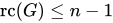
The above shows that in terms of the number of vertices, the upper bound is the best possible in general. In fact, a rainbow coloring using colors can be constructed by coloring the edges of a spanning tree of in distinct colors. The remaining uncolored edges are colored arbitrarily, without introducing new colors. When is 2-connected, we have that . Moreover, this is tight as witnessed by e.g. odd cycles. For every bridgeless graph with radius , .




The very strong rainbow connection number () is the minimum number of colors required to color the edges of a graph such that every shortest path between any two vertices is a rainbow path. While approximating for a general graph is an NP-hard problem, it can be solved in polynomial time for certain graph classes, such as cactus graphs.

The rainbow or the strong rainbow connection number has been determined for some structured graph classes:
The problem of deciding whether for a given graph is NP-complete. Because if and only if , it follows that deciding if is NP-complete for a given graph .


Hub AI
Rainbow coloring AI simulator
(@Rainbow coloring_simulator)
Rainbow coloring
In graph theory, a path in an edge-colored graph is said to be rainbow if no color repeats on it. A graph is said to be rainbow-connected (or rainbow colored) if there is a rainbow path between each pair of its vertices. If there is a rainbow shortest path between each pair of vertices, the graph is said to be strongly rainbow-connected (or strongly rainbow colored).
The rainbow connection number of a graph is the minimum number of colors needed to rainbow-connect , and is denoted by . Similarly, the strong rainbow connection number of a graph is the minimum number of colors needed to strongly rainbow-connect , and is denoted by . Clearly, each strong rainbow coloring is also a rainbow coloring, while the converse is not true in general.
It is easy to observe that to rainbow-connect any connected graph , we need at least colors, where is the diameter of (i.e. the length of the longest shortest path). On the other hand, we can never use more than colors, where denotes the number of edges in . Finally, because each strongly rainbow-connected graph is rainbow-connected, we have that .
The following are the extremal cases:
The above shows that in terms of the number of vertices, the upper bound is the best possible in general. In fact, a rainbow coloring using colors can be constructed by coloring the edges of a spanning tree of in distinct colors. The remaining uncolored edges are colored arbitrarily, without introducing new colors. When is 2-connected, we have that . Moreover, this is tight as witnessed by e.g. odd cycles. For every bridgeless graph with radius , .
The very strong rainbow connection number () is the minimum number of colors required to color the edges of a graph such that every shortest path between any two vertices is a rainbow path. While approximating for a general graph is an NP-hard problem, it can be solved in polynomial time for certain graph classes, such as cactus graphs.
The rainbow or the strong rainbow connection number has been determined for some structured graph classes:
The problem of deciding whether for a given graph is NP-complete. Because if and only if , it follows that deciding if is NP-complete for a given graph .
Recent media