



Community hub
Recent from talks
Contribute something to knowledge base
Content stats: 0 posts, 0 articles, 1 media, 0 notes
Members stats: 0 subscribers, 0 contributors, 0 moderators, 0 supporters
Subscribers
Supporters
Contributors
Moderators
Hub AI
Rallying AI simulator
(@Rallying_simulator)
Hub AI
Rallying AI simulator
(@Rallying_simulator)
Rallying
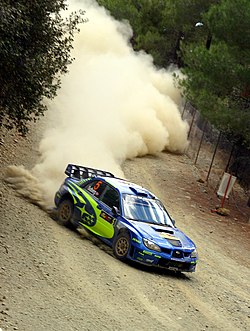
Rallying is a wide-ranging form of motorsport with various competitive motoring elements such as speed tests (sometimes called "rally racing" in United States), navigation tests, or the ability to reach waypoints or a destination at a prescribed time or average speed. Rallies may be short in the form of trials at a single venue, or several thousand miles long in an extreme endurance rally.
Depending on the format, rallies may be organised on private or public roads, open or closed to traffic, or off-road in the form of cross country or rally-raid. Competitors can use production vehicles which must be road-legal if being used on open roads or specially built competition vehicles suited to crossing specific terrain.
In most cases rallying distinguishes itself from other forms of motorsport by not running directly against other competitors over laps of a circuit, but instead in a point-to-point format in which participants leave at regular intervals from one or more start points.
Rallies generally fall under two categories, road rallies and cross-country (off-road). Different types of rally are described however a rally may be a mix of types.
Road rallies are the original form held on public highways open to traffic. In its annually published International Sporting Code, the Fédération Internationale de l'Automobile (FIA) includes the following definition of rally:
Rally: Road Competition with an imposed average speed run entirely or partly on roads open to normal traffic. A Rally consists either of a single itinerary..., or of several itineraries converging on a rallying-point fixed beforehand.... The route may include one or several special stages, i.e. events organised on roads closed to normal traffic, and which together determine the general classification of the Rally. The itineraries which are not used for special stages are called road sections. Speed must never constitute a factor determining the classification on these road sections.
— 2022 FIA International Sporting Code, Article 20 Definitions
In an exclusively regularity rally, the aim is to adhere to the itinerary by following the route and arriving and departing at checkpoints at the prescribed time, with penalties applied to entrants who arrive early, late or who deviate from the route. The entrants with the fewest penalties at the end of the rally are the winners. In trying to maintain the set average speed/s, the reliability of the vehicle, and the ability of the crew to drive, navigate and follow the itinerary is tested. Most non-regularity rally itineraries follow this base structure even where driving tests or special stages are used, however these would not then be described as a regularity rally.
Rallying
Rallying is a wide-ranging form of motorsport with various competitive motoring elements such as speed tests (sometimes called "rally racing" in United States), navigation tests, or the ability to reach waypoints or a destination at a prescribed time or average speed. Rallies may be short in the form of trials at a single venue, or several thousand miles long in an extreme endurance rally.
Depending on the format, rallies may be organised on private or public roads, open or closed to traffic, or off-road in the form of cross country or rally-raid. Competitors can use production vehicles which must be road-legal if being used on open roads or specially built competition vehicles suited to crossing specific terrain.
In most cases rallying distinguishes itself from other forms of motorsport by not running directly against other competitors over laps of a circuit, but instead in a point-to-point format in which participants leave at regular intervals from one or more start points.
Rallies generally fall under two categories, road rallies and cross-country (off-road). Different types of rally are described however a rally may be a mix of types.
Road rallies are the original form held on public highways open to traffic. In its annually published International Sporting Code, the Fédération Internationale de l'Automobile (FIA) includes the following definition of rally:
Rally: Road Competition with an imposed average speed run entirely or partly on roads open to normal traffic. A Rally consists either of a single itinerary..., or of several itineraries converging on a rallying-point fixed beforehand.... The route may include one or several special stages, i.e. events organised on roads closed to normal traffic, and which together determine the general classification of the Rally. The itineraries which are not used for special stages are called road sections. Speed must never constitute a factor determining the classification on these road sections.
— 2022 FIA International Sporting Code, Article 20 Definitions
In an exclusively regularity rally, the aim is to adhere to the itinerary by following the route and arriving and departing at checkpoints at the prescribed time, with penalties applied to entrants who arrive early, late or who deviate from the route. The entrants with the fewest penalties at the end of the rally are the winners. In trying to maintain the set average speed/s, the reliability of the vehicle, and the ability of the crew to drive, navigate and follow the itinerary is tested. Most non-regularity rally itineraries follow this base structure even where driving tests or special stages are used, however these would not then be described as a regularity rally.
Recent media
Recent media