
Recent from talks
Ramanandi Sampradaya
Knowledge base stats:
Talk channels stats:
Members stats:
Ramanandi Sampradaya
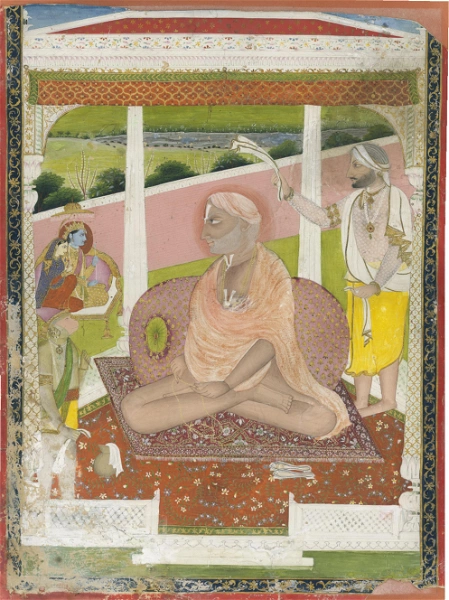
The Ramanandi (IAST: Rāmānandī), also known as Ramavats (Rāmāvat), is one of the largest sects of Vaishnavas. Out of 52 sub-branches of Vaishnavism, divided into four Vaishnava sampradayas, 36 are held by the Ramanandi. The sect mainly emphasizes the worship of Rama, Sita, Hanuman, and the avatars of Vishnu. They consider Rama and Sita as the Supreme Absolute who are not different from each other. It is considered to have been founded by Ramananda, a 14th-century Vaishnava saint.
The Ramanandi Sampradaya originates from Rama, who initiated Sita with his six-letter mantra. Sita later initiated her beloved disciple Hanuman with the same mantra. According to Shanti Lala Nagar, Valmiki Samhita says:
The Supreme Being, Rama, always ready to protect his eternal servants and to assist those with meek hearts. This is well-known in the Vedas. He created this universe and, with the desire for the welfare of people, Rama imparted the transcendental mantra to Sita, the daughter of King Janaka than She revealed this to the glorious Hanuman, the repository of virtues. Hanuman then conveyed it to Brahma, who in turn passed it on to the sage Vasishtha. Thus, in this sequence, the divine mantra descended into this world.
It is claimed that this tradition has been established in all four Yugas and in Kaliyuga Rama himself appeared as Ramanandacharya at Prayagraj.
Bhaktamal is a hagiographic work on Hindu saints and devotees written by Nabhadas in 1660, was a core text for all Vaishnavas including Ramanandis. Many localised commentaries of Bhaktamal were taught to young Vaishnavas across India. In the 19th century, proliferation of the printing press in the Gangetic plains of North India allowed various commentaries of the text to be widely distributed. Of these, Jankidas Sri Vaishnav's edition of Bhaktamal known as Bhaktamal Bhaskara is considered to be the most authoritative as he has used the most oldest handwritten manuscripts in this edition. Ramananda's guru Raghavananda is described as an egalitarian guru who taught students of all castes. Ramananda himself is described as an avatar of Rama, a humble student with great yogic talents.
Munsi Ram Sharma says that more than 500 disciples of Ramananda who lives with him in Varanasi. It is said that propagator of Ramanadi tradition is Sita. She first imparted teachings to Hanuman, through which the revelation of this secret occurred in the world. Due to this, the name of this tradition is Sri Sampradaya, and its main mantra is referred to as the 'Ram Tarak Mantra'. The guru imparts initiation of sacred Ram mantra into the disciple's ear. They apply an upward-pointing tilak (urdhva pund) on the forehead. Complete devotion and immersion in devotional songs (bhajans) is the tradition's way of life. Most saints lead a life of renunciation (paramhansa) within this tradition. Farquhar credits Ramananda and his followers as the origin of the North Indian practice of using Ram to refer to the Absolute. Farquhar finds no evidence to show that Ramananda endeavoured to "overturn caste as a social institution". On the other hand, Sita Ram, author of the Vaishnava history of Ayodhya, and George Grierson, eminent linguist and Indologist, represent Ramananda as saint who tried to transcend caste divisions of medieval India through the message of love and equality. The scholars also disagree on Ramananda's connection with Ramanuja. While Farquhar finds them completely unconnected, Sita Ram and Grierson finds Ramananda connection with Ramanuja tradition. But a historical debate held between Ramanuj and Ramanand tradition in Ujjain Kumbh 1921, ended up the issue of both the traditions being one; Ramanuja Ramprapannadas from Ramanuj tradition got defeated from Bhagvaddas of Ramanandi tradition.
Up to the nineteenth century, many of the trade routes in northern India were guarded by groups of warrior-ascetics, including the Nāgā sections of the Rāmānandīs, who were feared because of their strength and fearlessness. The British took steps to disarm these militant groups of ascetics, but even today the sects still retain their heroic traditions.
The Ramanandi Sampradaya is considered one of the largest and most egalitarian Hindu sects India, around the Gangetic Plain, and Nepal.
Hub AI
Ramanandi Sampradaya AI simulator
(@Ramanandi Sampradaya_simulator)
Ramanandi Sampradaya
The Ramanandi (IAST: Rāmānandī), also known as Ramavats (Rāmāvat), is one of the largest sects of Vaishnavas. Out of 52 sub-branches of Vaishnavism, divided into four Vaishnava sampradayas, 36 are held by the Ramanandi. The sect mainly emphasizes the worship of Rama, Sita, Hanuman, and the avatars of Vishnu. They consider Rama and Sita as the Supreme Absolute who are not different from each other. It is considered to have been founded by Ramananda, a 14th-century Vaishnava saint.
The Ramanandi Sampradaya originates from Rama, who initiated Sita with his six-letter mantra. Sita later initiated her beloved disciple Hanuman with the same mantra. According to Shanti Lala Nagar, Valmiki Samhita says:
The Supreme Being, Rama, always ready to protect his eternal servants and to assist those with meek hearts. This is well-known in the Vedas. He created this universe and, with the desire for the welfare of people, Rama imparted the transcendental mantra to Sita, the daughter of King Janaka than She revealed this to the glorious Hanuman, the repository of virtues. Hanuman then conveyed it to Brahma, who in turn passed it on to the sage Vasishtha. Thus, in this sequence, the divine mantra descended into this world.
It is claimed that this tradition has been established in all four Yugas and in Kaliyuga Rama himself appeared as Ramanandacharya at Prayagraj.
Bhaktamal is a hagiographic work on Hindu saints and devotees written by Nabhadas in 1660, was a core text for all Vaishnavas including Ramanandis. Many localised commentaries of Bhaktamal were taught to young Vaishnavas across India. In the 19th century, proliferation of the printing press in the Gangetic plains of North India allowed various commentaries of the text to be widely distributed. Of these, Jankidas Sri Vaishnav's edition of Bhaktamal known as Bhaktamal Bhaskara is considered to be the most authoritative as he has used the most oldest handwritten manuscripts in this edition. Ramananda's guru Raghavananda is described as an egalitarian guru who taught students of all castes. Ramananda himself is described as an avatar of Rama, a humble student with great yogic talents.
Munsi Ram Sharma says that more than 500 disciples of Ramananda who lives with him in Varanasi. It is said that propagator of Ramanadi tradition is Sita. She first imparted teachings to Hanuman, through which the revelation of this secret occurred in the world. Due to this, the name of this tradition is Sri Sampradaya, and its main mantra is referred to as the 'Ram Tarak Mantra'. The guru imparts initiation of sacred Ram mantra into the disciple's ear. They apply an upward-pointing tilak (urdhva pund) on the forehead. Complete devotion and immersion in devotional songs (bhajans) is the tradition's way of life. Most saints lead a life of renunciation (paramhansa) within this tradition. Farquhar credits Ramananda and his followers as the origin of the North Indian practice of using Ram to refer to the Absolute. Farquhar finds no evidence to show that Ramananda endeavoured to "overturn caste as a social institution". On the other hand, Sita Ram, author of the Vaishnava history of Ayodhya, and George Grierson, eminent linguist and Indologist, represent Ramananda as saint who tried to transcend caste divisions of medieval India through the message of love and equality. The scholars also disagree on Ramananda's connection with Ramanuja. While Farquhar finds them completely unconnected, Sita Ram and Grierson finds Ramananda connection with Ramanuja tradition. But a historical debate held between Ramanuj and Ramanand tradition in Ujjain Kumbh 1921, ended up the issue of both the traditions being one; Ramanuja Ramprapannadas from Ramanuj tradition got defeated from Bhagvaddas of Ramanandi tradition.
Up to the nineteenth century, many of the trade routes in northern India were guarded by groups of warrior-ascetics, including the Nāgā sections of the Rāmānandīs, who were feared because of their strength and fearlessness. The British took steps to disarm these militant groups of ascetics, but even today the sects still retain their heroic traditions.
The Ramanandi Sampradaya is considered one of the largest and most egalitarian Hindu sects India, around the Gangetic Plain, and Nepal.
Recent media