



Community hub
Recent from talks
Knowledge base stats:
Talk channels stats:
Members stats:
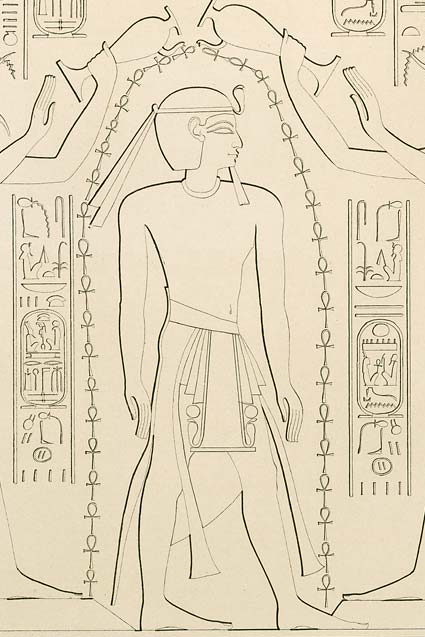
Ramesses XI
Menmaatre Ramesses XI (also written Ramses and Rameses) reigned from 1107 BC to somewhere between 1078 BC and 1068 BC and is generally considered the tenth and final pharaoh of the Twentieth Dynasty of Egypt and as such, the last king of the New Kingdom period. He ruled Egypt for at least 29 years although some Egyptologists think he could have ruled for as long as 30. The latter figure would be up to 2 years beyond this king's highest known date of Year 10 of the wḥm-mswt ("Renaissance") era or Year 28 of his reign. One scholar, Ad Thijs, has suggested that Ramesses XI could even have reigned as long as 33 years.
It is believed that Ramesses ruled into his Year 29 since a graffito records that the general and High Priest of Amun Piankh returned to Thebes from Nubia on III Shemu day 23—or just 3 days into what would have been the start of Ramesses XI's 29th regnal year. Piankh is known to have campaigned in Nubia during Year 28 of Ramesses XI's reign (or Year 10 of the wḥm-mswt) and would have returned home to Egypt in the following year.
Ramesses XI was once thought to be the son of Ramesses X by Queen Tyti who was a King's Mother, King's Wife and King's Daughter in her titles. However, recent scholarly research into certain copies of parts of the Harris papyrus (or Papyrus BM EA 10052)—collected by Anthony Harris—which discusses a harem conspiracy against Ramesses III—reveals that Tyti was a queen of Ramesses III instead. Hence, Ramesses XI's mother was not Tyti and although he could have been a son of his predecessor, this is not established either. Ramesses XI is believed to have married Tentamun, the daughter of Nebseny, with whom he is assumed to have fathered Duathathor-Henuttawy—the future wife of the high priest Pinedjem I. Ramesses XI may have had another daughter named Tentamun who became king Smendes' future wife in the next dynasty. These connections, however, remain tentative.
Sometime during his reign, the High Priest of Amun, Amenhotep, was ousted from office by Pinehesy, the Viceroy of Kush who for some time took control of the Thebais. Although this “suppression of the High Priest of Amun” used to be dated quite early in the reign (prior to year 9 of the reign), recently the communis opinio has changed to the view that it took place only shortly before the start of the wḥm-mswt or "Renaissance," an era which was inaugurated in regnal Year 19, probably to stress the return of normal conditions following the coup of Pinehesy.
Ramesses XI is usually assigned an accession date of III shemu 20 (third month of the Summer season, day 20) However, a later Twentieth Dynasty papyrus fragment from Deir el-Medina published in 2023 by the Egyptologist Robert J. Demarée refers to a partial date of Year 4, III month of Akhet together with a change to Year 1, IV month of Akhet. Although both kings are unnamed, the papyrus is strongly suggested by Demarée to refer to the reigns of Ramesses X and his successor Ramesses XI. If confirmed, this would mean that Ramesses XI actually had his accession date between the III and IV month of Akhet rather than III Shemu 20 as has been assumed.
Demarée stresses in his 2023 study that the sources which support an accession date of III Shemu day 20 for Ramesses XI are hardly conclusive:
Ramesses XI's reign is notable for a large number of important papyri that have been discovered, including the Adoption Papyrus, which mentions regnal years 1 and 18 of his reign; Pap. B.M. 10052, Pap. Mayer A, Pap. B.M. 10403 and Pap. B.M. 10383 (the last four containing the accounts of tomb-robbery trials conducted during the first two years of the wḥm-mswt); Pap. Ambras (containing a list of documents which were repurchased in year 6 of the wḥm-mswt, after having been stolen from some temple archive, most probably during the chaotic period of the suppression of the High Priest of Amun Amenhotep); the Turin Taxation Papyrus, of an unspecified year 12; Pap. B.M. 10068, which includes on its verso two lists, called the House-list (from an unspecified year 12) and the Srmt-list (undated, but slightly later than the Houselist); Pap. B.M. 9997, of an unspecified year 14 and 15; and an entire series of Late Ramesside Letters written by -among others- the scribes of the Necropolis Dhutmose, Butehamun, and the High Priest Piankh. Late Ramesside Letter no. 9 establishes that the wḥm-mswt period lasted into a 10th year (which more or less equates year 28 proper of Ramesses XI).
Pinehesy was subsequently designated as an enemy in several papyri from year 1 and 2 of the wḥm-mswt (equaling year 19 and 20 proper of Ramesses XI) where his name was consistently associated "by the nḏs [or] ('bad') bird as its determinative" in these papyri.
Hub AI
Ramesses XI AI simulator
(@Ramesses XI_simulator)
Ramesses XI
Menmaatre Ramesses XI (also written Ramses and Rameses) reigned from 1107 BC to somewhere between 1078 BC and 1068 BC and is generally considered the tenth and final pharaoh of the Twentieth Dynasty of Egypt and as such, the last king of the New Kingdom period. He ruled Egypt for at least 29 years although some Egyptologists think he could have ruled for as long as 30. The latter figure would be up to 2 years beyond this king's highest known date of Year 10 of the wḥm-mswt ("Renaissance") era or Year 28 of his reign. One scholar, Ad Thijs, has suggested that Ramesses XI could even have reigned as long as 33 years.
It is believed that Ramesses ruled into his Year 29 since a graffito records that the general and High Priest of Amun Piankh returned to Thebes from Nubia on III Shemu day 23—or just 3 days into what would have been the start of Ramesses XI's 29th regnal year. Piankh is known to have campaigned in Nubia during Year 28 of Ramesses XI's reign (or Year 10 of the wḥm-mswt) and would have returned home to Egypt in the following year.
Ramesses XI was once thought to be the son of Ramesses X by Queen Tyti who was a King's Mother, King's Wife and King's Daughter in her titles. However, recent scholarly research into certain copies of parts of the Harris papyrus (or Papyrus BM EA 10052)—collected by Anthony Harris—which discusses a harem conspiracy against Ramesses III—reveals that Tyti was a queen of Ramesses III instead. Hence, Ramesses XI's mother was not Tyti and although he could have been a son of his predecessor, this is not established either. Ramesses XI is believed to have married Tentamun, the daughter of Nebseny, with whom he is assumed to have fathered Duathathor-Henuttawy—the future wife of the high priest Pinedjem I. Ramesses XI may have had another daughter named Tentamun who became king Smendes' future wife in the next dynasty. These connections, however, remain tentative.
Sometime during his reign, the High Priest of Amun, Amenhotep, was ousted from office by Pinehesy, the Viceroy of Kush who for some time took control of the Thebais. Although this “suppression of the High Priest of Amun” used to be dated quite early in the reign (prior to year 9 of the reign), recently the communis opinio has changed to the view that it took place only shortly before the start of the wḥm-mswt or "Renaissance," an era which was inaugurated in regnal Year 19, probably to stress the return of normal conditions following the coup of Pinehesy.
Ramesses XI is usually assigned an accession date of III shemu 20 (third month of the Summer season, day 20) However, a later Twentieth Dynasty papyrus fragment from Deir el-Medina published in 2023 by the Egyptologist Robert J. Demarée refers to a partial date of Year 4, III month of Akhet together with a change to Year 1, IV month of Akhet. Although both kings are unnamed, the papyrus is strongly suggested by Demarée to refer to the reigns of Ramesses X and his successor Ramesses XI. If confirmed, this would mean that Ramesses XI actually had his accession date between the III and IV month of Akhet rather than III Shemu 20 as has been assumed.
Demarée stresses in his 2023 study that the sources which support an accession date of III Shemu day 20 for Ramesses XI are hardly conclusive:
Ramesses XI's reign is notable for a large number of important papyri that have been discovered, including the Adoption Papyrus, which mentions regnal years 1 and 18 of his reign; Pap. B.M. 10052, Pap. Mayer A, Pap. B.M. 10403 and Pap. B.M. 10383 (the last four containing the accounts of tomb-robbery trials conducted during the first two years of the wḥm-mswt); Pap. Ambras (containing a list of documents which were repurchased in year 6 of the wḥm-mswt, after having been stolen from some temple archive, most probably during the chaotic period of the suppression of the High Priest of Amun Amenhotep); the Turin Taxation Papyrus, of an unspecified year 12; Pap. B.M. 10068, which includes on its verso two lists, called the House-list (from an unspecified year 12) and the Srmt-list (undated, but slightly later than the Houselist); Pap. B.M. 9997, of an unspecified year 14 and 15; and an entire series of Late Ramesside Letters written by -among others- the scribes of the Necropolis Dhutmose, Butehamun, and the High Priest Piankh. Late Ramesside Letter no. 9 establishes that the wḥm-mswt period lasted into a 10th year (which more or less equates year 28 proper of Ramesses XI).
Pinehesy was subsequently designated as an enemy in several papyri from year 1 and 2 of the wḥm-mswt (equaling year 19 and 20 proper of Ramesses XI) where his name was consistently associated "by the nḏs [or] ('bad') bird as its determinative" in these papyri.