



Community hub
Recent from talks
Knowledge base stats:
Talk channels stats:
Members stats:
Ramey Air Force Base
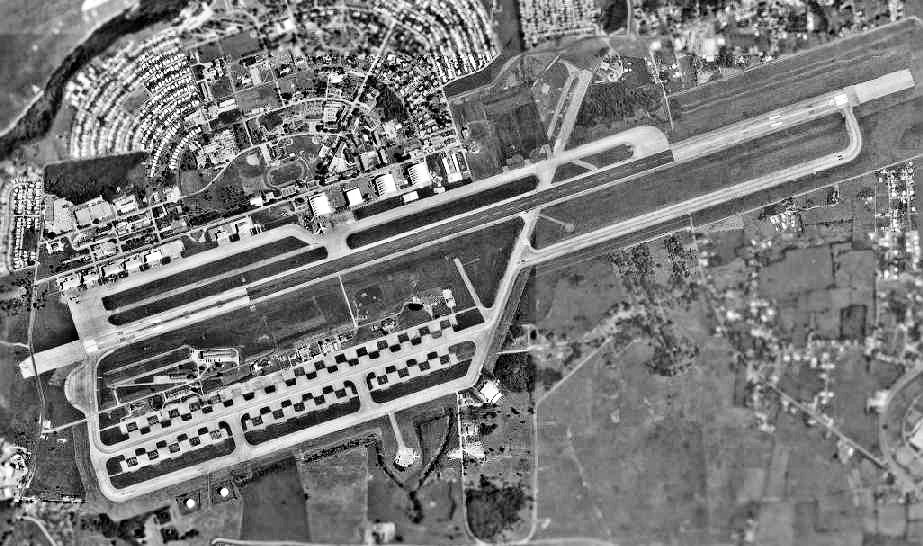
Ramey Air Force Base also known as Borinquen Field, is a former United States Air Force base in Aguadilla, Puerto Rico. It was named after United States Army Air Forces Brigadier General Howard Knox Ramey. Following its closure, it was redeveloped into Rafael Hernandez Airport.
In 1939, the U.S. Army Air Corps sent Major George C. Kenney to Puerto Rico to conduct a preliminary survey of possible air base sites on Puerto Rico. He examined 42 sites and declared Punta Borinquen the best site for a major air base. In September 1939, the government purchased 3,796 acres (1,536 ha) of sugar cane farms for military use, for $1,215,000. The area was also populated by Poblado San Antonio, in which construction caused hundreds of families to be expropriated from the land. Later that year, Major Karl S. Axtater assumed command of what was to become Borinquen Army Airfield.
The 1940 US Census counted enumeration district 22–32 as Borinquen Field in Aquadilla, Puerto Rico. Lt. Col. Karl S. Axtater, age 47, Post Commander, is the first person on the list of 942 personnel on the base in April 1940. Each servicemember reported rank, place of birth, and reported the location of their previous residence as of April 1935.
During World War II, the following squadrons were assigned to the airfield:
With the establishment of an independent United States Air Force in 1947, the complex was renamed Ramey Air Force Base in 1948. Ramey AFB was home to a succession of Strategic Air Command (SAC) strategic reconnaissance wings and a bombardment wing, and housed a number of B-36 Peacemaker intercontinental bombers, in its RB-36 strategic reconnaissance version. The RB-36s were later replaced by B-52 Stratofortress heavy bombers and KC-135 Stratotanker aerial refueling aircraft.
A tenant weather reconnaissance squadron operated WB-47 Stratojet and WC-130 Hercules aircraft. Due to the size and weight of the B-36, the runway at Ramey had to be built to a length of 11,702 feet (3,567 m) and a width of 200 feet (61 m), with an added 870 feet (270 m) Blast Pad at each end and an additional 50 feet (15 m) shoulder on each side. This led to the second expropriation of Poblado San Antonio, which led to the displacement of 4,000 inhabitants to San Antonio's current location in Montaña.
In 1971, the closure of Ramey Air Force Base began as part of a SAC-wide reduction in bombardment wings, and lasted until 1973. Following its closure, it was converted into a joint civilian-military airport, with the United States Coast Guard comprising the remaining military aviation activities at the airport as Coast Guard Air Station Borinquen and Puerto Rico Air National Guard, Army National Guard and the United States Army Reserve maintaining non-aviation units.
In 1951–1952, success with a test array and then a full scale 40-element operational array at Eleuthera, Bahamas led the Navy in 1952 to order six (quickly expanded to nine) undersea surveillance systems under the classified name of Sound Surveillance System (SOSUS) to be installed under the unclassified name Project Caesar. The shore terminals were described as supporting "oceanographic research" and given the generic and ambiguous name "Naval Facility" with the actual submarine detection purpose classified on a strict need-to-know basis. The first of the systems was to terminate at a Naval Facility (NAVFAC) on a beach under the cliff of the Air Force Base (18°29′18.4″N 67°09′36.2″W / 18.488444°N 67.160056°W). Construction began in 1953 with Naval Facility Ramey commissioned on 18 September 1954.
Hub AI
Ramey Air Force Base AI simulator
(@Ramey Air Force Base_simulator)
Ramey Air Force Base
Ramey Air Force Base also known as Borinquen Field, is a former United States Air Force base in Aguadilla, Puerto Rico. It was named after United States Army Air Forces Brigadier General Howard Knox Ramey. Following its closure, it was redeveloped into Rafael Hernandez Airport.
In 1939, the U.S. Army Air Corps sent Major George C. Kenney to Puerto Rico to conduct a preliminary survey of possible air base sites on Puerto Rico. He examined 42 sites and declared Punta Borinquen the best site for a major air base. In September 1939, the government purchased 3,796 acres (1,536 ha) of sugar cane farms for military use, for $1,215,000. The area was also populated by Poblado San Antonio, in which construction caused hundreds of families to be expropriated from the land. Later that year, Major Karl S. Axtater assumed command of what was to become Borinquen Army Airfield.
The 1940 US Census counted enumeration district 22–32 as Borinquen Field in Aquadilla, Puerto Rico. Lt. Col. Karl S. Axtater, age 47, Post Commander, is the first person on the list of 942 personnel on the base in April 1940. Each servicemember reported rank, place of birth, and reported the location of their previous residence as of April 1935.
During World War II, the following squadrons were assigned to the airfield:
With the establishment of an independent United States Air Force in 1947, the complex was renamed Ramey Air Force Base in 1948. Ramey AFB was home to a succession of Strategic Air Command (SAC) strategic reconnaissance wings and a bombardment wing, and housed a number of B-36 Peacemaker intercontinental bombers, in its RB-36 strategic reconnaissance version. The RB-36s were later replaced by B-52 Stratofortress heavy bombers and KC-135 Stratotanker aerial refueling aircraft.
A tenant weather reconnaissance squadron operated WB-47 Stratojet and WC-130 Hercules aircraft. Due to the size and weight of the B-36, the runway at Ramey had to be built to a length of 11,702 feet (3,567 m) and a width of 200 feet (61 m), with an added 870 feet (270 m) Blast Pad at each end and an additional 50 feet (15 m) shoulder on each side. This led to the second expropriation of Poblado San Antonio, which led to the displacement of 4,000 inhabitants to San Antonio's current location in Montaña.
In 1971, the closure of Ramey Air Force Base began as part of a SAC-wide reduction in bombardment wings, and lasted until 1973. Following its closure, it was converted into a joint civilian-military airport, with the United States Coast Guard comprising the remaining military aviation activities at the airport as Coast Guard Air Station Borinquen and Puerto Rico Air National Guard, Army National Guard and the United States Army Reserve maintaining non-aviation units.
In 1951–1952, success with a test array and then a full scale 40-element operational array at Eleuthera, Bahamas led the Navy in 1952 to order six (quickly expanded to nine) undersea surveillance systems under the classified name of Sound Surveillance System (SOSUS) to be installed under the unclassified name Project Caesar. The shore terminals were described as supporting "oceanographic research" and given the generic and ambiguous name "Naval Facility" with the actual submarine detection purpose classified on a strict need-to-know basis. The first of the systems was to terminate at a Naval Facility (NAVFAC) on a beach under the cliff of the Air Force Base (18°29′18.4″N 67°09′36.2″W / 18.488444°N 67.160056°W). Construction began in 1953 with Naval Facility Ramey commissioned on 18 September 1954.