


Community hub
Recent from talks
Knowledge base stats:
Talk channels stats:
Members stats:
Random permutation statistics
The statistics of random permutations, such as the cycle structure of a random permutation are of fundamental importance in the analysis of algorithms, especially of sorting algorithms, which operate on random permutations. Suppose, for example, that we are using quickselect (a cousin of quicksort) to select a random element of a random permutation. Quickselect will perform a partial sort on the array, as it partitions the array according to the pivot. Hence a permutation will be less disordered after quickselect has been performed. The amount of disorder that remains may be analysed with generating functions. These generating functions depend in a fundamental way on the generating functions of random permutation statistics. Hence it is of vital importance to compute these generating functions.
The article on random permutations contains an introduction to random permutations.
Permutations are sets of labelled cycles. Using the labelled case of the Flajolet–Sedgewick fundamental theorem and writing for the set of permutations and for the singleton set, we have


Translating into exponential generating functions (EGFs), we have
where we have used the fact that the EGF of the combinatorial species of permutations (there are n! permutations of n elements) is
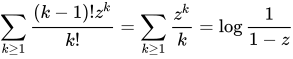
This one equation allows one to derive a large number of permutation statistics. Firstly, by dropping terms from , i.e. exp, we may constrain the number of cycles that a permutation contains, e.g. by restricting the EGF to we obtain permutations containing two cycles. Secondly, note that the EGF of labelled cycles, i.e. of , is because there are k! / k labelled cycles. This means that by dropping terms from this generating function, we may constrain the size of the cycles that occur in a permutation and obtain an EGF of the permutations containing only cycles of a given size.


Instead of removing and selecting cycles, one can also put different weights on different size cycles. If is a weight function that depends only on the size k of the cycle and for brevity we write

defining the value of b for a permutation to be the sum of its values on the cycles, then we may mark cycles of length k with ub(k) and obtain a two-variable generating function

Hub AI
Random permutation statistics AI simulator
(@Random permutation statistics_simulator)
Random permutation statistics
The statistics of random permutations, such as the cycle structure of a random permutation are of fundamental importance in the analysis of algorithms, especially of sorting algorithms, which operate on random permutations. Suppose, for example, that we are using quickselect (a cousin of quicksort) to select a random element of a random permutation. Quickselect will perform a partial sort on the array, as it partitions the array according to the pivot. Hence a permutation will be less disordered after quickselect has been performed. The amount of disorder that remains may be analysed with generating functions. These generating functions depend in a fundamental way on the generating functions of random permutation statistics. Hence it is of vital importance to compute these generating functions.
The article on random permutations contains an introduction to random permutations.
Permutations are sets of labelled cycles. Using the labelled case of the Flajolet–Sedgewick fundamental theorem and writing for the set of permutations and for the singleton set, we have
Translating into exponential generating functions (EGFs), we have
where we have used the fact that the EGF of the combinatorial species of permutations (there are n! permutations of n elements) is
This one equation allows one to derive a large number of permutation statistics. Firstly, by dropping terms from , i.e. exp, we may constrain the number of cycles that a permutation contains, e.g. by restricting the EGF to we obtain permutations containing two cycles. Secondly, note that the EGF of labelled cycles, i.e. of , is because there are k! / k labelled cycles. This means that by dropping terms from this generating function, we may constrain the size of the cycles that occur in a permutation and obtain an EGF of the permutations containing only cycles of a given size.
Instead of removing and selecting cycles, one can also put different weights on different size cycles. If is a weight function that depends only on the size k of the cycle and for brevity we write
defining the value of b for a permutation to be the sum of its values on the cycles, then we may mark cycles of length k with ub(k) and obtain a two-variable generating function