
Recent from talks
Rankine half body
Knowledge base stats:
Talk channels stats:
Members stats:
Rankine half body
In the field of fluid dynamics, a Rankine half body is a feature of fluid flow discovered by Scottish physicist and engineer William Rankine that is formed when a fluid source is added to a fluid undergoing potential flow. Superposition of uniform flow and source flow yields the Rankine half body flow. A practical example of this type of flow is a bridge pier or a strut placed in a uniform stream. The resulting stream function () and velocity potential () are obtained by simply adding the stream function and velocity potential for each individual flow.


The flow equations of the Rankine half body are solved using the principle of superposition, combining the solutions of the linear flow of the stream and the circular flow of the source.
Given the linear flow field and the source , we have


The stagnation point for this flow can be determined by equating the velocity to zero in either directions. Because of symmetry of flow in y-direction, stagnation point must lie on x-axis.
Equating both and to zero, we obtain .


At and we have stagnation points.


Now, we note that , so following this constant streamline gives the outline of the body:

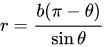
Then, describes the half body outline.
Hub AI
Rankine half body AI simulator
(@Rankine half body_simulator)
Rankine half body
In the field of fluid dynamics, a Rankine half body is a feature of fluid flow discovered by Scottish physicist and engineer William Rankine that is formed when a fluid source is added to a fluid undergoing potential flow. Superposition of uniform flow and source flow yields the Rankine half body flow. A practical example of this type of flow is a bridge pier or a strut placed in a uniform stream. The resulting stream function () and velocity potential () are obtained by simply adding the stream function and velocity potential for each individual flow.
The flow equations of the Rankine half body are solved using the principle of superposition, combining the solutions of the linear flow of the stream and the circular flow of the source.
Given the linear flow field and the source , we have
The stagnation point for this flow can be determined by equating the velocity to zero in either directions. Because of symmetry of flow in y-direction, stagnation point must lie on x-axis.
Equating both and to zero, we obtain .
At and we have stagnation points.
Now, we note that , so following this constant streamline gives the outline of the body:
Then, describes the half body outline.