Hubbry Logo
Ray BriemRay BriemMain
Open search
Ray Briem
Community hub
Ray Briem
logo
8 pages, 0 posts
0 subscribers
Be the first to start a discussion here.
Ray Briem
Ray Briem
from Wikipedia
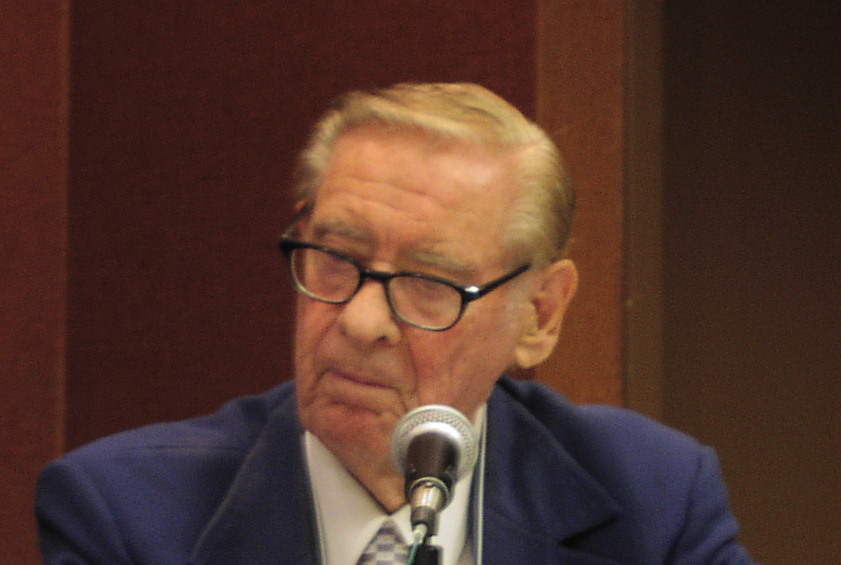
A photo of Ray Briem in 2009
Briem in 2009

Ray Briem (January 19, 1930 - December 12, 2012) was a radio personality who worked in Los Angeles most of his career, most notably at KABC.[1] He was noted for his conservative viewpoints, historical knowledge, polished delivery and love of Big Band music. He was especially capable of debating liberal callers and guests, but his shows were not limited to politics. He interviewed a wide range of celebrities primarily from the golden age of radio, music, movies and television. He worked the overnight shift and received good ratings. Briem consistently drew the highest ratings of any overnight talk show in Southern California, routinely attracting about 15% of the available audience.[2] He worked as a nationally syndicated host for a number of years, a time which he has recalled fondly for the variety and quality of callers.

On his overnight program he was able to persuade many news and opinion makers to stay up late, or, if on the east coast, get up early, to make appearances. A frequent guest was Howard Jarvis, the attorney and political activist, who used the show as a platform to promote California's property tax limitation initiative, Proposition 13, in 1978.

Briem received a number of honors, including a star on the Hollywood Walk of Fame.[3]

References

[edit]
Revisions and contributorsEdit on WikipediaRead on Wikipedia
from Grokipedia
Ray Briem is an American radio broadcaster and talk show host known for his influential overnight program on KABC-AM in Los Angeles, where he dominated ratings for nearly three decades with a mix of conservative commentary, celebrity interviews, and big-band music. Born on January 19, 1930, in Ogden, Utah, Briem began his radio career at age 15 at a local station before serving with Armed Forces Radio during the Korean War, where he hosted shows featuring prominent big-band leaders. After stints at stations including KGIL-AM and KLAC-AM in Los Angeles, he transitioned to talk radio under the influence of Joe Pyne and joined KABC in 1967 to host the midnight-to-5 a.m. slot until 1994. His program became a staple of late-night listening in Southern California, attracting a loyal audience through open caller lines, debates with liberal guests, and consistent support for conservative causes, including providing airtime to Proposition 13 proponent Howard Jarvis that helped build momentum for the 1978 tax-limiting measure. Briem's polished delivery, historical knowledge, and revenue-generating success made him one of the early architects of modern talk radio, earning him a star on the Hollywood Walk of Fame in the radio category in 1992. He later hosted a brief afternoon show on KIEV-AM before retiring in 1997. Briem died of cancer on December 12, 2012, at his home in Malibu, California.

Early life

Birth and family background

Ray Briem was born on January 19, 1930, in Ogden, Utah. He was the firstborn son of Leland Jesse Briem, who worked as a railroad engineer, and Edith Gidney Briem, who was employed as a teacher. Briem grew up in Ogden, Utah, where he attended public schools. He graduated from Ogden High School in 1947.

Introduction to radio

Ray Briem's introduction to radio began in his teenage years in Ogden, Utah. At age 15, he and his friends created a 15-minute radio drama titled "The Adventures of Vivacious Vicky," which they successfully convinced the small local station KLO to air. Later in 1945, on V-E Day, a staff member at KLO went on a drunken binge, prompting the station to ask Briem to fill in on air. He performed well enough that he was hired full-time later that year, marking the start of his professional radio work at age 15. These early experiences at KLO sparked Briem's lifelong passion for broadcasting, which continued to develop in subsequent years.

Military service

Armed Forces Radio service

Ray Briem enlisted in the Army at age 19 in 1949 and was assigned to public information work with the Armed Forces Radio Service. His first posting took him to New York City, where he emceed programs broadcast from Manhattan nightspots featuring legends of the Big Band Era, including those led by Harry James, Guy Lombardo, Count Basie, and Duke Ellington. These duties also included short-wave radio communications. During the Korean War, while based in Salt Lake City, Briem hosted the Armed Forces Radio program "Hometown Mailbag," which transmitted personal messages from home to U.S. military personnel stationed in Korea and Japan. The show proved highly popular with homesick troops and their families, drawing thousands of letters weekly in some accounts. After completing his military service in 1953, Briem relocated to Los Angeles to pursue civilian disc jockey work.

Early broadcasting career

Disc jockey roles

After completing his military service in 1953, Ray Briem moved to Los Angeles and began working as a disc jockey at KGIL-AM in the San Fernando Valley. He played popular music and interacted with listeners in the early phase of his broadcasting career in the area. Briem later relocated to Seattle for television work before returning to Los Angeles in 1960, where he joined KLAC-AM as a disc jockey. At KLAC, he was mentored by Joe Pyne, a prominent and controversial figure in broadcasting known for his bold style. Briem focused on music programming during this period. He continued as a deejay at the station through the early 1960s, building experience in music radio before shifting to talk formats later in his career.

Television hosting in Seattle

In the late 1950s and early 1960s, Ray Briem worked in Seattle for King Broadcasting Company, contributing to both its radio and television divisions. He hosted the popular teen dance program Seattle Bandstand on KING-TV, which debuted on March 16, 1958, and was directly modeled after Dick Clark's national American Bandstand. The live Saturday afternoon show, airing from 1:00 p.m. to 3:00 p.m., featured the weekly "King Size 10" top hits, lip-sync performances by national recording artists such as The Platters, Fabian, and Bobby Darin, and dancing by local teenagers who requested tickets in advance. Briem's charismatic on-air presence and the program's success in promoting Northwest teen bands led fans to nickname him "the Dick Clark of Seattle." He continued hosting Seattle Bandstand until February 1960, when he returned to Los Angeles to resume radio work at KLAC.

Talk radio career

Nighttime talk at KLAC

Ray Briem arrived in Los Angeles in 1960 to work as a disc jockey at KLAC-AM. Mentored by controversial talk host Joe Pyne, he initially focused on spinning records until the station shifted to a talk format in the mid-1960s, prompting management to ask him to host nighttime talk shows. Briem resisted the change, later recalling that he "went into it kicking and screaming" because he preferred music and had decided early in his career to become an announcer and deejay rather than a newsman. He admitted struggling with the new format due to limited knowledge of politics and government, describing his first year as "an embarrassment" and acknowledging, "I realized what a dumb head I was." Despite the rocky start, Briem built a following over his seven-year tenure at KLAC (1960–1967) by engaging listeners with straightforward, non-political topics such as cats, frogs, and even submarines. In a 1966 interview with the Los Angeles Times, he highlighted these subjects, noting that a program on submarines drew a call from a former Nazi U-boat commander who had settled in Los Angeles. Briem also developed a feature called "Kooky Calls," where he made surprise dial-ins to various people. One of the most celebrated involved a police chief from Hogansville, Georgia, who entertained listeners with stories about confiscating and testing Georgia moonshine, prompting Briem to bring the chief to Hollywood for a week of VIP treatment, during which he was greeted by a welcoming party of 300 KLAC listeners. In 1967, Briem left KLAC for KABC.

Overnight program at KABC

Ray Briem hosted the overnight talk show on KABC-AM from 1967 to 1994, airing live from midnight to 5 a.m. and establishing one of the longest-running programs in Los Angeles radio during that era. The show consistently drew the largest ratings of any overnight talk program in the region, making it the highest-rated in Southern California throughout much of his tenure. In his final year of 1994, Briem achieved a 15.7% share of the available audience, an exceptionally strong performance for the time slot. The program featured open phone lines that encouraged direct listener participation, Briem's opinionated conservative commentary, and regular interludes of big-band music, reflecting his personal enthusiasm for the genre. Its commercial success was notable, generating over $1 million in annual revenue. Briem's skill in persuading prominent news makers and opinion leaders to appear on the late-night broadcast, often by accommodating challenging schedules such as early mornings for East Coast guests, helped sustain the show's appeal and dominance.

Notable interviews and political influence

Ray Briem's overnight talk show on KABC served as a key platform for advancing conservative causes, particularly through his frequent interviews with Howard Jarvis, the author of Proposition 13, the landmark 1978 property tax limitation initiative. Jarvis credited Briem's program with helping build the public groundswell that contributed to the measure's overwhelming voter approval. Briem later supported Proposition 187 in 1994, which sought to limit state services for undocumented immigrants, and Harold Ezell, a leader of that campaign, credited him with helping qualify the initiative for the ballot. During the Watergate scandal, Briem consistently defended President Richard Nixon on air, a position that earned him lasting loyalty from one listener who, upon her death at age 100, left him her house in her will. He also maintained a long-running on-air relationship with Vladimir Pozner, the prominent Radio Moscow commentator, who became one of his most memorable recurring phone guests. In addition to political figures, Briem conducted numerous interviews with celebrities from the golden age of radio, music, movies, and television, reflecting his broad interests and deep historical knowledge. He was recognized for debating liberal callers and guests effectively while sustaining an open discussion format that encouraged listener participation.

Later career and retirement

Personal life

Briem was the son of a schoolteacher mother and a railroad engineer father. He married Elsie Child in 1958; the marriage ended in divorce in 1964. He had two sons, Bryan Briem (of Malibu) and Kevin Briem (of San Diego), and was survived by five grandchildren. Briem was an avid pilot. He once inherited a house from a 100-year-old loyal listener and sold it to purchase an airplane. He briefly attended the University of Utah, studying chemistry, before focusing on his radio career.

Death

Legacy

Awards and honors

Ray Briem received a star on the Hollywood Walk of Fame in the radio category at 6125 Hollywood Boulevard. The star was dedicated on October 22, 1992. He was also honored with the Diamond Circle Award by the Pacific Pioneer Broadcasters on September 19, 2008.

Impact on radio

Ray Briem was a pioneer of the all-night talk radio format during an era when the genre was largely unformulated, unstandardized, and limited to only a handful of stations nationwide. By launching and sustaining his overnight program on KABC from 1967 to 1994, he helped establish the framework for what became a major radio format, relying on creative personality-driven hosting rather than researched or consulted structures. Michael Harrison, publisher of Talkers magazine, described Briem as "one of the most important radio talk-show hosts of all time," emphasizing his status as one of the originals in a nascent field built on distinctive characters. Briem's colleague at KABC, the talk host Michael Jackson, praised his approach despite their political differences, noting that Briem "cared about the caller," was "always fair," had "no affectation," and earned deep audience trust. As an influential conservative commentator, Briem shaped public discourse by providing a consistent platform for Proposition 13 proponent Howard Jarvis throughout the 1970s, with Jarvis crediting Briem's airtime for building the public support that led to the measure's overwhelming passage in 1978.
Add your contribution
Related Hubs
User Avatar
No comments yet.