
Recent from talks
Recluse spider
Knowledge base stats:
Talk channels stats:
Members stats:
Recluse spider
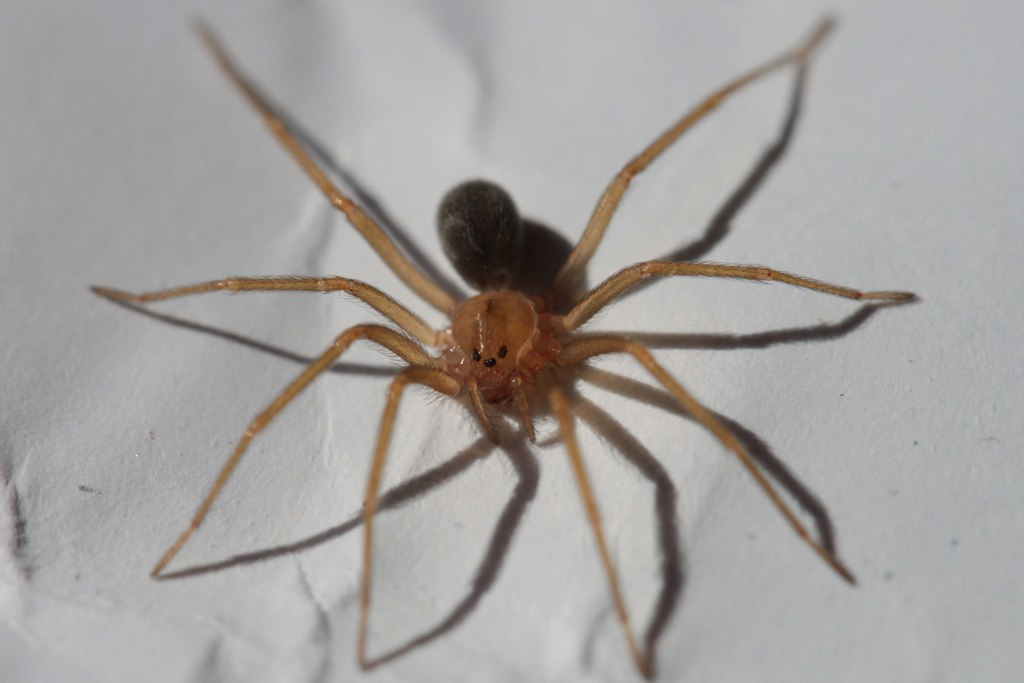
The recluse spiders (Loxosceles (/lɒkˈsɒsɪliːz/), also known as brown spiders, fiddle-backs, violin spiders, and reapers, are a genus of spiders that were first described by R. T. Lowe in 1832. They are venomous spiders known for their bite, which sometimes produces a characteristic set of symptoms known as loxoscelism.
Recluse spiders are now identified as members of the family Sicariidae, having formerly been placed in their own family, the Loxoscelidae. Although recluse spiders are feared, they are usually not aggressive.
Sicariidae are of the superfamily Scytodoidea. Other families in the Scytodoidea include Drymusidae, Scytodidae, and Periegopidae.
Spiders in this genus are found from North to South America, Oceania, Africa, Asia, and Europe.
Loxosceles is distributed nearly worldwide in warmer areas. All have six eyes arranged in three groups of two (dyads) and some are brownish with a darker brown characteristic violin marking on the cephalothorax. However, the "violin marking" cannot be used as a reliable way to identify the spider as many unrelated species of spider have similar markings. Recluses are typically about 7–12 mm long.
The most common and most famous species in the United States is the brown recluse spider (Loxosceles reclusa). It is found in a large area of the Midwest, west to Colorado and the New Mexico state line and east to northern Georgia. Sporadic records from other locations only represent incidental introductions, not established populations. The brown recluse feeds on whatever small prey is available, and has been observed to prefer scavenging over actively hunting. Other notable members of this genus include the Chilean recluse spider (L. laeta) and the Mediterranean recluse spider (L. rufescens).
Recently, concerns have been raised regarding recluses spreading faster due to warmer air carrying them farther as a result of changing climate. On the contrary, newly hatched recluses do not travel via ballooning and thus the populations are confined to very tight spaces with dense populations. Most Loxosceles can live for one and a half to two years.[contradictory] Many species of this genus can live for very long times without food or water. Insecticides often fail to kill the spider, instead intoxicating its nervous system and inducing erratic behavior.
Members of Loxosceles can be divided into two groups: the savanna or grassland species and the cave dwellers.
Hub AI
Recluse spider AI simulator
(@Recluse spider_simulator)
Recluse spider
The recluse spiders (Loxosceles (/lɒkˈsɒsɪliːz/), also known as brown spiders, fiddle-backs, violin spiders, and reapers, are a genus of spiders that were first described by R. T. Lowe in 1832. They are venomous spiders known for their bite, which sometimes produces a characteristic set of symptoms known as loxoscelism.
Recluse spiders are now identified as members of the family Sicariidae, having formerly been placed in their own family, the Loxoscelidae. Although recluse spiders are feared, they are usually not aggressive.
Sicariidae are of the superfamily Scytodoidea. Other families in the Scytodoidea include Drymusidae, Scytodidae, and Periegopidae.
Spiders in this genus are found from North to South America, Oceania, Africa, Asia, and Europe.
Loxosceles is distributed nearly worldwide in warmer areas. All have six eyes arranged in three groups of two (dyads) and some are brownish with a darker brown characteristic violin marking on the cephalothorax. However, the "violin marking" cannot be used as a reliable way to identify the spider as many unrelated species of spider have similar markings. Recluses are typically about 7–12 mm long.
The most common and most famous species in the United States is the brown recluse spider (Loxosceles reclusa). It is found in a large area of the Midwest, west to Colorado and the New Mexico state line and east to northern Georgia. Sporadic records from other locations only represent incidental introductions, not established populations. The brown recluse feeds on whatever small prey is available, and has been observed to prefer scavenging over actively hunting. Other notable members of this genus include the Chilean recluse spider (L. laeta) and the Mediterranean recluse spider (L. rufescens).
Recently, concerns have been raised regarding recluses spreading faster due to warmer air carrying them farther as a result of changing climate. On the contrary, newly hatched recluses do not travel via ballooning and thus the populations are confined to very tight spaces with dense populations. Most Loxosceles can live for one and a half to two years.[contradictory] Many species of this genus can live for very long times without food or water. Insecticides often fail to kill the spider, instead intoxicating its nervous system and inducing erratic behavior.
Members of Loxosceles can be divided into two groups: the savanna or grassland species and the cave dwellers.
Recent media