



Community hub
Recent from talks
Knowledge base stats:
Talk channels stats:
Members stats:
Red Rocks Amphitheatre
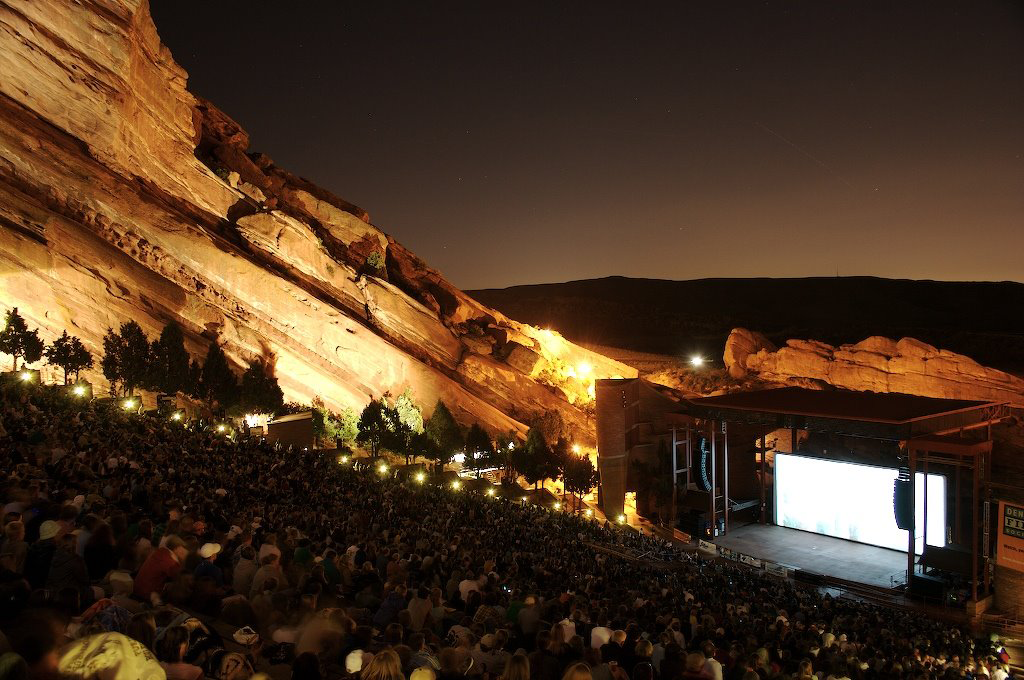
Red Rocks Amphitheatre (also known colloquially Red Rocks) is an open-air amphitheater near Morrison, Colorado, approximately ten miles (16 km) southwest of Denver. It is owned and operated by the city of Denver. In addition to several other large sandstone formations nearby, the venue is best recognized by its two massive monoliths, named "Ship Rock" and "Creation Rock", as well as the smaller "Stage Rock", which together flank its 9,525 capacity seating area and naturally form the amphitheater. While the venue is primarily known for hosting concerts and music festivals, other events of various types and sizes are held throughout the year.
In 1957, the American Institute of Architects selected Red Rocks to be Colorado's entry at the National Gallery of Art for the AIA's Centennial Exhibition. In 1999, after Pollstar magazine awarded Red Rocks the annual honor of being the best small outdoor venue for the eleventh time, the magazine changed the name of the award to the "Red Rocks Award" and removed Red Rocks from the running.
Construction began in October 2020 to replace the existing stage roof and expand the structure's rigging capacity; the work was completed the following summer.
The natural features surrounding the amphitheater were formed millions of years ago as part of the Fountain Formation, then lifted and tilted during a geological upheaval event called the Laramide Orogeny, the same time in which the nearby Garden of the Gods and Flatirons were formed. The characteristic reddish colors of the rock formations is the result of oxidized minerals.
While the grounds were likely used by the Ute tribe in earlier times, an Army expedition led by Stephen Long rediscovered present-day Red Rocks in 1820. The prevalence of the nearby Colorado gold rush between 1858–1859 drew further interest from prospectors and new settlers along the Front Range. Originally named the "Garden of the Angels", Marion Burts became the first recorded owner of the site in 1872. He sold it to Leonard H. Eicholtz, who in turn developed the property into a park in 1878. Nearly 30 years later, Eicholtz sold Red Rocks to famed magazine editor John Brisben Walker in 1906.
The site was renamed to "Garden of the Titans" and further developed to incorporate a temporary platform for hosting concerts from. In addition to the platform, Walker also built the Mount Morrison Cable Incline funicular railway, which carried tourists from the lower area of the park up to the top of Mount Morrison. The incline operated for about five years beginning in 1909. In 1927, George Cranmer, Manager of Denver Parks, convinced the City of Denver to purchase the area of Red Rocks from Walker for $54,133 ($1,014,994 today), officially adopting the title of "Red Rocks" Amphitheatre, a name it had been informally referred to since the area was settled.
Cranmer then convinced Mayor Benjamin Stapleton to build upon the foundation laid by Walker. By enlisting the help of Denver architect Burnham F. Hoyt and Stanley E. Morse, along with labor and materials provided by the Civilian Conservation Corps (CCC) and the Works Progress Administration (WPA) as part of the New Deal program, construction of the amphitheater began in 1936 and was formally dedicated on June 15, 1941, with a performance by Helen Jepson.
Public, organizational and private performances have been held at Red Rocks for over a century. The earliest documented performance at the amphitheater was the Grand Opening of the Garden of the Titans, put on by publisher John Brisben Walker on May 31, 1906. Featuring Pietro Satriano and his 25-piece brass band, it was the formal opening of the natural amphitheater for use by the general public after Walker purchased it with the proceeds of his sale of Cosmopolitan.
Hub AI
Red Rocks Amphitheatre AI simulator
(@Red Rocks Amphitheatre_simulator)
Red Rocks Amphitheatre
Red Rocks Amphitheatre (also known colloquially Red Rocks) is an open-air amphitheater near Morrison, Colorado, approximately ten miles (16 km) southwest of Denver. It is owned and operated by the city of Denver. In addition to several other large sandstone formations nearby, the venue is best recognized by its two massive monoliths, named "Ship Rock" and "Creation Rock", as well as the smaller "Stage Rock", which together flank its 9,525 capacity seating area and naturally form the amphitheater. While the venue is primarily known for hosting concerts and music festivals, other events of various types and sizes are held throughout the year.
In 1957, the American Institute of Architects selected Red Rocks to be Colorado's entry at the National Gallery of Art for the AIA's Centennial Exhibition. In 1999, after Pollstar magazine awarded Red Rocks the annual honor of being the best small outdoor venue for the eleventh time, the magazine changed the name of the award to the "Red Rocks Award" and removed Red Rocks from the running.
Construction began in October 2020 to replace the existing stage roof and expand the structure's rigging capacity; the work was completed the following summer.
The natural features surrounding the amphitheater were formed millions of years ago as part of the Fountain Formation, then lifted and tilted during a geological upheaval event called the Laramide Orogeny, the same time in which the nearby Garden of the Gods and Flatirons were formed. The characteristic reddish colors of the rock formations is the result of oxidized minerals.
While the grounds were likely used by the Ute tribe in earlier times, an Army expedition led by Stephen Long rediscovered present-day Red Rocks in 1820. The prevalence of the nearby Colorado gold rush between 1858–1859 drew further interest from prospectors and new settlers along the Front Range. Originally named the "Garden of the Angels", Marion Burts became the first recorded owner of the site in 1872. He sold it to Leonard H. Eicholtz, who in turn developed the property into a park in 1878. Nearly 30 years later, Eicholtz sold Red Rocks to famed magazine editor John Brisben Walker in 1906.
The site was renamed to "Garden of the Titans" and further developed to incorporate a temporary platform for hosting concerts from. In addition to the platform, Walker also built the Mount Morrison Cable Incline funicular railway, which carried tourists from the lower area of the park up to the top of Mount Morrison. The incline operated for about five years beginning in 1909. In 1927, George Cranmer, Manager of Denver Parks, convinced the City of Denver to purchase the area of Red Rocks from Walker for $54,133 ($1,014,994 today), officially adopting the title of "Red Rocks" Amphitheatre, a name it had been informally referred to since the area was settled.
Cranmer then convinced Mayor Benjamin Stapleton to build upon the foundation laid by Walker. By enlisting the help of Denver architect Burnham F. Hoyt and Stanley E. Morse, along with labor and materials provided by the Civilian Conservation Corps (CCC) and the Works Progress Administration (WPA) as part of the New Deal program, construction of the amphitheater began in 1936 and was formally dedicated on June 15, 1941, with a performance by Helen Jepson.
Public, organizational and private performances have been held at Red Rocks for over a century. The earliest documented performance at the amphitheater was the Grand Opening of the Garden of the Titans, put on by publisher John Brisben Walker on May 31, 1906. Featuring Pietro Satriano and his 25-piece brass band, it was the formal opening of the natural amphitheater for use by the general public after Walker purchased it with the proceeds of his sale of Cosmopolitan.