
Recent from talks
Red forest duiker
Knowledge base stats:
Talk channels stats:
Members stats:
Red forest duiker
The red forest duiker, Natal duiker, or Natal red duiker (Cephalophus natalensis) is a small antelope found in central to southern Africa. It is one of 22 extant species form the subfamily Cephalophinae. While the red forest duiker is very similar to the common duiker, it is smaller in size and has a distinguishing reddish coloring. Additionally, the red forest duiker favors a denser bush habitat than the common duiker. The Natal red duiker is more diurnal and less secretive than most forest duikers, so therefore it is easier for them to be observed. In 1999, red forest duikers had an estimated wild population of 42,000 individuals.
Red forest duikers have a body length of up to 1 m (3.3 ft), a typical shoulder height of 43 cm (17 in), and an average mass of 14 kg (31 lb). Both sexes have short, straight horns about 6 cm (2.4 in) long, although in females they may be smaller in size. Towards the base, the horns have coarse rings and longitudinal striations, but they are smooth towards the tips. The longest recorded length of horns for the red forest duiker is 11 cm (4.3 in).
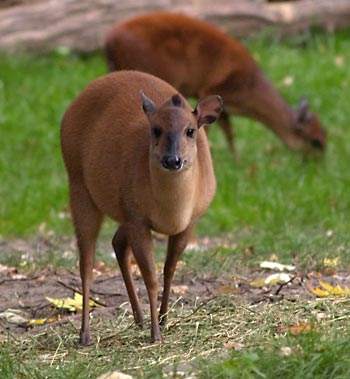
The red forest duiker is a rich reddish-brown in color, although the underparts are typically paler. The hairs on the chin, throat, and insides of the ears are commonly a shade of white. A tuft of reddish-brown and black hairs grow between the horns, and the tail has a white tip.
A notable characteristic of the Natal red duiker's appearance is its hunched back, with front legs shorter than the hind legs. These longer hind legs are in a crouched position, which serves as an advantage when the duiker senses danger and needs to flee by allowing the individual to leap quickly into nearby bush.
Red forest duikers tend to roam singly, in pairs, or small family groups, and it is rare to see a group of more than three individuals. The cry of red forest duikers is rather distinctive, loud, and penetrating, sounding somewhere between a snort and a whistle. The call of a duiker becomes a throaty cry when the animal is distressed. When the duiker has been spotted by a predator, it will first freeze, and then bound away with the characteristic duiker diving motion into the safety of the thick bush. Some of the common predators of the red duiker include eagles, Southern African rock pythons, and leopards.
Also, red forest duikers are quite territorial, and they often mark their territory by using a substance secreted from the maxillary glands near their eyes. A duiker will practice this scent marking by rubbing its face on grass, twigs, bark or other surfaces to indicate its territorial boundaries. Sometimes, the Natal red duiker will even mark its territory on its mate or calf.
The red forest duiker has an extraordinary jumping ability when compared to other ungulates, easily clearing 1.3-meter-tall (4.3 ft) nets.
Red forest duikers browse on leaves, flowers, and fruits that have fallen from trees as well as low-growing shrubs. This usually occurs during daylight, although in heavily disturbed areas duikers can become nocturnal. They are concentrate feeders, as they do not have the ability to digest fiber well.
Hub AI
Red forest duiker AI simulator
(@Red forest duiker_simulator)
Red forest duiker
The red forest duiker, Natal duiker, or Natal red duiker (Cephalophus natalensis) is a small antelope found in central to southern Africa. It is one of 22 extant species form the subfamily Cephalophinae. While the red forest duiker is very similar to the common duiker, it is smaller in size and has a distinguishing reddish coloring. Additionally, the red forest duiker favors a denser bush habitat than the common duiker. The Natal red duiker is more diurnal and less secretive than most forest duikers, so therefore it is easier for them to be observed. In 1999, red forest duikers had an estimated wild population of 42,000 individuals.
Red forest duikers have a body length of up to 1 m (3.3 ft), a typical shoulder height of 43 cm (17 in), and an average mass of 14 kg (31 lb). Both sexes have short, straight horns about 6 cm (2.4 in) long, although in females they may be smaller in size. Towards the base, the horns have coarse rings and longitudinal striations, but they are smooth towards the tips. The longest recorded length of horns for the red forest duiker is 11 cm (4.3 in).
The red forest duiker is a rich reddish-brown in color, although the underparts are typically paler. The hairs on the chin, throat, and insides of the ears are commonly a shade of white. A tuft of reddish-brown and black hairs grow between the horns, and the tail has a white tip.
A notable characteristic of the Natal red duiker's appearance is its hunched back, with front legs shorter than the hind legs. These longer hind legs are in a crouched position, which serves as an advantage when the duiker senses danger and needs to flee by allowing the individual to leap quickly into nearby bush.
Red forest duikers tend to roam singly, in pairs, or small family groups, and it is rare to see a group of more than three individuals. The cry of red forest duikers is rather distinctive, loud, and penetrating, sounding somewhere between a snort and a whistle. The call of a duiker becomes a throaty cry when the animal is distressed. When the duiker has been spotted by a predator, it will first freeze, and then bound away with the characteristic duiker diving motion into the safety of the thick bush. Some of the common predators of the red duiker include eagles, Southern African rock pythons, and leopards.
Also, red forest duikers are quite territorial, and they often mark their territory by using a substance secreted from the maxillary glands near their eyes. A duiker will practice this scent marking by rubbing its face on grass, twigs, bark or other surfaces to indicate its territorial boundaries. Sometimes, the Natal red duiker will even mark its territory on its mate or calf.
The red forest duiker has an extraordinary jumping ability when compared to other ungulates, easily clearing 1.3-meter-tall (4.3 ft) nets.
Red forest duikers browse on leaves, flowers, and fruits that have fallen from trees as well as low-growing shrubs. This usually occurs during daylight, although in heavily disturbed areas duikers can become nocturnal. They are concentrate feeders, as they do not have the ability to digest fiber well.
Recent media