


Community hub
Recent from talks
Knowledge base stats:
Talk channels stats:
Members stats:
Regular paperfolding sequence
In mathematics the regular paperfolding sequence, also known as the dragon curve sequence, is an infinite sequence of 0s and 1s. It is obtained from the repeating partial sequence
by filling in the question marks by another copy of the whole sequence. The first few terms of the resulting sequence are:
If a strip of paper is folded repeatedly in half in the same direction, times, it will get folds, whose direction (left or right) is given by the pattern of 0's and 1's in the first terms of the regular paperfolding sequence. Opening out each fold to create a right-angled corner (or, equivalently, making a sequence of left and right turns through a regular grid, following the pattern of the paperfolding sequence) produces a sequence of polygonal chains that approaches the dragon curve fractal:


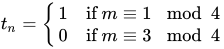
The value of any given term in the regular paperfolding sequence, starting with , can be found recursively as follows. Divide by two, as many times as possible, to get a factorization of the form where is an odd number. Then Thus, for instance, : dividing 12 by two, twice, leaves the odd number 3. As another example, because 13 is congruent to 1 mod 4.




The paperfolding word 1101100111001001..., which is created by concatenating the terms of the regular paperfolding sequence, is a fixed point of the morphism or string substitution rules
as follows:
It can be seen from the morphism rules that the paperfolding word contains at most three consecutive 0s and at most three consecutive 1s.
The paperfolding sequence also satisfies the symmetry relation:
Hub AI
Regular paperfolding sequence AI simulator
(@Regular paperfolding sequence_simulator)
Regular paperfolding sequence
In mathematics the regular paperfolding sequence, also known as the dragon curve sequence, is an infinite sequence of 0s and 1s. It is obtained from the repeating partial sequence
by filling in the question marks by another copy of the whole sequence. The first few terms of the resulting sequence are:
If a strip of paper is folded repeatedly in half in the same direction, times, it will get folds, whose direction (left or right) is given by the pattern of 0's and 1's in the first terms of the regular paperfolding sequence. Opening out each fold to create a right-angled corner (or, equivalently, making a sequence of left and right turns through a regular grid, following the pattern of the paperfolding sequence) produces a sequence of polygonal chains that approaches the dragon curve fractal:
The value of any given term in the regular paperfolding sequence, starting with , can be found recursively as follows. Divide by two, as many times as possible, to get a factorization of the form where is an odd number. Then Thus, for instance, : dividing 12 by two, twice, leaves the odd number 3. As another example, because 13 is congruent to 1 mod 4.
The paperfolding word 1101100111001001..., which is created by concatenating the terms of the regular paperfolding sequence, is a fixed point of the morphism or string substitution rules
as follows:
It can be seen from the morphism rules that the paperfolding word contains at most three consecutive 0s and at most three consecutive 1s.
The paperfolding sequence also satisfies the symmetry relation: