Hubbry Logo
RejectedRejectedMain
Open search
Rejected
Community hub
Rejected
logo
8 pages, 0 posts
0 subscribers
Be the first to start a discussion here.
Contribute something
Rejected
Rejected
from Wikipedia

Rejected
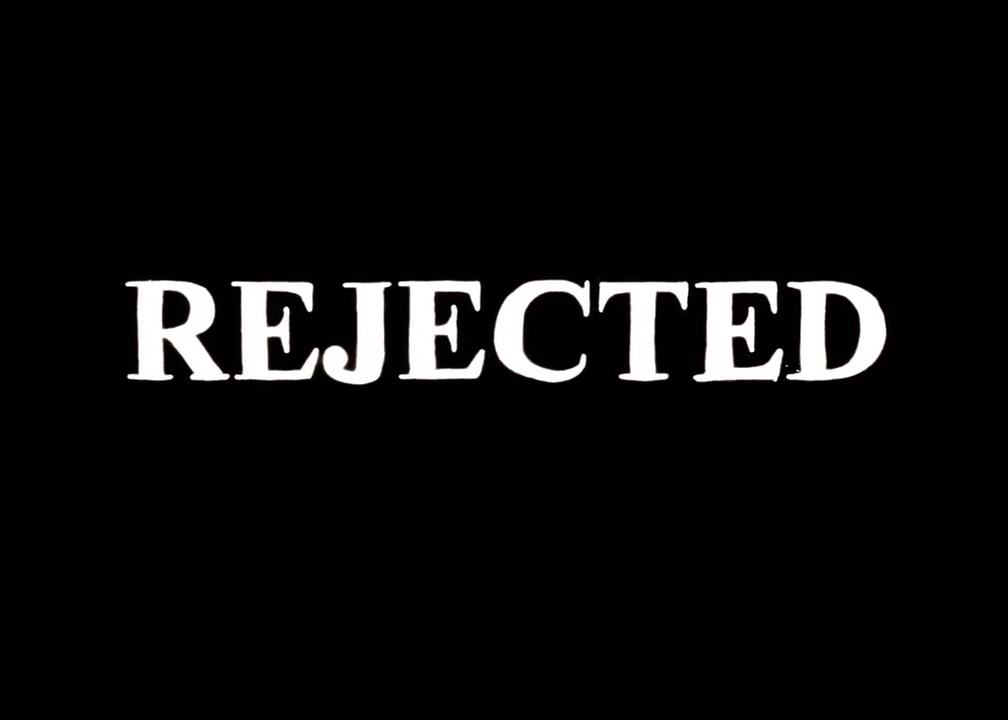
The film's title card
Directed byDon Hertzfeldt
Written byDon Hertzfeldt
Produced byDon Hertzfeldt
Starring
  • Robert May
  • Jennifer Nyholm
  • Don Hertzfeldt
CinematographyDon Hertzfeldt
Edited byRebecca Moline
Production
company
Release date
  • 25 July 2000 (2000-07-25)
Running time
9 minutes
CountryUnited States
LanguageEnglish

Rejected is an animated surrealist short comedy film directed by Don Hertzfeldt that was released in 2000. It was nominated for an Academy Award for Best Animated Short Film the following year at the 73rd Academy Awards,[1] and received 27 awards from film festivals around the world.[2]

Story

[edit]
Rejected makes heavy use of surreal humor, such as in this scene that uses a giant spoon and an anthropomorphic banana to advertise the Family Learning Channel.

The film takes place over four segments and is initially introduced as a collection of unaired promo interstitials for the fictional "Family Learning Channel." The "advertisements" are surreal, feature non-human characters, are often gruesome, and have nothing to do with the product. The second section is introduced as a collection of rejected advertisements for the fictional "Johnson & Mills Corporation" and features the same surreal dark and absurd humour as the earlier section. The third section is introduced with an explanation that the animator had begun further rejecting the norms of animation and a single shot is then shown which was apparently animated with Hertzfeld's left hand only. In this short, the audio is garbled and the characters speak only complete nonsense.

The fourth and final segment is introduced with a title card explaining that the "rejected" cartoons began falling apart. Various characters and elements from the earlier shorts then appear in disjointed succession as their world literally falls apart: clouds and stars fall from the sky, killing characters; the paper the cartoons are drawn on crumples and destroys the animations; characters attempt to break out of the screen or are sucked into holes in the page. A close-up of a distorted, screaming character ends the short which abruptly cuts to end credits scored with dramatic classical music.

Production

[edit]

Hertzfeldt's first film after graduating from college, Rejected was photographed on a 35mm rostrum camera he purchased in 1999.

Rejected features simple hand-drawn artwork, featuring mostly black pen animation on a white background with occasional use of color. As the film progresses and the fictionalized animator begins to fall apart, the drawings become more crude and the animation becomes more erratic. As the film concludes, the paper the animation is drawn on begins to crumple and tear, and the characters are seen struggling to evade the destruction.

Besides the iconic Allegro ma non-troppo from Beethoven's 9th that plays in the text introductions to each segment, a particular segment with the "Fluffy Guys" uses background music from the Swedish Christmas song Nu är det jul igen.

Inspiration

[edit]
Rejected's advertisements poke fun at consumerism.

Although the film is fictional and Hertzfeldt has never done any advertising work,[3] he did receive many offers to do television commercials after Billy's Balloon received international attention and acclaim. In appearances, he would often tell the humorous story of how he was tempted to produce the worst possible cartoons he could come up with for the companies, run off with their money, and see if they would actually make it to air. Eventually, this became the germ for Rejected's theme of a collection of cartoons so bad they were rejected by advertising agencies, leading to their creator's breakdown.

Hertzfeldt has never accepted "real" advertising work and has stated numerous times on his website and in public appearances that he never will, as he feels advertisements are "lies" and he does not want to lie to his audience.[4]

Release

[edit]

Exhibition history

[edit]

Rejected world-premiered at the San Diego Comic Convention in 2000. Between hundreds of film festival appearances, Rejected also toured North American theaters in 2000, 2001, and 2002 with Spike and Mike's Festival of Animation; in 2001 and 2002 again with a retrospective touring program of Hertzfeldt's and animator Bill Plympton's films called "The Don and Bill Show"; and returned to theaters once again in 2003 and 2004 with Hertzfeldt's own the Animation Show tour.[2]

Released nationwide in theaters through the Spike and Mike's Festival of Animation in 2000, the short won 27 film festival awards and was nominated for an Oscar for Best Animated Short Film the following year.

In the early 2000s, pirated copies of Rejected turned the film into a viral sensation online, where it has been credited with shaping the surreal sense of humor of the early Internet.[5][6]

In 2003, two of the "Fluffy Guy" characters reappeared in three Hertzfeldt cartoons created to introduce and bookend the first year of the Animation Show: Welcome to the Show, Intermission in the Third Dimension, and the End of the Show.[7] The two characters appeared again in 2025, in a new pair of bookend cartoons, to introduce the Hertzfeldt-curated theatrical program Animation Mixtape.

Rejected was scheduled to air on Adult Swim in 2001 but was delayed for unknown reasons—it was rescheduled to air on November 3, 2002 "uncut and commercial free",[8] and was heavily promoted on the network that week. However, the short was pulled from the schedule at the last minute, for unknown reasons. Rumors about the reasons behind this highly unusual action have included: the film's brief use of the phrase "Sweet Jesus" ("Jesus" being a word allegedly not allowed on a Turner Network back then), and an anonymous high-ranking network executive simply not finding the short to be funny. Rejected has since aired without incident on the Cartoon Network in other countries as well as on other international television networks, but has to date never been broadcast on American television.[2] However, a brief clip from the film has since aired on the Adult Swim anthology series Off the Air, 14 years later, in the episode "Holes". The scene mentioned in the episode is the scene with the "fluffy guys" in which one announces that his "anus is bleeding."[9]

In 2020, for the film's twentieth anniversary, Hertzfeldt appeared at the Austin Film Society for a rare 35mm screening and discussed the making of the cartoon and its impact.[10]

DVD and Blu-ray

[edit]

In 2001 Bitter Films released a limited edition DVD "single" of the short film. The DVD "single" featured a deleted scene as well as an audio commentary, and is now out of print.

In 2006, Rejected was remastered and restored for inclusion on the DVD, "Bitter Films Volume 1", a compilation of Don Hertzfeldt's short films from 1995–2005. Special features on this DVD relating to Rejected included a new text commentary by Hertzfeldt (via closed-caption boxes), footage from the abandoned cartoon "The Spanky the Bear Show" that later evolved into a central scene in the film, original pencil tests, the 2001 audio commentary, and dozens of pages devoted to Hertzfeldt's original sketches, storyboards, notes, and deleted ideas from the film.

In 2015, the cartoon was remastered again, this time in high definition, for inclusion on the Blu-ray of It's Such a Beautiful Day.

A 35-second deleted scene from Rejected was only released on the 2001 DVD "single". In it, a father inquires into his son's desire to drink goat's blood. The scene appears to fit in with the "Johnson & Mills" portion of the original film and is revealed to be an advertisement for cotton swabs at the end.

Legacy

[edit]

Rejected is now considered a cult classic and one of the most influential animated films ever made.[11][12]

In the early 2000s, pirated copies of Rejected turned the film into a viral video, where it has been credited with shaping the surreal sense of humor of the early Internet.[11][13][14][15] In 2018 New York magazine wrote, "If there is a single piece of media that inspired what we nebulously refer to as "Internet humor," it's probably Rejected", additionally citing it as "the cartoon that invented Internet culture."[14]

In 2009, Rejected was the only short film named as one of the "Films of the Decade" by Salon.[16] In 2010, it was noted as one of the five "most innovative animated films of the past ten years" by The Huffington Post.[17] Indiewire film critic Eric Kohn named Rejected one of the "10 best films of the 21st century" on his list for the BBC Culture poll in 2016.[18]

[edit]
  • A fan of the film, quoting, "I am the Queen of France!" appeared on the Late Show with David Letterman.[19]
  • The alternate dimension scenes from the Aqua Teen Hunger Force episode "Broodwich" were an acknowledged homage to Don Hertzfeldt. Hertzfeldt's films, and Rejected in particular, were a strong early influence on Adult Swim writers and Aqua Teen creators Matt Maiellaro and Dave Willis.[20]
  • A 2013 episode of the Fine Brothers' web series YouTubers React featured Rejected.[21]
  • The introduction section of the 2006 video game Prey features a crude scrawling in the room's bathroom that is a direct reference to the first sketch; "My spoon is too big."[22]
  • Musician Neil Cicierega's album Hip to the Javabean features a song titled "Consumer Whore", which is named after a line from the short film. The response line, "And how!" crosses over into the next track, "Between You and Me".
  • In the first episode of the 26th season of The Simpsons, Clown in the Dumps, the opening couch gag was created by Don Hertzfeldt. Rejected established the roots of a dystopia by consumerism style of satire through the guise of rejected advertisements; this shortcuts directly to the point. It depicts Homer using a time-traveling remote control to regress to his original 1987 character model, then accidentally going into a distant future incarnation of the show called The Sampsans where he and his family have evolved into grotesque, mindless, catchphrase-spouting mutants. Carey Bodenheimer of CNN wrote: "[The Simpsons] kicked off season 26 with a staggering, Don Hertzfeldt-directed intro sequence."
  • The infamous "My anus is bleeding" scene was featured in the Off the Air episode "Holes".

See also

[edit]

References

[edit]
[edit]
Revisions and contributorsEdit on WikipediaRead on Wikipedia
from Grokipedia

Rejected is a surrealist animated short comedy film written, directed, and animated by Don Hertzfeldt, released in 2000 as his third independent short film produced under Bitter Films. The nine-minute work depicts an animator pitching increasingly absurd and violent television commercials that are rejected by network executives, leading to a meta-narrative breakdown of the film's own animated reality and the creator's fracturing psyche. Crafted by the then-23-year-old Hertzfeldt using traditional 35mm film photography, cutout animation, and hand-drawn elements, it exemplifies his minimalist yet chaotic style blending dark humor, non-sequiturs, and existential absurdity.
The film garnered critical acclaim for its innovative deconstruction of advertising tropes and animation boundaries, earning an Academy Award nomination for Best Animated Short Film at the 73rd ceremony in 2001, though it lost to Michael Dudok de Wit's . It secured 27 additional international festival awards, establishing Hertzfeldt as a prominent independent animator and contributing to his reputation for boundary-pushing work that critiques commercial media while exploring themes of mental instability. Rejected has since achieved status, influencing subsequent animators and remaining a staple in discussions of surreal , with a 2015 4K restoration highlighting its enduring technical and artistic merit despite the original's labor-intensive production.

Plot Summary

Synopsis

The film opens with a series of rejected commercial pitches animated in a rudimentary stick-figure style, beginning with promotions for featuring simplistic characters and taglines like endorsements of strength and , overlaid with handwritten "REJECTED" stamps. These initial segments quickly escalate in , transitioning to pitches for pain relievers that depict characters enduring agony before surreal, ineffective resolutions, such as distorted remedies and violent outbursts, similarly marked for dismissal. The narrative shifts to the animator—a fictional self-portrait—experiencing a breakdown amid the rejections, conveyed through on-screen handwritten text declaring "My brain hurts" and visual cues of mounting frustration, including erratic line work and fading coherence. Animated figures start disintegrating, their forms warping and dissolving into abstract shapes, accompanied by motifs of pain and dismissal repeating across the frame. The sequence builds to a climax of chaotic existential rants, with overlaid text and voice elements ranting about purpose, suffering, and rejection, as the entire constructed world collapses in a frenzy of melting entities, fragmented stop-motion inserts, and experimental distortions, culminating in total animated void.

Interpretations

Viewers and critics frequently interpret Rejected as a critiquing the rigid demands of commercial and the creative compromises required to meet client expectations, with the escalating reflecting the animator's rebellion against such constraints. has described the work as exposing his own reluctance to produce advertising content, emphasizing personal artistic expression over commodified output like commercials for everyday products. feedback, including user reviews aggregating thousands of responses, highlights its humor in portraying rejected pitches devolving into chaos, often citing the animator's on-screen pleas—such as demands for more "cancer"—as emblematic of frustration with formulaic briefs. Alternative interpretations frame the narrative as a depiction of artistic burnout, where repeated rejections culminate in mental disintegration, prefiguring Hertzfeldt's subsequent films like the 2000s (It's Such a Beautiful Day series), which explore existential despair through similar stick-figure protagonists. This view draws empirical support from the film's structure, where initial commercial vignettes fracture into non-sequiturs, mirroring documented experiences of deadline-induced exhaustion in independent production accounts. Some readings emphasize existential , interpreting the universe's collapse as commentary on the futility of imposed , though Hertzfeldt's commentary underscores a more grounded origin in real-world pitch rejections rather than abstract philosophy. Self-reflexive elements further blur distinctions between creator and character, as the animator's visible interventions—erasing and redrawing figures—invite audiences to see Hertzfeldt's hand in the breakdown, fostering interpretations of the film as a meta-critique on animation's labor-intensive process. Critics note this technique anticipates expressionist styles in Hertzfeldt's oeuvre, where formal constraints amplify thematic rupture without relying on psychological speculation. Claims of deeper social or political commentary, such as allegories for institutional beyond , lack substantiation in Hertzfeldt's statements or contemporaneous reviews, which consistently center on industry-specific ; no primary evidence from the creator or production notes supports broader ideological intent.

Production

Development and Inspiration

Don Hertzfeldt conceived Rejected as an independent animation project in 1999, completing it in late 2000 shortly after graduating from the . At age 20, he drew upon his growing disillusionment with the demands of commercial animation, channeling frustrations from early pitches and the pressure to produce marketable content into a satirical of increasingly unhinged rejected advertisements. The film's core concept—a parade of absurd, client-repelling spots for products like "Family Learning Channel" segments—mirrored Hertzfeldt's aversion to compromising artistic integrity for corporate gigs, a theme he has described as embodying a "big mass of frustration" with consumerist expectations in the industry. Lacking any studio backing, Hertzfeldt self-financed the endeavor using rudimentary tools, including paper, pens, and a 35mm camera for frame-by-frame production, which underscored his DIY approach and rejection of mainstream production pipelines. This followed his earlier short Billy's Balloon (1998), which had earned acclaim but did not lead him toward commercial opportunities; instead, Rejected amplified his commitment to personal expression over lucrative work, despite subsequent offers he declined. The evolving ideas stemmed from discarded sketches and concepts initially explored as student exercises, which coalesced into a critique of how creative pitches devolve under client feedback, without reliance on external funding or collaborators.

Animation Process

The animation of Rejected employed traditional hand-drawn techniques on paper, with Don Hertzfeldt creating each frame individually using pen and pencil to produce the film's simple line-based stick-figure characters and backgrounds. The process required drawing thousands of frames at approximately 12 drawings per second of screen time, resulting in roughly 720 unique images per minute for the 9-minute short. Hertzfeldt handled all aspects of the animation solo, without assistants, inking lines directly on paper rather than using celluloid cels for transparency. Frames were exposed sequentially under a 35mm Richardson animation camera stand in Hertzfeldt's home workshop, one of the last operational models of its kind, capturing the artwork directly onto for an analog workflow that avoided digital tools during principal production. This setup allowed for precise control over exposure and registration, essential for the film's boiling line quality and subtle variations in character movement. and occurred on film, with optical techniques employed to layer elements and achieve the surreal distortions, such as ink bleeding and structural breakdowns, through manual frame manipulations and multiple passes. The labor-intensive production spanned approximately one year, from 1999 to 2000, involving continuous drawing and shooting sessions that Hertzfeldt managed independently to maintain full artistic control. This handmade approach, rooted in pre-digital practices, contributed to the film's raw, imperfect aesthetic, with the original 35mm negative later serving as the basis for high-resolution restorations.

Technical Challenges

Don Hertzfeldt produced Rejected entirely by himself using traditional hand-drawn techniques on paper with pens and paint, eschewing digital tools and computers to maintain full creative control in his home workshop. This solitary approach, necessitated by limited funding, contrasted sharply with the large crews and specialized departments typical in Hollywood animation studios, where teams handle separate stages like storyboarding, inbetweening, and compositing. Instead, Hertzfeldt operated an antique 35mm Richardson animation camera stand—originally used for productions like the Peanuts specials—to shoot each frame, allowing real-time experimentation such as incorporating flashlights for lighting effects and simple props for added depth, which contributed to the film's raw, unpolished aesthetic. The physical demands of frame-by-frame drawing and shooting imposed significant repetitive strain, with Hertzfeldt logging what he described as "millions of hours" at his desk over the production period. Animating the film's comedic sequences proved particularly exhausting, as initial enthusiasm waned after about two weeks, leaving months of monotonous labor that risked diminishing the spontaneity of the humor. These constraints amplified the artisanal quality of the visuals, where imperfections like inconsistent line work and minimal color flashes—achieved without advanced optical available in digital workflows—enhanced the surreal, deteriorating style symbolizing the protagonist's mental unraveling. Pre-digital era limitations further shaped the output, as reliance on 35mm precluded easy corrections or complex effects, forcing resourceful shortcuts like multi-purpose that prioritized authenticity over seamless polish. Hertzfeldt has noted that projects like Rejected would have been infeasible without this analog medium, underscoring how budget-driven improvisation yielded a distinctive, imperfect realism praised for its directness amid the era's shift toward computer-generated .

Themes and Style

Core Themes

The film's central critique targets the corporate rejection cycle as a systemic barrier to artistic integrity, where iterative demands for marketable content compel creators to dilute originality in favor of , culminating in professional and personal disintegration. This is manifested through the animator's progression from conventional pitches to surreal deviations, highlighting how commercial gatekeeping fosters and alienation rather than . Hertzfeldt has described Rejected as embodying his aversion to such compromises, viewing advertising commissions as antithetical to genuine expression, with "nothing to express about paper towels or tampons." Implicitly, sequences evoking existential dread and bodily decay—such as motifs of fatigue, malfunction, and perceptual distortion—metaphorize the visceral pains of creative labor, portraying rejection not merely as professional setback but as an erosive force on the psyche. These elements reject sanitized, uplifting narratives prevalent in commercial media, instead unfiltered frailty, , and the of persistence amid futility. The work thus privileges raw, unpolished experience over engineered optimism, aligning with Hertzfeldt's stated prioritization of intuitive personal art over formulaic output. Hertzfeldt's real-life rejection of lucrative mainstream advertising deals following Rejected's 2000 release empirically reinforces this anti-commercial posture; despite influxes of offers post its Academy Award nomination, he declined them to self-fund independent projects like The Meaning of Life (2005), preserving autonomy from industry constraints. This stance affirms the film's implicit warning against commercialism's corrosive incentives, which prioritize profitability over uncompromised creativity, as evidenced by his ongoing eschewal of such work into the 2010s.

Artistic Techniques

The minimalist stick-figure aesthetic of Rejected utilizes rudimentary line drawings and limited color palettes, primarily black ink on white backgrounds, to evoke a sense of raw that causally intensifies the film's descent into surreal horror by stripping away visual polish and exposing the fragility of the animated form itself. This approach contrasts sharply with the emerging dominance of in late-1990s animation, where hyper-realistic rendering often dilutes thematic unease; here, the handmade imperfections—such as shaky lines and inconsistent proportions—mirror the animator's fictional mental collapse, making the breakdown feel viscerally immediate rather than abstracted. Sound design employs sparse, monotone —performed by director himself—and minimalistic scoring with dissonant tones and abrupt silences to build escalating tension, where the DIY recording quality (using basic and no gloss) amplifies auditory discomfort akin to the visuals' crudeness. These elements causally reinforce thematic chaos by forgoing orchestral swells or synchronized effects typical of commercial shorts, instead leveraging phonetic repetition (e.g., characters' looping non-sequiturs like "My spoon is too big") to transition from absurd humor to auditory overload, evoking a loss of narrative control. Pacing techniques feature quick, staccato cuts interspersed with prolonged static holds and iterative motifs, initially fostering comedic through rapid-fire vignettes but gradually slowing into , nightmarish stasis that causally underscores the theme of creative by trapping viewers in cycles of degradation. This repetition, drawn from precedents emphasizing structural breakdown over linear progression, heightens psychological impact without relying on complex editing software, as Hertzfeldt animated frame-by-frame on paper before basic digital compositing. Influences from traditions, such as Gary Larson's single-panel , inform this restraint, prioritizing conceptual punch over elaborate motion to sustain the film's critique of commercial dilution.

Release

Festival Premiere

Rejected premiered at the on January 18, 2001, marking its first public screening to critical acclaim within circles. The short subsequently toured dozens of international in 2001, including the Indie Film Festival where it captured the Grand Jury Prize for Best . These screenings generated significant early buzz among animation aficionados, fostering a cult following through word-of-mouth in an era before ubiquitous high-speed enabled viral dissemination. Over the course of its festival run in 2000 and 2001, Rejected amassed 27 awards from various competitions, with a notable emphasis on audience prizes that reflected its comedic appeal and innovative style. The film's success culminated in a nomination for Best Animated at the held on March 25, 2001, positioning Hertzfeldt as a rising talent in despite not securing the win. This festival circuit validation underscored the short's resonance with niche audiences, highlighting its surreal humor and technical ingenuity prior to wider theatrical and digital exposure.

Distribution and Home Media

Rejected received no wide theatrical release, as its nine-minute runtime limited commercial viability for standalone distribution; instead, post-festival availability emphasized independent home media channels managed by Hertzfeldt's Bitter Films. The short was first issued on DVD by Bitter Films around 2002, initially as a standalone release before inclusion in compilations. In 2006, it appeared on the Bitter Films Volume 1: 1995-2005 DVD, gathering Hertzfeldt's early works up to The Meaning of Life. A high-definition remaster, scanned at 4K from the original 35mm elements, was produced in 2015 for the Blu-ray edition of It's Such a Beautiful Day, which bundled Rejected with other restored shorts including Wisdom Teeth and student films Billy's Balloon and Lily and Jim. In November 2018, Hertzfeldt uploaded this 4K version to his YouTube channel free of charge, amassing millions of views and enhancing accessibility beyond physical media. The film remains streamable on Vimeo On Demand, supporting direct purchases or rentals while underscoring its endurance via creator-led digital platforms absent major studio involvement.

Reception

Critical Reviews

Critics acclaimed Rejected for its bold originality and surreal humor, with outlets describing creator Don Hertzfeldt's style as both "hilarious" and emblematic of a "psychopath"-like intensity in . The film's structure—framed as rejected commercials devolving into existential chaos—was praised for maximizing impact through minimalist hand-drawn techniques and non-sequitur gags, earning an Academy Award nomination that underscored its artistic innovation over conventional appeal. This recognition countered perceptions of niche abrasiveness, as the work's chaotic energy and disturbing undertones, such as hallucinatory breakdowns, were viewed as deliberate risks that elevated it beyond typical shorts. Early 2000s coverage highlighted the 's prescient alignment with emerging online distribution, positioning it as a proto-viral phenomenon that anticipated animation's dominance through shareable absurdity. While some critiques noted its potential to alienate with unrelenting intensity—lacking narrative cohesion for broader audiences—the empirical metrics of prizes and digital proliferation affirmed its merit as uncompromised experimentation rather than mere provocation. Retrospective analyses reinforce this, emphasizing how Rejected's rejection motif mirrored Hertzfeldt's independent , prioritizing raw creativity over commercial polish.

Audience Response

Rejected achieved early grassroots popularity through festival screenings in 2000, fostering a via word-of-mouth among attendees drawn to its subversive humor. Prior to widespread streaming platforms, the short circulated via bootleg copies and downloads, marking it as one of the most pirated independent animations of its era. Its commercial DVD release in 2001 amplified this underground spread, appealing particularly to viewers appreciative of dark, non-conformist comedy akin to early or content. The film's absurd sequences and lines, such as exploding character heads and exclamations like "A monkey poured coffee in my boots!", evolved into persistent online memes and GIFs, maintaining relevance among users into the 2020s. This viral endurance stems from sharing rather than institutional promotion, with bootlegs often outpacing official viewings in the pre-YouTube era. The satirical framing as "rejected" commercials critiquing industry excess further endeared it to anti-commercial skeptics and DIY enthusiasts. Post-2018, the 4K-restored version uploaded to YouTube garnered over 3.3 million views, underscoring ongoing audience engagement independent of critical acclaim. This metric reflects a dedicated demographic of animation aficionados who value Hertzfeldt's raw, unpolished style, evidenced by sustained shares and references in online communities favoring experimental shorts over polished studio output.

Awards and Nominations

Rejected received an Academy Award nomination for Best Animated Short Film at the held on March 25, 2001, but lost to directed by Michael Dudok de Wit. The nomination recognized the film's innovative and satirical style following its festival circuit success. The short garnered 27 awards from international festivals during its 2000–2001 run, including prizes at events such as the , Sidewalk Film Festival, and Freaky Film Festival. These accolades highlighted its appeal in independent and -focused circuits, with wins spanning categories like best short and audience awards. No significant additional awards or nominations followed after 2001, though the film's recognition persisted in compilations and retrospectives.

Legacy

Cultural Impact

"Rejected" gained iconic status in early through grassroots sharing on humor sites, predating platforms like and becoming one of the first animated works to achieve viral dissemination via file-sharing and early web forums in the early . Its structure as a series of absurd, rejected commercial pitches resonated with online audiences seeking escapist nonsense, embedding phrases such as "My spoon is too big" and character outbursts like "I am a !" into nascent digital humor traditions. The 2018 high-definition restoration uploaded to by Hertzfeldt has accumulated over 3.3 million views, underscoring sustained online engagement two decades post-release. Elements of the film's escalating and anti-commercial have permeated , particularly influencing the absurd, low-fi aesthetic of programming. Animators at have explicitly cited Hertzfeldt's style in "Rejected" as a formative influence on their experimental shorts and bumps, which prioritize chaotic non-sequiturs over narrative coherence. Similarly, creators of ranked Hertzfeldt among top inspirations for their blend of humor and cultural , helping propagate "Rejected"-like irreverence into mainstream late-night blocks starting in the mid-2000s. The short's portrayal of corporate rejection fueling creative breakdown has echoed among independent filmmakers and online creators wary of , serving as a cautionary emblem of authenticity versus . This theme has informed discussions on sustaining indie voices amid rising digital virality, with "Rejected" exemplifying how unpolished, subversive content can outlast sanitized alternatives through organic sharing rather than studio promotion.

Influence on Animation

"Rejected" (2000) established a template for low-fi in through its minimalist line drawings, absurd non-sequiturs, and self-referential breakdown of the creative process, influencing subsequent absurdist works that prioritized raw, unpolished expression over commercial refinement. This approach, characterized by escalating chaos in simple sketches, prefigured the surreal, self-aware humor that became central to Adult Swim's programming in the mid-2000s, where animators drew on similar interstitial-style vignettes featuring nihilistic and meta elements. The film's success demonstrated the viability of independent production outside major studios, as its festival circuit run—beginning with Spike and Mike's Sick and Twisted Festival in 2000—led to widespread bootleg distribution and early virality, enabling creators to bypass traditional pipelines for audience reach and funding. For Hertzfeldt himself, the acclaim from "Rejected," including its 2001 Academy Award nomination for Best Animated Short, provided the financial and reputational foundation to pursue longer-form projects, culminating in the feature-length "It's Such a " (2012), which expanded the short's narrative experimentation into a cohesive exploration of consciousness and decay using evolved stick-figure aesthetics. Broader trends shifted as "Rejected" exemplified how handmade, low-budget could challenge the dominance of high-production-value studio output, emphasizing personal vision and thematic depth—such as anti-commercial —over market-driven polish, a model that encouraged self-funded indie animators to tour theaters and sell DVDs rather than rely on free online dissemination. This indie ethos, rooted in "Rejected's" rejection of gigs despite offers, underscored a causal pivot toward sustainable, artist-controlled distribution in animation.

References

Add your contribution
Related Hubs
Contribute something
User Avatar
No comments yet.