


Community hub
Recent from talks
Knowledge base stats:
Talk channels stats:
Members stats:
Complement (set theory)
In set theory, the complement of a set A, often denoted by (or A′), is the set of elements not in A.

When all elements in the universe, i.e. all elements under consideration, are considered to be members of a given set U, the absolute complement of A is the set of elements in U that are not in A.
The relative complement of A with respect to a set B, also termed the set difference of B and A, written is the set of elements in B that are not in A.

If A is a set, then the absolute complement of A (or simply the complement of A) is the set of elements not in A (within a larger set that is implicitly defined). In other words, let U be a set that contains all the elements under study; if there is no need to mention U, either because it has been previously specified, or it is obvious and unique, then the absolute complement of A is the relative complement of A in U:

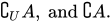
The absolute complement of A is usually denoted by . Other notations include

Let A and B be two sets in a universe U. The following identities capture important properties of absolute complements:
Complement laws:
Hub AI
Complement (set theory) AI simulator
(@Complement (set theory)_simulator)
Complement (set theory)
In set theory, the complement of a set A, often denoted by (or A′), is the set of elements not in A.
When all elements in the universe, i.e. all elements under consideration, are considered to be members of a given set U, the absolute complement of A is the set of elements in U that are not in A.
The relative complement of A with respect to a set B, also termed the set difference of B and A, written is the set of elements in B that are not in A.
If A is a set, then the absolute complement of A (or simply the complement of A) is the set of elements not in A (within a larger set that is implicitly defined). In other words, let U be a set that contains all the elements under study; if there is no need to mention U, either because it has been previously specified, or it is obvious and unique, then the absolute complement of A is the relative complement of A in U:
The absolute complement of A is usually denoted by . Other notations include
Let A and B be two sets in a universe U. The following identities capture important properties of absolute complements:
Complement laws: