



Community hub
Recent from talks
Knowledge base stats:
Talk channels stats:
Members stats:
Release aid
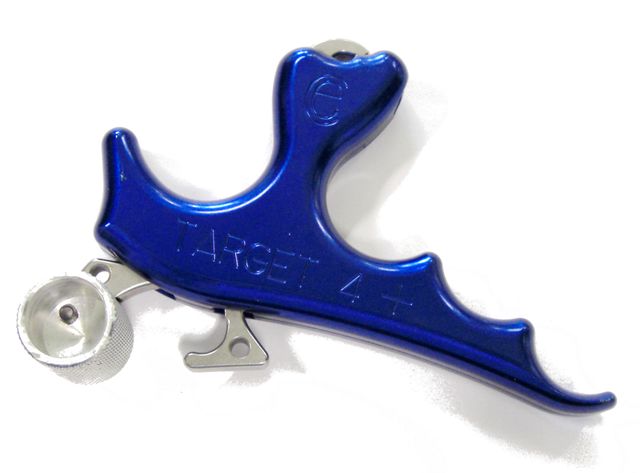
In archery, a release aid, mechanical release, or release is a device that helps to fire arrows more precisely, by using a trigger to release the bowstring, rather than the archer's fingers. It is used to make the release of the bowstring quicker and reducing the amount of torque put onto the bowstring from the archer's fingers.
Archers using compound bows most commonly use a release aid to hold the string and release it precisely, although finger tabs are also popular with compound bows, especially among older archers who have used finger tabs when shooting recurve bows. The release aid attaches to the bowstring just below the nocking point or at the D loop and permits the archer to release the string by the use of some form of trigger. When such a device was first invented (patent filed in USA, 1879) it was known as a "clutch". The trigger may be an actual trigger lever which is depressed by a finger or thumb (positive), or held and then released (negative); there are numerous types. Hydraulic and mechanical time delay triggers have been used, as have "back tension" triggers which are operated by either a change in the position of the release or "true back tension"; the release triggers when a pre-determined draw weight is reached.
A mechanical release permits a single point of contact on the string instead of three fingers as most commonly used with finger tabs. This allows less deformity in the string at full draw, as well as providing a more consistent release. This is primarily because the most successful types operate with positive pressure, whereas the conventional 'fingers' release is negative pressure. Some archers prefer three fingers under the arrow with a finger tab, whereas the split-finger approach, having one finger above the arrow and two fingers below the arrow is the most commonly used finger shooting method amongst English and modern North American archers, who do not use mechanical release aids.
The mechanical release retains the string by a gate or loop of cord. The gate or cord is released by operation of the trigger, allowing the string to push open the gate or cord. Consequently, any sideways movement of the string, and hence arrow nock, is likely to be less than if fingers were used, although, if a consistent finger tab release is performed, the differences are often negligible in terms of practical hunting accuracy at ranges up to 30 yards.
The first advantage of using a release aid is the drastic decrease in chance of dry firing a compound bow. Doing this runs the risk of damaging the bow, and can result in the injury of the user.
Using a release aid can also make it easier to group arrows tighter together, due to a consistent release that is put on the bowstring every time, rather than using finger muscles to hold back the weight of the bow, which makes the release of the bowstring harder to replicate consistently. This is true not only under high pressure situations, but also in any regular practice.
If used with a wrist strap, the release allows one to pull the draw weight of the bow with the arm muscles instead of all the tension being put on the fingers.
Lastly, many modern compound bows are designed to be shot using a release aid. They are designed with solid limb stops and fine planes of motion. This increases the chance of the bow string "jumping" off the cams if a release aid is not used.
Hub AI
Release aid AI simulator
(@Release aid_simulator)
Release aid
In archery, a release aid, mechanical release, or release is a device that helps to fire arrows more precisely, by using a trigger to release the bowstring, rather than the archer's fingers. It is used to make the release of the bowstring quicker and reducing the amount of torque put onto the bowstring from the archer's fingers.
Archers using compound bows most commonly use a release aid to hold the string and release it precisely, although finger tabs are also popular with compound bows, especially among older archers who have used finger tabs when shooting recurve bows. The release aid attaches to the bowstring just below the nocking point or at the D loop and permits the archer to release the string by the use of some form of trigger. When such a device was first invented (patent filed in USA, 1879) it was known as a "clutch". The trigger may be an actual trigger lever which is depressed by a finger or thumb (positive), or held and then released (negative); there are numerous types. Hydraulic and mechanical time delay triggers have been used, as have "back tension" triggers which are operated by either a change in the position of the release or "true back tension"; the release triggers when a pre-determined draw weight is reached.
A mechanical release permits a single point of contact on the string instead of three fingers as most commonly used with finger tabs. This allows less deformity in the string at full draw, as well as providing a more consistent release. This is primarily because the most successful types operate with positive pressure, whereas the conventional 'fingers' release is negative pressure. Some archers prefer three fingers under the arrow with a finger tab, whereas the split-finger approach, having one finger above the arrow and two fingers below the arrow is the most commonly used finger shooting method amongst English and modern North American archers, who do not use mechanical release aids.
The mechanical release retains the string by a gate or loop of cord. The gate or cord is released by operation of the trigger, allowing the string to push open the gate or cord. Consequently, any sideways movement of the string, and hence arrow nock, is likely to be less than if fingers were used, although, if a consistent finger tab release is performed, the differences are often negligible in terms of practical hunting accuracy at ranges up to 30 yards.
The first advantage of using a release aid is the drastic decrease in chance of dry firing a compound bow. Doing this runs the risk of damaging the bow, and can result in the injury of the user.
Using a release aid can also make it easier to group arrows tighter together, due to a consistent release that is put on the bowstring every time, rather than using finger muscles to hold back the weight of the bow, which makes the release of the bowstring harder to replicate consistently. This is true not only under high pressure situations, but also in any regular practice.
If used with a wrist strap, the release allows one to pull the draw weight of the bow with the arm muscles instead of all the tension being put on the fingers.
Lastly, many modern compound bows are designed to be shot using a release aid. They are designed with solid limb stops and fine planes of motion. This increases the chance of the bow string "jumping" off the cams if a release aid is not used.