



Community hub
Recent from talks
Knowledge base stats:
Talk channels stats:
Members stats:
Religion in Antarctica
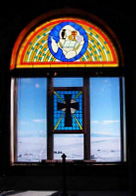
Religion in Antarctica is largely dominated by Christianity, with churches being the only religious buildings on the continent. Although used regularly for Christian worship, the Chapel of the Snows has also been used for Buddhist and Baháʼí Faith ceremonies. Some of the early religious buildings are now protected as important historical monuments.
The first clergyman of any denomination to set foot on Antarctica was Arnold Spencer-Smith (1883–1916), an Anglican priest who was chaplain and photographer for the Ross Sea Party of Shackleton's Imperial Trans Antarctic Expedition. Spencer-Smith set up a chapel in Ponting's darkroom in Scott's Hut at Cape Evans. He arranged an altar with a cross and candlesticks and an aumbry where he reserved the Blessed Sacrament; he made a lamp to hang by the aumbry to indicate the real presence. In his diary, Spencer-Smith records when he celebrated Eucharist and how many were present. He also records when he heard confession on the continent. Spencer-Smith was the first clergyman to land in Antarctica, the first to celebrate the Eucharist and the first to die and be buried there.
A cross on Wind Vane Hill, Cape Evans, was erected by the Ross Sea Party, led by Captain Aeneas Mackintosh, of Sir Ernest Shackleton’s Imperial Trans-Antarctic Expedition of 1914–1917, in memory of three members of the party who died in the vicinity in 1916. The cross has been designated a Historic Site or Monument (HSM 17), following a proposal by New Zealand and the United Kingdom to the Antarctic Treaty Consultative Meeting.
On 20 February 1946, the first Catholic mass to be held in Antarctica took place at the Stella Maris chapel at the Argentine Orcadas station, led by the Spanish Jesuit Father Felipe Lérida. An 8-metre cross was erected and the pope was contacted by telegram.
The first Roman Catholic service in Antarctica was performed in 1947 by William Menster (1913–2007), Lieutenant Commander of the United States Navy during Operation Highjump. During a Catholic service held in a tent set up on land, he consecrated Antarctica. Ministering to approximately 2,000 men from a variety of Christian denominations gave him experience in leading ecumenical services.[citation needed]
Although they are used mostly for Christian worship, the Chapel of the Snows has also been used for Buddhist and Baháʼí Faith ceremonies. Some of the buildings are among historically important sites and under protection, such as the Chilean Captain Arturo Prat Base's wooden cross and a Statue of Our Lady of the Carmel.
Around 1900, whaling stations and expedition camps were erected in the larger area. After World War II, some military expeditions explored the region. The International Geophysical Year (1957–1958) marked the end of a long period during the Cold War when scientific interchange between East and West had been seriously interrupted and has since contributed to civil scientific exploration. Since the 1950s, most stations in Antarctica have been constructed exclusively for scientific research. Extended stays in the region can be an extremely stressful experience for the researchers who often have been separated from their families for months at a time. Jesuits, who have had a long tradition of geophysical research in Antarctica, contributed as well to the early Antarctic missions. Notable Jesuit scholars like Edward A. Bradley, Henry F. Birkenhauer, J. Joseph Lynch and Daniel J. Linehan have been among those.
The first churches south of the Antarctic Convergence and north of 60° S latitude (and thus not part of the Antarctic Treaty System) are Notre-Dame des Vents at Port-aux-Français on the main island of Kerguelen and the Norwegian Lutheran Church, a former Lutheran chapel in Grytviken, South Georgia (since 1913). After years of abandonment and weathering the harsh elements of the region (roof damaged in 1994), the Grytviken church was renovated by the keepers of South Georgia Museum and volunteers in 1996–1998 and now serves for occasional church services and marriage ceremonies.
Hub AI
Religion in Antarctica AI simulator
(@Religion in Antarctica_simulator)
Religion in Antarctica
Religion in Antarctica is largely dominated by Christianity, with churches being the only religious buildings on the continent. Although used regularly for Christian worship, the Chapel of the Snows has also been used for Buddhist and Baháʼí Faith ceremonies. Some of the early religious buildings are now protected as important historical monuments.
The first clergyman of any denomination to set foot on Antarctica was Arnold Spencer-Smith (1883–1916), an Anglican priest who was chaplain and photographer for the Ross Sea Party of Shackleton's Imperial Trans Antarctic Expedition. Spencer-Smith set up a chapel in Ponting's darkroom in Scott's Hut at Cape Evans. He arranged an altar with a cross and candlesticks and an aumbry where he reserved the Blessed Sacrament; he made a lamp to hang by the aumbry to indicate the real presence. In his diary, Spencer-Smith records when he celebrated Eucharist and how many were present. He also records when he heard confession on the continent. Spencer-Smith was the first clergyman to land in Antarctica, the first to celebrate the Eucharist and the first to die and be buried there.
A cross on Wind Vane Hill, Cape Evans, was erected by the Ross Sea Party, led by Captain Aeneas Mackintosh, of Sir Ernest Shackleton’s Imperial Trans-Antarctic Expedition of 1914–1917, in memory of three members of the party who died in the vicinity in 1916. The cross has been designated a Historic Site or Monument (HSM 17), following a proposal by New Zealand and the United Kingdom to the Antarctic Treaty Consultative Meeting.
On 20 February 1946, the first Catholic mass to be held in Antarctica took place at the Stella Maris chapel at the Argentine Orcadas station, led by the Spanish Jesuit Father Felipe Lérida. An 8-metre cross was erected and the pope was contacted by telegram.
The first Roman Catholic service in Antarctica was performed in 1947 by William Menster (1913–2007), Lieutenant Commander of the United States Navy during Operation Highjump. During a Catholic service held in a tent set up on land, he consecrated Antarctica. Ministering to approximately 2,000 men from a variety of Christian denominations gave him experience in leading ecumenical services.[citation needed]
Although they are used mostly for Christian worship, the Chapel of the Snows has also been used for Buddhist and Baháʼí Faith ceremonies. Some of the buildings are among historically important sites and under protection, such as the Chilean Captain Arturo Prat Base's wooden cross and a Statue of Our Lady of the Carmel.
Around 1900, whaling stations and expedition camps were erected in the larger area. After World War II, some military expeditions explored the region. The International Geophysical Year (1957–1958) marked the end of a long period during the Cold War when scientific interchange between East and West had been seriously interrupted and has since contributed to civil scientific exploration. Since the 1950s, most stations in Antarctica have been constructed exclusively for scientific research. Extended stays in the region can be an extremely stressful experience for the researchers who often have been separated from their families for months at a time. Jesuits, who have had a long tradition of geophysical research in Antarctica, contributed as well to the early Antarctic missions. Notable Jesuit scholars like Edward A. Bradley, Henry F. Birkenhauer, J. Joseph Lynch and Daniel J. Linehan have been among those.
The first churches south of the Antarctic Convergence and north of 60° S latitude (and thus not part of the Antarctic Treaty System) are Notre-Dame des Vents at Port-aux-Français on the main island of Kerguelen and the Norwegian Lutheran Church, a former Lutheran chapel in Grytviken, South Georgia (since 1913). After years of abandonment and weathering the harsh elements of the region (roof damaged in 1994), the Grytviken church was renovated by the keepers of South Georgia Museum and volunteers in 1996–1998 and now serves for occasional church services and marriage ceremonies.