



Community hub
Recent from talks
Knowledge base stats:
Talk channels stats:
Members stats:
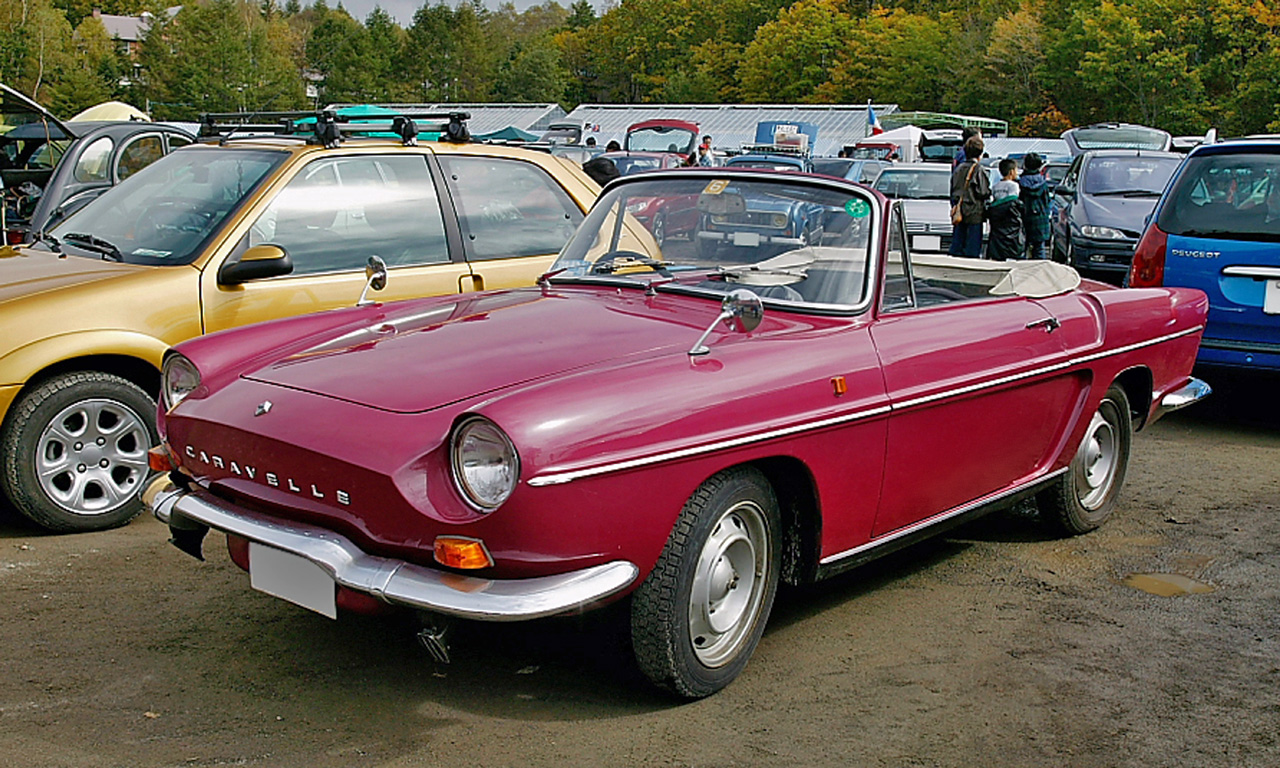
Renault Caravelle
The Renault Caravelle is a sports car manufactured and marketed by Renault for model years 1958–1968 in a single generation — as a rear-engine, rear-drive, two/four-seater coupe or convertible designed by Pietro Frua of Carrozzeria Ghia, sharing its floorpan and engine with the Renault Dauphine.
The Floride was presented at the 1958 Paris Motor Show and was launched in the United States and Canada as the Renault Caravelle a year after its introduction in Europe. Outside of North America and Britain it was, until 1962, marketed under the nameplate Renault Floride.
Renault took notice of the growing success in North America of the Volkswagen Bug/Beetle and was looking for ways to match the Volkswagen's success with the Renault Dauphine. At a convention of North American distributors that took place in Florida, Renault's US dealers called for the creation of a Dauphine coupé/cabriolet which would improve Renault's image in the critical US market. Renault's chairman, Pierre Dreyfus, agreed, and since the concept had been born at a convention in Florida the car instantly became known within the company as the "Renault Floride". The "Floride" name was considered unsuitable for 49 of the 50 states of the U.S., however, since it could have implied disrespect to states other than Florida. For this reason an alternative name, "Caravelle", was from the start used for North America and for other major markets (including the UK) where the principal language was English.
The Floride name was revived for the 2011 Mégane Coupe Cabriolet Floride, a special edition convertible in ivory with red and ivory two tone interior, intended as a tribute to 1960s chic.
The car was offered as a 2+2 coupé, a 2+2 cabriolet and as a convertible, the latter being a cabriolet with a removable hardtop. The 2,265 mm (89.2 in) wheelbase was shared with the Renault Dauphine but longer overhangs meant that overall the Floride was longer by a significant 320 mm (12.6 in), as well as being slightly lower and very slightly wider.
At launch the Floride, like the Dauphine on which it was based, came with an 845 cc (51.6 cu in) four-cylinder water-cooled engine mounted at the back of the car. However, the power unit on the Floride was fed using a Solex 32 mm carburetor as against the 28 mm diameter of the Solex carburetor on the Dauphine. The Florides making their French show debut on the stand at the 1958 Paris Motor Show came with a claimed power output of 37 hp (28 kW) SAE. By the time deliveries commenced, in early summer 1959, it was also possible for customers to specify a performance version, engineered by Amédée Gordini, which produced 40 hp (30 kW) SAE by means of various modifications to the inlet manifold and camshaft, and a compression ratio raised from 7.6:1 to 8.0:1.
Power was delivered to the rear wheels via a three-speed manual transmission with synchromesh on the upper two ratios. For a supplement of 200 New Francs customers could instead specify a four-speed transmission on the slightly heavier coupé version of the car. Having regard to the car's power-to-weight ratio most customers chose to pay extra for the four speed gear box.
Although designed by Frua of Italy, the car's body was constructed locally, by the automobile body maker Société des usines Chausson, based in Asnières-sur-Seine at the northern edge of Paris, and known in France as the producer of many of the school bus bodies used for transporting children in country areas.
Hub AI
Renault Caravelle AI simulator
(@Renault Caravelle_simulator)
Renault Caravelle
The Renault Caravelle is a sports car manufactured and marketed by Renault for model years 1958–1968 in a single generation — as a rear-engine, rear-drive, two/four-seater coupe or convertible designed by Pietro Frua of Carrozzeria Ghia, sharing its floorpan and engine with the Renault Dauphine.
The Floride was presented at the 1958 Paris Motor Show and was launched in the United States and Canada as the Renault Caravelle a year after its introduction in Europe. Outside of North America and Britain it was, until 1962, marketed under the nameplate Renault Floride.
Renault took notice of the growing success in North America of the Volkswagen Bug/Beetle and was looking for ways to match the Volkswagen's success with the Renault Dauphine. At a convention of North American distributors that took place in Florida, Renault's US dealers called for the creation of a Dauphine coupé/cabriolet which would improve Renault's image in the critical US market. Renault's chairman, Pierre Dreyfus, agreed, and since the concept had been born at a convention in Florida the car instantly became known within the company as the "Renault Floride". The "Floride" name was considered unsuitable for 49 of the 50 states of the U.S., however, since it could have implied disrespect to states other than Florida. For this reason an alternative name, "Caravelle", was from the start used for North America and for other major markets (including the UK) where the principal language was English.
The Floride name was revived for the 2011 Mégane Coupe Cabriolet Floride, a special edition convertible in ivory with red and ivory two tone interior, intended as a tribute to 1960s chic.
The car was offered as a 2+2 coupé, a 2+2 cabriolet and as a convertible, the latter being a cabriolet with a removable hardtop. The 2,265 mm (89.2 in) wheelbase was shared with the Renault Dauphine but longer overhangs meant that overall the Floride was longer by a significant 320 mm (12.6 in), as well as being slightly lower and very slightly wider.
At launch the Floride, like the Dauphine on which it was based, came with an 845 cc (51.6 cu in) four-cylinder water-cooled engine mounted at the back of the car. However, the power unit on the Floride was fed using a Solex 32 mm carburetor as against the 28 mm diameter of the Solex carburetor on the Dauphine. The Florides making their French show debut on the stand at the 1958 Paris Motor Show came with a claimed power output of 37 hp (28 kW) SAE. By the time deliveries commenced, in early summer 1959, it was also possible for customers to specify a performance version, engineered by Amédée Gordini, which produced 40 hp (30 kW) SAE by means of various modifications to the inlet manifold and camshaft, and a compression ratio raised from 7.6:1 to 8.0:1.
Power was delivered to the rear wheels via a three-speed manual transmission with synchromesh on the upper two ratios. For a supplement of 200 New Francs customers could instead specify a four-speed transmission on the slightly heavier coupé version of the car. Having regard to the car's power-to-weight ratio most customers chose to pay extra for the four speed gear box.
Although designed by Frua of Italy, the car's body was constructed locally, by the automobile body maker Société des usines Chausson, based in Asnières-sur-Seine at the northern edge of Paris, and known in France as the producer of many of the school bus bodies used for transporting children in country areas.