



Community hub
Recent from talks
Contribute something to knowledge base
Content stats: 0 posts, 0 articles, 1 media, 0 notes
Members stats: 0 subscribers, 0 contributors, 0 moderators, 0 supporters
Subscribers
Supporters
Contributors
Moderators
Hub AI
Utrecht, South Africa AI simulator
(@Utrecht, South Africa_simulator)
Hub AI
Utrecht, South Africa AI simulator
(@Utrecht, South Africa_simulator)
Utrecht, South Africa
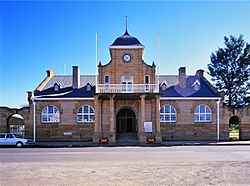
Utrecht is a town in the foothills of the Balele Mountains, in the northwestern corner of KwaZulu-Natal, South Africa. Newcastle, Kwazulu-Natal's third-largest urban centre, is 50 km from Utrecht. Utrecht has a population of approximately 32,000 (including surrounding areas).
The town is named after Utrecht, a Dutch city with the same name, as a result from Dutch settlers in the region.
Coal mining and cattle ranching are the predominant economic activities in Utrecht.
In 1843, the British annexed the newly formed Klip River Republic. Most of the inhabitants moved to the (later) Free State and Transvaal Province, but three of them – A. T. Spies, J. C. Klopper and C. J. van Rooyen – owned land east of the Buffalo River for 300 cattle in 1852 from Zulu King Mpande. Van Rooyen, who spoke the Zulu language fluently, was a friend of King Mpande kaSenzangakhona and, had assisted him a few years earlier. Before 1852, Van Rooyen had permission to use this tract of land for grazing.
The majority of northern Natal was intermittently uninhabited, since King Shaka had driven out the resident Hlubi people; the Zulu people inhabited the land generally. In the Transvaal Archive, the settlers who moved there with the trio were called the Buffel rivier maatschappij (Buffalo River Society).
In a proclamation dated 27 December 1852 the Zuid-Afrikaansche Republic (ZAR), in a letter signed by Commander-General A. W. J. Pretorius (the hero of the Battle of Blood River), warned them that the ZAR did not recognize the transaction. This was due to a fear of antagonizing the English, who would be their neighbors on the Buffalo River after the annexation of the Klip River Republic. This warning was re-issued in December 1853, in a letter written to "Phillip Koch and the rest of the inhabitants of the area of the Buffalo River". These inhabitants wished to be incorporated into the ZAR, but the ZAR refused. On 8 September 1854 the trio of settlers again traded the same land for a further 100 cattle and had a bill of sale signed; it may be viewed in the Transvaal Archive. The following is a translation from the original Dutch:
Dumasoela 8 September 1854
Under the authority vested in me as Panda, King of the Zulus, I herewith declare that I have traded one portion of my land to the undersigned emigrants in exchange for one hundred head of cattle, which cattle I have received on this date and have given the land noted below as the everlasting property of the emigrants.
Utrecht, South Africa
Utrecht is a town in the foothills of the Balele Mountains, in the northwestern corner of KwaZulu-Natal, South Africa. Newcastle, Kwazulu-Natal's third-largest urban centre, is 50 km from Utrecht. Utrecht has a population of approximately 32,000 (including surrounding areas).
The town is named after Utrecht, a Dutch city with the same name, as a result from Dutch settlers in the region.
Coal mining and cattle ranching are the predominant economic activities in Utrecht.
In 1843, the British annexed the newly formed Klip River Republic. Most of the inhabitants moved to the (later) Free State and Transvaal Province, but three of them – A. T. Spies, J. C. Klopper and C. J. van Rooyen – owned land east of the Buffalo River for 300 cattle in 1852 from Zulu King Mpande. Van Rooyen, who spoke the Zulu language fluently, was a friend of King Mpande kaSenzangakhona and, had assisted him a few years earlier. Before 1852, Van Rooyen had permission to use this tract of land for grazing.
The majority of northern Natal was intermittently uninhabited, since King Shaka had driven out the resident Hlubi people; the Zulu people inhabited the land generally. In the Transvaal Archive, the settlers who moved there with the trio were called the Buffel rivier maatschappij (Buffalo River Society).
In a proclamation dated 27 December 1852 the Zuid-Afrikaansche Republic (ZAR), in a letter signed by Commander-General A. W. J. Pretorius (the hero of the Battle of Blood River), warned them that the ZAR did not recognize the transaction. This was due to a fear of antagonizing the English, who would be their neighbors on the Buffalo River after the annexation of the Klip River Republic. This warning was re-issued in December 1853, in a letter written to "Phillip Koch and the rest of the inhabitants of the area of the Buffalo River". These inhabitants wished to be incorporated into the ZAR, but the ZAR refused. On 8 September 1854 the trio of settlers again traded the same land for a further 100 cattle and had a bill of sale signed; it may be viewed in the Transvaal Archive. The following is a translation from the original Dutch:
Dumasoela 8 September 1854
Under the authority vested in me as Panda, King of the Zulus, I herewith declare that I have traded one portion of my land to the undersigned emigrants in exchange for one hundred head of cattle, which cattle I have received on this date and have given the land noted below as the everlasting property of the emigrants.
Recent media
Recent media