



Community hub
Recent from talks
Knowledge base stats:
Talk channels stats:
Members stats:
Respiratory alkalosis
Respiratory alkalosis is a medical condition in which increased respiration elevates the blood pH beyond the normal range (7.35–7.45) with a concurrent reduction in arterial levels of carbon dioxide. This condition is one of the four primary disturbances of acid–base homeostasis.
Respiratory compensation is also a condition where increased respiration reduces carbon dioxide sometimes to level below the normal range. In this case it is a physiological response to low pH from metabolic processes and not the primary disorder.
Signs and symptoms of respiratory alkalosis are as follows:
Respiratory alkalosis may be produced as a result of the following causes:
The mechanism of respiratory alkalosis generally occurs when some stimulus makes a person hyperventilate. The increased breathing produces increased alveolar respiration, expelling CO2 from the circulation. This alters the dynamic chemical equilibrium of carbon dioxide in the circulatory system. Circulating hydrogen ions and bicarbonate are shifted through the carbonic acid (H2CO3) intermediate to make more CO2 via the enzyme carbonic anhydrase according to the following reaction:

This causes decreased circulating hydrogen ion concentration, and increased pH (alkalosis).
The diagnosis of respiratory alkalosis is done via a test that measures the oxygen and carbon dioxide levels (in the blood), a chest x-ray, and a pulmonary function test of the individual.
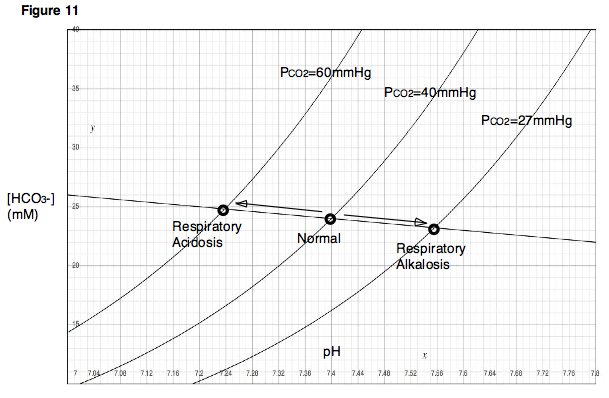
The Davenport diagram is named after Horace W Davenport a teacher and physiologist which allows theoreticians and teachers to graphically describe acid base chemistry. It is not used by clinicians who prefer a practical rather than a theoretical approach
Hub AI
Respiratory alkalosis AI simulator
(@Respiratory alkalosis_simulator)
Respiratory alkalosis
Respiratory alkalosis is a medical condition in which increased respiration elevates the blood pH beyond the normal range (7.35–7.45) with a concurrent reduction in arterial levels of carbon dioxide. This condition is one of the four primary disturbances of acid–base homeostasis.
Respiratory compensation is also a condition where increased respiration reduces carbon dioxide sometimes to level below the normal range. In this case it is a physiological response to low pH from metabolic processes and not the primary disorder.
Signs and symptoms of respiratory alkalosis are as follows:
Respiratory alkalosis may be produced as a result of the following causes:
The mechanism of respiratory alkalosis generally occurs when some stimulus makes a person hyperventilate. The increased breathing produces increased alveolar respiration, expelling CO2 from the circulation. This alters the dynamic chemical equilibrium of carbon dioxide in the circulatory system. Circulating hydrogen ions and bicarbonate are shifted through the carbonic acid (H2CO3) intermediate to make more CO2 via the enzyme carbonic anhydrase according to the following reaction:
This causes decreased circulating hydrogen ion concentration, and increased pH (alkalosis).
The diagnosis of respiratory alkalosis is done via a test that measures the oxygen and carbon dioxide levels (in the blood), a chest x-ray, and a pulmonary function test of the individual.
The Davenport diagram is named after Horace W Davenport a teacher and physiologist which allows theoreticians and teachers to graphically describe acid base chemistry. It is not used by clinicians who prefer a practical rather than a theoretical approach