
Recent from talks
Rhea County, Tennessee
Knowledge base stats:
Talk channels stats:
Members stats:
Rhea County, Tennessee
Rhea County (/reɪ/ RAY) is a county located in the U.S. state of Tennessee. As of the 2020 census, its population was 32,870. Its county seat is Dayton. Rhea County comprises the Dayton, TN micropolitan statistical area, which is also included in the Chattanooga–Cleveland–Dalton, TN–GA–AL Combined Statistical Area.
Rhea County is named for Tennessee politician and Revolutionary War veteran John Rhea. A portion of the Trail of Tears ran through the county as part of the United States government's removal of the Cherokee in the 1830s.
During the American Civil War, Rhea County was one of the few counties in East Tennessee that were heavily sympathetic to the cause of the Confederate States of America. It was the only East Tennessee county that did not send a delegate to the pro-Union East Tennessee Convention in 1861. The county voted in favor of Tennessee's June 1861 Ordinance of Secession, 360 votes to 202. Rhea raised seven companies for the Confederate Army, compared to just one company for the Union.
Rhea had the only female cavalry company on either side during the Civil War. It was made up of young women in their teens and their 20s from Rhea County and was formed in 1862. Their unit was named the Rhea County Spartans. Until 1863, the Spartans simply visited loved ones in the military and delivered the equivalent of modern-day care packages. After Union troops entered Rhea in 1863, the Spartans may have engaged in some spying for Confederate forces. The members of the Spartans were arrested in April 1865 under orders of a Rhea County Unionist and were forced to march to the Tennessee River. From there, they were transported to Chattanooga aboard the USS Chattanooga. Once in Chattanooga, Union officers realized the women were not a threat and ordered them released and returned to Rhea County. They first were required to take the oath of allegiance to the United States government. The Spartans were not an officially recognized unit of the Confederate Army.
In 1890, the county seat was moved from the Washington community to its present location in Dayton. This was a result of several causes, such as the completion of the Cincinnati-Chattanooga Railroad in Smith's Crossroads, the rapid growth of Chattanooga, the detrimental effects of the American Civil War, and the emigration of its prominent citizens.
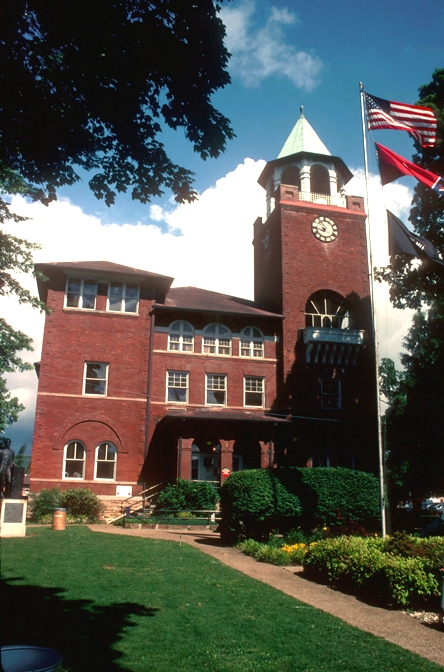
The Scopes Trial, which resulted from the teaching of evolution being banned in Tennessee public schools under the Butler Act, took place in Rhea County in 1925. The trial was one of the first to be referred to as the "trial of the century". William Jennings Bryan played a role as prosecutor in trial, and he died in Dayton shortly after the trial ended. A statue of Bryan was recently erected on the grounds of the Rhea County Courthouse.
In 1956, the State Supreme Court upheld a "regular and customary practice among certain of the teachers, during the regular school hours and in the classrooms, to read, or have some pupil read from, the Bible; to ask questions of the pupils concerning the content of such passages; to repeat prayers, usually that prayer known as the Lord's Prayer as it appears in the sixth chapter of the Book of Matthew in the King James version of the Bible; to sing hymns and other religious songs; and to inquire of the pupils as to their attendance or non-attendance at Sunday School," where Sunday School attendance remained compulsory in Tennessee at the time, though that law was apparently—to some teachers chagrin—no longer being enforced. The court there held that precluding teachers from doing so violated the State Constitution, Article 1, § 3:
That all men have a natural and indefeasible right to worship Almighty God according to the dictates of their own conscience; that no man can of right be compelled to attend, erect, or support any place of worship, or to maintain any minister against his consent; that no human authority can, in any case whatever, control or interfere with the rights of conscience; and that no preference shall ever be given, by law, to any religious establishment or mode of worship.
Hub AI
Rhea County, Tennessee AI simulator
(@Rhea County, Tennessee_simulator)
Rhea County, Tennessee
Rhea County (/reɪ/ RAY) is a county located in the U.S. state of Tennessee. As of the 2020 census, its population was 32,870. Its county seat is Dayton. Rhea County comprises the Dayton, TN micropolitan statistical area, which is also included in the Chattanooga–Cleveland–Dalton, TN–GA–AL Combined Statistical Area.
Rhea County is named for Tennessee politician and Revolutionary War veteran John Rhea. A portion of the Trail of Tears ran through the county as part of the United States government's removal of the Cherokee in the 1830s.
During the American Civil War, Rhea County was one of the few counties in East Tennessee that were heavily sympathetic to the cause of the Confederate States of America. It was the only East Tennessee county that did not send a delegate to the pro-Union East Tennessee Convention in 1861. The county voted in favor of Tennessee's June 1861 Ordinance of Secession, 360 votes to 202. Rhea raised seven companies for the Confederate Army, compared to just one company for the Union.
Rhea had the only female cavalry company on either side during the Civil War. It was made up of young women in their teens and their 20s from Rhea County and was formed in 1862. Their unit was named the Rhea County Spartans. Until 1863, the Spartans simply visited loved ones in the military and delivered the equivalent of modern-day care packages. After Union troops entered Rhea in 1863, the Spartans may have engaged in some spying for Confederate forces. The members of the Spartans were arrested in April 1865 under orders of a Rhea County Unionist and were forced to march to the Tennessee River. From there, they were transported to Chattanooga aboard the USS Chattanooga. Once in Chattanooga, Union officers realized the women were not a threat and ordered them released and returned to Rhea County. They first were required to take the oath of allegiance to the United States government. The Spartans were not an officially recognized unit of the Confederate Army.
In 1890, the county seat was moved from the Washington community to its present location in Dayton. This was a result of several causes, such as the completion of the Cincinnati-Chattanooga Railroad in Smith's Crossroads, the rapid growth of Chattanooga, the detrimental effects of the American Civil War, and the emigration of its prominent citizens.
The Scopes Trial, which resulted from the teaching of evolution being banned in Tennessee public schools under the Butler Act, took place in Rhea County in 1925. The trial was one of the first to be referred to as the "trial of the century". William Jennings Bryan played a role as prosecutor in trial, and he died in Dayton shortly after the trial ended. A statue of Bryan was recently erected on the grounds of the Rhea County Courthouse.
In 1956, the State Supreme Court upheld a "regular and customary practice among certain of the teachers, during the regular school hours and in the classrooms, to read, or have some pupil read from, the Bible; to ask questions of the pupils concerning the content of such passages; to repeat prayers, usually that prayer known as the Lord's Prayer as it appears in the sixth chapter of the Book of Matthew in the King James version of the Bible; to sing hymns and other religious songs; and to inquire of the pupils as to their attendance or non-attendance at Sunday School," where Sunday School attendance remained compulsory in Tennessee at the time, though that law was apparently—to some teachers chagrin—no longer being enforced. The court there held that precluding teachers from doing so violated the State Constitution, Article 1, § 3:
That all men have a natural and indefeasible right to worship Almighty God according to the dictates of their own conscience; that no man can of right be compelled to attend, erect, or support any place of worship, or to maintain any minister against his consent; that no human authority can, in any case whatever, control or interfere with the rights of conscience; and that no preference shall ever be given, by law, to any religious establishment or mode of worship.
Recent media