


Community hub
Recent from talks
Contribute something
Nothing was collected or created yet.
Cherokee
View on Wikipedia
Key Information


The Cherokee (/ˈtʃɛrəkiː/ CHEH-rə-kee, /ˌtʃɛrəˈkiː/ ⓘ CHEH-rə-KEE;[8][9] Cherokee: ᎠᏂᏴᏫᏯᎢ, romanized: Aniyvwiyaʔi / Anigiduwagi, or ᏣᎳᎩ, Tsalagi) people are one of the Indigenous peoples of the Southeastern Woodlands of the United States. Prior to the 18th century, they were concentrated in their homelands, in towns along river valleys of what is now southwestern North Carolina, southeastern Tennessee, southwestern Virginia, edges of western South Carolina, northern Georgia and northeastern Alabama with hunting grounds in Kentucky, together consisting of around 40,000 square miles.[10]
The Cherokee language is part of the Iroquoian language group. In the 19th century, James Mooney, an early American ethnographer, recorded one oral tradition that told of the tribe having migrated south in ancient times from the Great Lakes region, where other Iroquoian peoples have been based.[11] However, anthropologist Thomas R. Whyte, writing in 2007, dated the split among the peoples as occurring earlier. He believes that the origin of the proto-Iroquoian language was likely the Appalachian region, and the split between Northern and Southern Iroquoian languages began 4,000 years ago.[12]
By the 19th century, White American settlers had classified the Cherokee of the Southeast as one of the "Five Civilized Tribes" in the region. They were agrarian, lived in permanent villages and had begun to adopt some cultural and technological practices of the white settlers. They also developed their own writing system.
Today three Cherokee tribes are federally recognized: the United Keetoowah Band of Cherokee Indians (UKB) in Oklahoma, the Cherokee Nation (CN) in Oklahoma, and the Eastern Band of Cherokee Indians (EBCI) in North Carolina.[13]
The Cherokee Nation has more than 300,000 tribal citizens, making it the largest of the 574 federally recognized tribes in the United States.[14] In addition, numerous groups claim Cherokee lineage, and some of these are state-recognized. A total of more than 819,000 people are estimated to have identified as having Cherokee ancestry on the U.S. census; most are not enrolled citizens of any tribe.[2]
Of the three federally recognized Cherokee tribes, the Cherokee Nation and the UKB have headquarters in Tahlequah, Oklahoma, and most of their citizens live in the state. The UKB are mostly descendants of "Old Settlers", also called Western Cherokee: those who migrated from the Southeast to Arkansas and Oklahoma in about 1817, prior to Indian removal. They are related to the Cherokee who were later forcibly relocated there in the 1830s under the Indian Removal Act. The Eastern Band of Cherokee Indians is located on land known as the Qualla Boundary in western North Carolina. They are mostly descendants of ancestors who had resisted or avoided relocation, remaining in the area. Because they gave up tribal citizenship at the time, they became state and US citizens. In the late 19th century, they reorganized as a federally recognized tribe.[15]
Etymology
[edit]A Cherokee-language name for Cherokee people is Aniyvwiya (ᎠᏂᏴᏫᏯ, translating as 'Principal People').[16] Another endonym is Anigiduwagi (ᎠᏂᎩᏚᏩᎩ, translating as 'People from Kituwah').[17] Tsalagi Gawonihisdi (ᏣᎳᎩ ᎦᏬᏂᎯᏍᏗ) is the Cherokee name for the Cherokee language.[18][19]
Many theories, though all unproven, abound about the origin of the name Cherokee. It may have originally been derived from one of the competitive tribes in the area.
The earliest Spanish transliteration of the name, from 1755, is recorded as Tchalaque, but it dates to accounts related to the Hernando de Soto expedition in the mid-16th century.[20] Another theory is that Cherokee derives from the Lower Creek word Cvlakke ("chuh-log-gee"), as the Creek were also in this mountainous region.[21]
The Iroquois Five Nations, historically based in New York and Pennsylvania, called the Cherokee Oyata'ge'ronoñ ('inhabitants of the cave country').[22] It is possible the word Cherokee comes from a Muscogee Creek word meaning 'people of different speech', because the two peoples spoke different languages.[23] Jack Kilpatrick disputes this idea, noting that he believes the name come from the Cherokee word tsàdlagí meaning 'he has turned aside'.
Origins
[edit]
Anthropologists and historians have two main theories of Cherokee origins. One is that the Cherokee, an Iroquoian-speaking people, migrated to Southern Appalachia from northern areas around the Great Lakes in late prehistoric times.[clarify] The area became territory of the Iroquois (also known as the "Haudenosaunee") nations and other Iroquoian-speaking peoples of the Southeast such as the Tuscarora people of the Carolinas, and the Meherrin and Nottaway of Virginia. The other theory is that the Cherokee had been in the Southeast for thousands of years and that proto-Iroquoian developed there instead of in the north.
Supporting the first theory are recorded conversations of Cherokee elders made by ethnographer James Mooney in the late 19th century, who recounted an oral tradition of their people migrating south from the Great Lakes region in ancient times.[11] They occupied territories where earthwork platform mounds were built by peoples during the earlier Woodland period.
The people of the Middle Woodland period are believed to be ancestors of the historic Cherokee and occupied what is now Western North Carolina, circa 200 to 600 CE. They are believed to have built what is called the Biltmore Mound, found in 1984 south of the Swannanoa River on the Biltmore Estate, which has numerous Native American sites.[24]
Other ancestors of the Cherokee are considered to be part of the later Pisgah phase of South Appalachian Mississippian culture, a regional variation of the Mississippian culture that arose circa 1000 and lasted to 1500 CE.[25] There is a consensus among most specialists in Southeast archeology and anthropology about these dates. But Finger says that ancestors of the Cherokee people lived in western North Carolina and eastern Tennessee for a far longer period of time.[26] Additional mounds were built by peoples during this cultural phase. Typically in this region, towns had a single platform mound and served as a political center for smaller villages.
Homelands
[edit]The Cherokee occupied numerous towns throughout the river valleys and mountain ridges of their homelands. What were called the Lower towns were found in what is present-day western Oconee County, South Carolina, along the Keowee River (called the Savannah River in its lower portion). The principal town of the Lower Towns was Keowee. Other Cherokee towns on the Keowee River included Estatoe and Sugartown (Kulsetsiyi), a name repeated in other areas.
In western North Carolina, what were known as the Valley, Middle, and Outer Towns were located along the major rivers of the Tuckasegee, the upper Little Tennessee, Hiwasee, French Broad and other systems. The Overhill Cherokee occupied towns along the lower Little Tennessee River and upper Tennessee River on the western side of the Appalachian Mountains, in present-day southeastern Tennessee.
Agriculture
[edit]During the late Archaic and Woodland Period, Native Americans in the region began to cultivate plants such as marsh elder, lambsquarters, pigweed, sunflowers, and some native squash. People created new art forms such as shell gorgets, adopted new technologies, and developed an elaborate cycle of religious ceremonies.
During the Mississippian culture-period (1000 to 1500 CE in the regional variation known as the South Appalachian Mississippian culture), local women developed a new variety of maize (corn) called eastern flint corn. It closely resembled modern corn and produced larger crops. The successful cultivation of corn surpluses allowed the rise of larger, more complex chiefdoms consisting of several villages and concentrated populations during this period. Corn became celebrated among numerous peoples in religious ceremonies, especially the Green Corn Ceremony.
Early culture
[edit]Much of what is known about pre-18th century Native American cultures has come from records of Spanish expeditions. The earliest ones of the mid-16th century encountered peoples of the Mississippian culture era, who were ancestral to tribes that emerged in the Southeast, such as the Cherokee, Muscogee, Cheraw, and Catawba. Specifically in 1540–41, a Spanish expedition led by Hernando de Soto passed through present-day South Carolina, proceeding into western North Carolina and what is considered Cherokee country. The Spanish recorded a Chalaque[28] people as living around the Keowee River, where western North Carolina, South Carolina, and northeastern Georgia meet. The Cherokee consider this area to be part of their homelands, which also extended into southeastern Tennessee.[29]
Further west, De Soto's expedition visited villages in present-day northwestern Georgia, recording them as ruled at the time by the Coosa chiefdom. This is believed to be a chiefdom ancestral to the Muscogee Creek people, who developed as a Muskogean-speaking people with a distinct culture.[30]
In 1566, the Juan Pardo expedition traveled from the present-day South Carolina coast into its interior, and into western North Carolina and southeastern Tennessee. He recorded meeting Cherokee-speaking people who visited him while he stayed at the Joara chiefdom (north of present-day Morganton, North Carolina). The historic Catawba later lived in this area of the upper Catawba River. Pardo and his forces wintered over at Joara, building Fort San Juan there in 1567.
His expedition proceeded into the interior, noting villages near modern Asheville and other places that are part of the Cherokee homelands. According to anthropologist Charles M. Hudson, the Pardo expedition also recorded encounters with Muskogean-speaking peoples at Chiaha in southeastern modern Tennessee.
Linguistic studies
[edit]Linguistic studies have been another way for researchers to study the development of people and their cultures. Unlike most other Native American tribes in the American Southeast at the start of the historic era, the Cherokee and Tuscarora people spoke Iroquoian languages. Since the Great Lakes region was the territory of most Iroquoian-language speakers, scholars have theorized that both the Cherokee and Tuscarora migrated south from that region. The Cherokee oral history tradition supports their migration from the Great Lakes.
Linguistic analysis shows a relatively large difference between Cherokee and the northern Iroquoian languages, suggesting they had migrated long ago. Scholars posit a split between the groups in the distant past, perhaps 3,500–3,800 years ago.[31] Glottochronology studies suggest the split occurred between about 1500 and 1800 BCE.[32] The Cherokee say that the ancient settlement of Kituwa on the Tuckasegee River is their original settlement in the Southeast.[31] It was formerly adjacent to and is now part of Qualla Boundary (the base of the federally recognized Eastern Band of Cherokee Indians) in North Carolina.
According to Thomas Whyte, who posits that proto-Iroquoian developed in Appalachia, the Cherokee and Tuscarora broke off in the Southeast from the major group of Iroquoian speakers who migrated north to the Great Lakes area. There a succession of Iroquoian-speaking tribes were encountered by Europeans in historic times.
Other sources of early Cherokee history
[edit]In the 1830s, the American writer John Howard Payne visited Cherokee then based in Georgia. He recounted what they shared about pre-19th-century Cherokee culture and society. For instance, the Payne papers describe the account by Cherokee elders of a traditional two-part societal structure. A "white" organization of elders represented the seven clans. As Payne recounted, this group, which was hereditary and priestly, was responsible for religious activities, such as healing, purification, and prayer. A second group of younger men, the "red" organization, was responsible for warfare. The Cherokee considered warfare a polluting activity.[33]
Researchers have debated the reasons for the change. Some historians believe the decline in priestly power originated with a revolt by the Cherokee against the abuses of the priestly class known as the Ani-kutani.[34] Ethnographer James Mooney, who studied and talked with the Cherokee in the late 1880s, was the first to trace the decline of the former hierarchy to this revolt.[35] By the time that Mooney was studying the people in the late 1880s, the structure of Cherokee religious practitioners was more informal, based more on individual knowledge and ability than upon heredity.[34]
Another major source of early cultural history comes from materials written in the 19th century by the didanvwisgi (ᏗᏓᏅᏫᏍᎩ), Cherokee medicine men, after Sequoyah's creation of the Cherokee syllabary in the 1820s. Initially only the didanvwisgi learned to write and read such materials, which were considered extremely powerful in a spiritual sense.[34] Later, the syllabary and writings were widely adopted by the Cherokee people.
History
[edit]17th century: English contact
[edit]In 1657, there was a disturbance in Virginia Colony as the Rechahecrians or Rickahockans, as well as the Siouan Manahoac and Nahyssan, broke through the frontier and settled near the Falls of the James River, near present-day Richmond, Virginia. The following year, a combined force of English colonists and Pamunkey drove the newcomers away. The identity of the Rechahecrians has been much debated. Historians noted the name closely resembled that recorded for the Eriechronon or Erielhonan, commonly known as the Erie tribe, another Iroquoian-speaking people based south of the Great Lakes in present-day northern Pennsylvania.[36] This Iroquoian people had been driven away from the southern shore of Lake Erie in 1654 by the powerful Iroquois Five Nations, also known as Haudenosaunee, who were seeking more hunting grounds to support their dominance in the beaver fur trade. The anthropologist Martin Smith theorized some remnants of the tribe migrated to Virginia after the wars (1986:131–32), later becoming known as the Westo to English colonists in the Province of Carolina. A few historians suggest this tribe was Cherokee.[37]
Virginian traders developed a small-scale trading system with the Cherokee in the Piedmont before the end of the 17th century. The earliest recorded Virginia trader to live among the Cherokee was Cornelius Dougherty or Dority, in 1690.[38][39]
18th century
[edit]
The Cherokee gave sanctuary to a band of Shawnee in the 1660s. But from 1710 to 1715, the Cherokee and Chickasaw allied with the British, and fought the Shawnee, who were allied with French colonists, forcing the Shawnee to move northward.[40]
The Cherokee fought with the Yamasee, Catawba, and British in late 1712 and early 1713 against the Tuscarora in the Second Tuscarora War. The Tuscarora War marked the beginning of a British-Cherokee relationship that, despite breaking down on occasion, remained strong for much of the 18th century. With the growth of the deerskin trade, the Cherokee were considered valuable trading partners, since deer skins from the cooler country of their mountain hunting-grounds were of better quality than those supplied by the lowland coastal tribes, who were neighbors of the English colonists.
In January 1716, Cherokee murdered a delegation of Muscogee Creek leaders at the town of Tugaloo, marking their entry into the Yamasee War. It ended in 1717 with peace treaties between the colony of South Carolina and the Creek. Hostility and sporadic raids between the Cherokee and Creek continued for decades.[41] These raids came to a head at the Battle of Taliwa in 1755, at present-day Ball Ground, Georgia, with the defeat of the Muscogee.
In 1721, the Cherokee ceded lands in South Carolina. In 1730, at Nikwasi, a Cherokee town and Mississippian culture site, a Scots adventurer, Sir Alexander Cuming, crowned Moytoy of Tellico as "Emperor" of the Cherokee. Moytoy agreed to recognize King George II of Great Britain as the Cherokee protector. Cuming arranged to take seven prominent Cherokee, including Attakullakulla, to London, England. There the Cherokee delegation signed the Treaty of Whitehall with the British. Moytoy's son, Amo-sgasite (Dreadful Water), attempted to succeed him as "Emperor" in 1741, but the Cherokee elected their own leader, Conocotocko (Old Hop) of Chota.[42]
Political power among the Cherokee remained decentralized, and towns acted autonomously. In 1735, the Cherokee were said to have 64 towns and villages, with an estimated fighting force of 6,000 men.[43] In 1738 and 1739, smallpox epidemics broke out among the Cherokee, who had no natural immunity to the new infectious disease. Nearly half their population died within a year. Hundreds of other Cherokee committed suicide due to their losses and disfigurement from the disease.

British colonial officer Henry Timberlake, born in Virginia, described the Cherokee people as he saw them in 1761:
The Cherokees are of a middle stature, of an olive colour, tho' generally painted, and their skins stained with gun-powder, pricked into it in very pretty figures. The hair of their head is shaved, tho' many of the old people have it plucked out by the roots, except a patch on the hinder part of the head, about twice the bigness of a crown-piece, which is ornamented with beads, feathers, wampum, stained deer hair, and such like baubles. The ears are slit and stretched to an enormous size, putting the person who undergoes the operation to incredible pain, being unable to lie on either side for nearly forty days. To remedy this, they generally slit but one at a time; so soon as the patient can bear it, they wound round with wire to expand them, and are adorned with silver pendants and rings, which they likewise wear at the nose. This custom does not belong originally to the Cherokees, but taken by them from the Shawnese, or other northern nations. They that can afford it wear a collar of wampum, which are beads cut out of clam-shells, a silver breast-plate, and bracelets on their arms and wrists of the same metal, a bit of cloth over their private parts, a shirt of the English make, a sort of cloth-boots, and mockasons (sic), which are shoes of a make peculiar to the Americans, ornamented with porcupine-quills; a large mantle or match-coat thrown over all complete their dress at home ...[44]
From 1753 to 1755, battles broke out between the Cherokee and Muscogee over disputed hunting grounds in North Georgia. The Cherokee were victorious in the Battle of Taliwa. British soldiers built forts in Cherokee country to defend against the French in the Seven Years' War, which was fought across Europe and was called the French and Indian War on the North American front. These included Fort Loudoun near Chota on the Tennessee River in eastern Tennessee. Serious misunderstandings arose quickly between the two allies, resulting in the 1760 Anglo-Cherokee War.[45]
King George III's Royal Proclamation of 1763 forbade British settlements west of the Appalachian crest, as his government tried to afford some protection from colonial encroachment to the Cherokee and other tribes they depended on as allies. The Crown found the ruling difficult to enforce with colonists.[45]
From 1771 to 1772, North Carolinian settlers squatted on Cherokee lands in Tennessee, forming the Watauga Association.[46] Daniel Boone and his party tried to settle in Kentucky, but the Shawnee, Delaware, Mingo, and some Cherokee attacked a scouting and forage party that included Boone's son, James Boone, and William Russell's son, Henry, who were killed in the skirmish.[47]
In 1776, allied with the Shawnee led by Cornstalk, Cherokee attacked settlers in South Carolina, Georgia, Virginia, and North Carolina in the Second Cherokee War. Overhill Cherokee Nancy Ward, Dragging Canoe's cousin, warned settlers of impending attacks. Provincial militias retaliated, destroying more than 50 Cherokee towns. North Carolina militia in 1776 and 1780 invaded and destroyed the Overhill towns in what is now Tennessee. In 1777, surviving Cherokee town leaders signed treaties with the new states.
Dragging Canoe and his band settled along Chickamauga Creek near present-day Chattanooga, Tennessee, where they established 11 new towns. Chickamauga Town was his headquarters and the colonists tended to call his entire band the Chickamauga to distinguish them from other Cherokee. From here he fought a guerrilla war against settlers, which lasted from 1776 to 1794. These are known informally as the Cherokee–American wars, but this is not a historian's term.
The first Treaty of Tellico Blockhouse, signed November 7, 1794, finally brought peace between the Cherokee and Americans, who had achieved independence from the British Crown. In 1805, the Cherokee ceded their lands between the Cumberland and Duck rivers (i.e. the Cumberland Plateau) to Tennessee.
Scots (and other Europeans) among the Cherokee in the 18th century
[edit]The traders and British government agents dealing with the southern tribes in general, and the Cherokee in particular, were nearly all of Scottish ancestry, with many documented as being from the Highlands. A few were Scotch-Irish, English, French, and German (see Scottish Indian trade). Many of these men married women from their host peoples and remained after the fighting had ended. Some of their mixed-race children, who were raised in Native American cultures, later became significant leaders among the Five Civilized Tribes of the Southeast.[48]

Notable traders, agents, and refugee Tories among the Cherokee included John Stuart, Henry Stuart, Alexander Cameron, John McDonald, John Joseph Vann (father of James Vann), Daniel Ross (father of John Ross), John Walker Sr., Mark Winthrop Battle, John McLemore (father of Bob), William Buchanan, John Watts (father of John Watts Jr.), John D. Chisholm, John Benge (father of Bob Benge), Thomas Brown, John Rogers (Welsh), John Gunter (German, founder of Gunter's Landing), James Adair (Irish), William Thorpe (English), and Peter Hildebrand (German), among many others. Some attained the honorary status of minor chiefs and/or members of significant delegations.
By contrast, a large portion of the settlers encroaching on the Native American territories were Scotch-Irish, Irish from Ulster who were of Scottish descent and had been part of the plantation of Ulster. They also tended to support the Revolution. But in the back country, there were also Scotch-Irish who were Loyalists, such as Simon Girty.
19th century
[edit]Acculturation
[edit]The Cherokee lands between the Tennessee and Chattahoochee rivers were remote enough from white settlers to remain independent after the Cherokee–American wars. The deerskin trade was no longer feasible on their greatly reduced lands, and over the next several decades, the people of the fledgling Cherokee Nation began to build a new society modeled on the white Southern United States.

George Washington sought to 'civilize' Southeastern Native Americans, through programs overseen by the Indian Agent Benjamin Hawkins. He encouraged the Cherokee to abandon their communal land-tenure and settle on individual farmsteads, which was facilitated by the destruction of many American Indian towns during the American Revolutionary War. The deerskin trade brought white-tailed deer to the brink of extinction, and as pigs and cattle were introduced, they became the principal sources of meat. The government supplied the tribes with spinning wheels and cotton-seed, and men were taught to fence and plow the land, in contrast to their traditional division in which crop cultivation was woman's labor. Americans instructed the women in weaving. Eventually, Hawkins helped them set up smithies, gristmills and cotton plantations.
The Cherokee organized a national government under Principal Chiefs Little Turkey (1788–1801), Black Fox (1801–1811), and Pathkiller (1811–1827), all former warriors of Dragging Canoe. The 'Cherokee triumvirate' of James Vann and his protégés The Ridge and Charles R. Hicks advocated acculturation, formal education, and modern methods of farming. In 1801 they invited Moravian missionaries from North Carolina to teach Christianity and the 'arts of civilized life.' The Moravians and later Congregationalist missionaries ran boarding schools, and a select few students were educated at the American Board of Commissioners for Foreign Missions school in Connecticut.
In 1806 a Federal Road from Savannah, Georgia, to Knoxville, Tennessee, was built through Cherokee land. Chief James Vann opened a tavern, inn and ferry across the Chattahoochee and built a cotton-plantation on a spur of the road from Athens, Georgia, to Nashville. His son 'Rich Joe' Vann developed the plantation to 800 acres (3.2 km2), cultivated by 150 slaves. He exported cotton to England, and owned a steamboat on the Tennessee River.[49]
The Cherokee allied with the U.S. against the nativist and pro-British Red Stick faction of the Upper Creek in the Creek War during the War of 1812. Cherokee warriors led by Major Ridge played a major role in General Andrew Jackson's victory at the Battle of Horseshoe Bend. Major Ridge moved his family to Rome, Georgia, where he built a substantial house, developed a large plantation and ran a ferry on the Oostanaula River. Although he never learned English, he sent his son and nephews to New England to be educated in mission schools. His interpreter and protégé Chief John Ross, the descendant of several generations of Cherokee women and Scots fur-traders, built a plantation and operated a trading firm and a ferry at Ross' Landing (Chattanooga, Tennessee). During this period, divisions arose between the acculturated elite and the great majority of Cherokee, who clung to traditional ways of life.
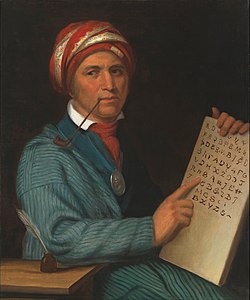
Around 1809 Sequoyah began developing a written form of the Cherokee language. He spoke no English, but his experiences as a silversmith dealing regularly with white settlers, and as a warrior at Horseshoe Bend, convinced him the Cherokee needed to develop writing. In 1821, he introduced Cherokee syllabary, the first written syllabic form of an American Indian language outside of Central America. Initially, his innovation was opposed by both Cherokee traditionalists and white missionaries, who sought to encourage the use of English. When Sequoyah taught children to read and write with the syllabary, he reached the adults. By the 1820s, the Cherokee had a higher rate of literacy than the whites around them in Georgia.

In 1819, the Cherokee began holding council meetings at New Town, at the headwaters of the Oostanaula (near present-day Calhoun, Georgia). In November 1825, New Town became the capital of the Cherokee Nation, and was renamed New Echota, after the Overhill Cherokee principal town of Chota.[50] Sequoyah's syllabary was adopted. They had developed a police force, a judicial system, and a National Committee.
In 1827, the Cherokee Nation drafted a Constitution modeled on the United States, with executive, legislative and judicial branches and a system of checks and balances. The two-tiered legislature was led by Major Ridge and his son John Ridge. Convinced the tribe's survival required English-speaking leaders who could negotiate with the U.S., the legislature appointed John Ross as Principal Chief. A printing press was established at New Echota by the Vermont missionary Samuel Worcester and Major Ridge's nephew Elias Boudinot, who had taken the name of his white benefactor, a leader of the Continental Congress and New Jersey Congressman. They translated the Bible into Cherokee syllabary. Boudinot published the first edition of the bilingual 'Cherokee Phoenix,' the first American Indian newspaper, in February 1828.[51]
Removal era
[edit]
Before the final removal to present-day Oklahoma, many Cherokees relocated to present-day Arkansas, Missouri and Texas.[52] Between 1775 and 1786 the Cherokee, along with people of other nations such as the Choctaw and Chickasaw, began voluntarily settling along the Arkansas and Red Rivers.[53]
In 1802, the federal government promised to extinguish Indian titles to lands claimed by Georgia in return for Georgia's cession of the western lands that became Alabama and Mississippi. To convince the Cherokee to move voluntarily in 1815, the US government established a Cherokee Reservation in Arkansas.[54] The reservation boundaries extended from north of the Arkansas River to the southern bank of the White River. Di'wali (The Bowl), Sequoyah, Spring Frog and Tatsi (Dutch) and their bands settled there. These Cherokees became known as "Old Settlers."
The Cherokee eventually migrated as far north as the Missouri Bootheel by 1816. They lived interspersed among the Delawares and Shawnees of that area.[55] The Cherokee in Missouri Territory increased rapidly in population, from 1,000 to 6,000 over the next year (1816–1817), according to reports by Governor William Clark.[56] Increased conflicts with the Osage Nation led to the Battle of Claremore Mound and the eventual establishment of Fort Smith between Cherokee and Osage communities.[57] In the Treaty of St. Louis (1825), the Osage were made to "cede and relinquish to the United States, all their right, title, interest, and claim, to lands lying within the State of Missouri and Territory of Arkansas ..." to make room for the Cherokee and the Mashcoux, Muscogee Creeks.[58] As late as the winter of 1838, Cherokee and Creek living in the Missouri and Arkansas areas petitioned the War Department to remove the Osage from the area.[59]
A group of Cherokee traditionalists led by Di'wali moved to Spanish Texas in 1819. Settling near Nacogdoches, they were welcomed by Mexican authorities as potential allies against Anglo-American colonists. The Texas Cherokees were mostly neutral during the Texas War of Independence. In 1836, they signed a treaty with Texas President Sam Houston, an adopted member of the Cherokee tribe. His successor Mirabeau Lamar sent militia to evict them in 1839.
Trail of Tears
[edit]
Following the War of 1812, and the concurrent Red Stick War, the U.S. government persuaded several groups of Cherokee to a voluntary removal to the Arkansas Territory. These were the "Old Settlers", the first of the Cherokee to make their way to what would eventually become Indian Territory (modern day Oklahoma). This effort was headed by Indian Agent Return J. Meigs, and was finalized with the signing of the Jackson and McMinn Treaty, giving the Old Settlers undisputed title to the lands designated for their use.[60]
During this time, Georgia focused on removing the Cherokee's neighbors, the Lower Creek. Georgia Governor George Troup and his cousin William McIntosh, chief of the Lower Creek, signed the Treaty of Indian Springs in 1825, ceding the last Muscogee (Creek) lands claimed by Georgia. The state's northwestern border reached the Chattahoochee, the border of the Cherokee Nation. In 1829, gold was discovered at Dahlonega, on Cherokee land claimed by Georgia. The Georgia Gold Rush was the first in U.S. history, and state officials demanded that the federal government expel the Cherokee. When Andrew Jackson was inaugurated as president in 1829, Georgia gained a strong ally in Washington. In 1830 Congress passed the Indian Removal Act, authorizing the forcible relocation of American Indians east of the Mississippi to a new Indian Territory.
Jackson claimed the removal policy was an effort to prevent the Cherokee from facing extinction as a people, which he considered the fate that "...the Mohegan, the Narragansett, and the Delaware" had suffered.[61] There is, however, ample evidence that the Cherokee were adapting to modern farming techniques. A modern analysis shows that the area was in general in a state of economic surplus and could have accommodated both the Cherokee and new settlers.[62]
The Cherokee brought their grievances to a US judicial review that set a precedent in Indian country. John Ross traveled to Washington, D.C., and won support from National Republican Party leaders Henry Clay and Daniel Webster. Samuel Worcester campaigned on behalf of the Cherokee in New England, where their cause was taken up by Ralph Waldo Emerson (see Emerson's 1838 letter to Martin Van Buren). In June 1830, a delegation led by Chief Ross defended Cherokee rights before the U.S. Supreme Court in Cherokee Nation v. Georgia.
In 1831, Georgia militia arrested Samuel Worcester for residing on Indian lands without a state permit, imprisoning him in Milledgeville. In Worcester v. Georgia (1832), the US Supreme Court Chief Justice John Marshall ruled that American Indian nations were "distinct, independent political communities retaining their original natural rights," and entitled to federal protection from the actions of state governments that infringed on their sovereignty.[63] Worcester v. Georgia is considered one of the most important dicta in law dealing with Native Americans.
Jackson ignored the Supreme Court's ruling, as he needed to conciliate Southern sectionalism during the era of the Nullification Crisis. His landslide reelection in 1832 emboldened calls for Cherokee removal. Georgia sold Cherokee lands to its citizens in a Land Lottery, and the state militia occupied New Echota. The Cherokee National Council, led by John Ross, fled to Red Clay, a remote valley north of Georgia's land claim. Ross had the support of Cherokee traditionalists, who could not imagine removal from their ancestral lands.

A small group known as the "Ridge Party" or the "Treaty Party" saw relocation as inevitable and believed the Cherokee Nation needed to make the best deal to preserve their rights in Indian Territory. Led by Major Ridge, John Ridge and Elias Boudinot, they represented the Cherokee elite, whose homes, plantations and businesses were confiscated, or under threat of being taken by white squatters with Georgia land-titles. With capital to acquire new lands, they were more inclined to accept relocation. On December 29, 1835, the "Ridge Party" signed the Treaty of New Echota, stipulating terms and conditions for the removal of the Cherokee Nation. In return for their lands, the Cherokee were promised a large tract in the Indian Territory, $5 million, and $300,000 for improvements on their new lands.[64]
John Ross gathered over 15,000 signatures for a petition to the U.S. Senate, insisting that the treaty was invalid because it did not have the support of the majority of the Cherokee people. The Senate passed the Treaty of New Echota by a one-vote margin. It was enacted into law in May 1836.[65]
Two years later, President Martin Van Buren ordered 7,000 federal troops and state militia under General Winfield Scott into Cherokee lands to evict the tribe. Over 16,000 Cherokee were forcibly relocated westward to Indian Territory in 1838–1839, a migration known as the Trail of Tears or in Cherokee ᏅᎾ ᏓᎤᎳ ᏨᏱ or Nvna Daula Tsvyi (The Trail Where They Cried), although it is described by another word Tlo-va-sa (The Removal). Marched over 800 miles (1,300 km) across Tennessee, Kentucky, Illinois, Missouri and Arkansas, the people suffered from disease, exposure and starvation, and as many as 4,000 died, nearly a fifth of the population.[66] As some Cherokees were slaveholders, they took enslaved African Americans with them west of the Mississippi. Intermarried European Americans and missionaries also walked the Trail of Tears. Ross preserved a vestige of independence by negotiating permission for the Cherokee to conduct their own removal under U.S. supervision.[67]
In keeping with the tribe's "blood law" that prescribed the death penalty for Cherokee who sold lands, Ross's son arranged the murder of the leaders of the "Treaty Party". On June 22, 1839, a party of twenty-five Ross supporters assassinated Major Ridge, John Ridge and Elias Boudinot. The party included Daniel Colston, John Vann, Archibald, James and Joseph Spear. Boudinot's brother Stand Watie fought and survived that day, escaping to Arkansas.
In 1827, Sequoyah had led a delegation of Old Settlers to Washington, D.C., to negotiate for the exchange of Arkansas land for land in Indian Territory. After the Trail of Tears, he helped mediate divisions between the Old Settlers and the rival factions of the more recent arrivals. In 1839, as President of the Western Cherokee, Sequoyah signed an Act of Union with John Ross that reunited the two groups of the Cherokee Nation.
Eastern Band
[edit]_Smithsonian.jpg)
The Cherokee living along the Oconaluftee River in the Great Smoky Mountains were the most conservative and isolated from European–American settlements. They rejected the reforms of the Cherokee Nation. When the Cherokee government ceded all territory east of the Little Tennessee River to North Carolina in 1819, they withdrew from the Nation.[68] William Holland Thomas, a white store owner and state legislator from Jackson County, North Carolina, helped over 600 Cherokee from Qualla Town obtain North Carolina citizenship, which exempted them from forced removal. Over 400 Cherokee either hid from Federal troops in the remote Snowbird Mountains, under the leadership of Tsali (ᏣᎵ),[69] or belonged to the former Valley Towns area around the Cheoah River who negotiated with the state government to stay in North Carolina. An additional 400 Cherokee stayed on reserves in Southeast Tennessee, North Georgia, and Northeast Alabama, as citizens of their respective states. Together, these groups were the ancestors of the federally recognized Eastern Band of Cherokee Indians, and some of the state-recognized tribes in surrounding states.
Civil War
[edit]
The American Civil War was devastating for both East and Western Cherokee. The Eastern Band, aided by William Thomas, became the Thomas Legion of Cherokee Indians and Highlanders, fighting for the Confederacy in the American Civil War.[70] Cherokee in Indian Territory divided into Union and Confederate factions.
Stand Watie, the leader of the Ridge Party, raised a regiment for Confederate service in 1861. John Ross, who had reluctantly agreed to ally with the Confederacy, was captured by Federal troops in 1862. He lived in a self-imposed exile in Philadelphia, supporting the Union. In the Indian Territory, the national council of those who supported the Union voted to abolish slavery in the Cherokee Nation in 1863, but they were not the majority slaveholders and the vote had little effect on those supporting the Confederacy.
Watie was elected Principal Chief of the pro-Confederacy majority. A master of hit-and-run cavalry tactics, Watie fought those Cherokee loyal to John Ross and Federal troops in Indian Territory and Arkansas, capturing Union supply trains and steamboats, and saving a Confederate army by covering their retreat after the Battle of Pea Ridge in March 1862. He became a Brigadier General of the Confederate States; the only other American Indian to hold the rank in the American Civil War was Ely S. Parker with the Union Army. On June 25, 1865, two months after Robert E. Lee surrendered at Appomattox, Stand Watie became the last Confederate General to stand down.
Reconstruction and late 19th century
[edit]
After the Civil War, the U.S. government required the Cherokee Nation to sign a new treaty, because of its alliance with the Confederacy. The U.S. required the 1866 Treaty to provide for the emancipation of all Cherokee slaves, and full citizenship to all Cherokee Freedmen and all African Americans who chose to continue to reside within tribal lands, so that they "shall have all the rights of native Cherokees."[71] Both before and after the Civil War, some Cherokee intermarried or had relationships with African Americans, just as they had with whites. Many Cherokee Freedmen have been active politically within the tribe.
The US government also acquired easement rights to the western part of the territory, which became the Oklahoma Territory, for the construction of railroads. Development and settlers followed the railroads. By the late 19th century, the government believed that Native Americans would be better off if each family owned its own land. The Dawes Act of 1887 provided for the breakup of commonly held tribal land into individual household allotments. Native Americans were registered on the Dawes Rolls and allotted land from the common reserve. The U.S. government counted the remainder of tribal land as "surplus" and sold it to non-Cherokee individuals.
The Curtis Act of 1898 dismantled tribal governments, courts, schools, and other civic institutions. For Indian Territory, this meant the abolition of the Cherokee courts and governmental systems. This was seen as necessary before the Oklahoma and Indian territories could be admitted as a combined state. In 1905, the Five Civilized Tribes of the Indian Territory proposed the creation of the State of Sequoyah as one to be exclusively Native American but failed to gain support in Washington, D.C.. In 1907, the Oklahoma and Indian Territories entered the union as the state of Oklahoma.

By the late 19th century, the Eastern Band of Cherokee were laboring under the constraints of a segregated society. In the aftermath of Reconstruction, conservative white Democrats regained power in North Carolina and other southern states. They proceeded to effectively disenfranchise all blacks and many poor whites by new constitutions and laws related to voter registration and elections. They passed Jim Crow laws that divided society into "white" and "colored", mostly to control freedmen. Cherokee and other Native Americans were classified on the colored side and suffered the same racial segregation and disenfranchisement as former slaves. They also often lost their historical documentation for identification as Indians, when the Southern states classified them as colored. Black Americans and Native Americans would not have their constitutional rights as U.S. citizens enforced until after the Civil Rights Movement secured passage of civil rights legislation in the mid-1960s, and the federal government began to monitor voter registration and elections, as well as other programs.[citation needed]
Tribal land jurisdiction status
[edit]On July 9, 2020, the United States Supreme Court decided in the McGirt v Oklahoma decision in a criminal jurisdiction case that roughly half the land of the state of Oklahoma made up of tribal nations like the Cherokee are officially Native American tribal land jurisdictions.[72] Oklahoma Governor Kevin Stitt, himself a Cherokee Nation citizen, sought to reverse the Supreme Court decision. The following year, the state of Oklahoma couldn't block federal action to grant the Cherokee Nation—along with the Chickasaw, Choctaw, Muscogee (Creek), and Seminole Nations—reservation status.[73]
Population history
[edit]John R. Swanton enumerates 201 Cherokee villages and towns.[74] The Cherokee had 6,000 warriors (and therefore around 30,000 people) in years 1730–35 according to J. Adair. In 1738 they also had 6,000 warriors, but down to 5,000 in 1740 (according to Ga. Hist. Coll., II). Colonel James Oglethorpe confirms that they had 5,000 warriors in 1739 (Ga. Coll. Rec., V). Also according to Ga. Coll. Rec., V an epidemic reduced them "by almost one-half" in 1738, but this source doesn't specify how numerous they were before the epidemic. Perhaps this source exaggerates the casualties caused by that epidemic, and in fact it killed just around 1,000 warriors. Arthur Dobbs estimated the Cherokee warrior strength in 1755 at 2,590 (but W. Douglas at about the same time reported 6,000 warriors). In 1761 soon after the end of the Anglo-Cherokee War there were 2,300 warriors according to J. Adair. By year 1768 their number recovered back to 3,000 warriors, and B. R. Carroll in "Historical Collections of South Carolina" also reported that they had 3,000 warriors.[75] By 1819 there were 4,000 warriors (and therefore around 20,000 people - including about 5,000 to the west of the Mississippi). George Catlin estimated 22,000 Cherokees in 1832, before their removal. But according to a report by the Commissioner of Indian Affairs dated November 25, 1841, the number of Cherokees who had already been removed west of the Mississippi (to Oklahoma, Indian Territory) was 25,911.[76] Henry Schoolcraft reported 21,707 Cherokees in 1857. Indian Affairs 1861 reported 22,000. Enumeration published in 1886 counted 23,000 Cherokee in Oklahoma (Indian Territory) as of year 1884.[77] Indian Affairs reported in 1890 around 25,000 among the Western Cherokee (in Oklahoma) and in years 1884 and 1889 around 3,000 among the Eastern Cherokee. The Cherokee national census of 1890 in Oklahoma gave the total number of the nation under Cherokee law to be 25,978. In 1900 there were 35,000 in Oklahoma. According to James Mooney (quoted by Frederick Webb Hodge) the majority of the earlier estimates of the Cherokee population are probably too low as the Cherokee occupied so extensive a territory that only a part of them came into contact with the Whites. Indian Affairs 1910 reported that in 1910 the Cherokee in Oklahoma contained 41,701 people, including 36,301 by blood, 286 by intermarriage and 4,917 Freedmen.[78] While the census of 1910 counted 31,489 Cherokees.
In the 2020 census a total of 1,130,730 people claimed Cherokee ancestry.[79] However the percentage of full-blood individuals is probably very low considering that the Eastern Band of Cherokee Indians reported having only 395 full-blood members.[80] Perhaps there is a larger number of full-blood individuals among the United Keetoowah Band and among the Cherokee Nation.
Culture
[edit]Spirituality
[edit]The Cherokee believe that the world is divided into two major spiritual forces: "red" (war, success, youth) and "white" (peace, introspection, old age).[81][82][83]
Cultural institutions
[edit]The Qualla Arts and Crafts Mutual, Inc., of Cherokee, North Carolina, is the oldest continuing Native American art co-operative. They were founded in 1946 to provide a venue for traditional Eastern Band Cherokee artists.[84] The Museum of the Cherokee People, also in Cherokee, displays permanent and changing exhibits, houses archives and collections important to Cherokee history, and sponsors cultural groups, such as the Warriors of the AniKituhwa dance group.[85]
In 2007, the Eastern Band of Cherokee Indians entered into a partnership with Southwestern Community College and Western Carolina University to create the Oconaluftee Institute for Cultural Arts (OICA), to emphasize native art and culture in traditional fine arts education. This is intended both to preserve traditional art forms and encourage exploration of contemporary ideas. Located in Cherokee, OICA offered an associate degree program.[86] In August 2010, OICA acquired a letterpress and had the Cherokee syllabary recast to begin printing one-of-a-kind fine art books and prints in the Cherokee language.[87] In 2012, the Fine Art degree program at OICA was incorporated into Southwestern Community College and moved to the SCC Swain Center, where it continues to operate.[88]
The Cherokee Heritage Center, of Park Hill, Oklahoma, is the site of a reproduction of an ancient Cherokee village, Adams Rural Village (including 19th-century buildings), Nofire Farms, and the Cherokee Family Research Center for genealogy.[89] The Cherokee Heritage Center also houses the Cherokee National Archives. Both the Cherokee Nation (of Oklahoma) and the United Keetoowah Band of Cherokee, as well as other tribes, contribute funding to the CHC.
Marriage
[edit]Before the 19th century, polygamy was common among the Cherokee, especially by elite men.[90] The matrilineal culture meant that women controlled property, such as their dwellings, and their children were considered born into their mother's clan, where they gained hereditary status. Advancement to leadership positions was generally subject to approval by the women elders. In addition, the society was matrifocal; customarily, a married couple lived with or near the woman's family, so she could be aided by her female relatives. Her eldest brother was a more important mentor to her sons than was their father, who belonged to another clan. Traditionally, couples, particularly women, can divorce freely.[91]
It was unusual for a Cherokee man to marry a European-American woman. The children of such a union were disadvantaged, as they would not belong to the nation. They would be born outside the clans and traditionally were not considered Cherokee citizens. This is because of the matrilineal aspect of Cherokee culture.[90] As the Cherokee began to adopt some elements of European-American culture in the early 19th century, they sent elite young men, such as John Ridge and Elias Boudinot to American schools for education. After Ridge had married a European-American woman from Connecticut and Boudinot was engaged to another, the Cherokee Council in 1825 passed a law making children of such unions full citizens of the tribe, as if their mothers were Cherokee. This was a way to protect the families of men expected to be leaders of the tribe.[92]
In the late nineteenth century, the U.S. government put new restrictions on marriage between a Cherokee and non-Cherokee, although it was still relatively common. A European-American man could legally marry a Cherokee woman by petitioning the federal court, after gaining the approval of ten of her blood relatives. Once married, the man had status as an "Intermarried White," a member of the Cherokee tribe with restricted rights; for instance, he could not hold any tribal office. He remained a citizen of and under the laws of the United States. Common law marriages were more popular. Such "Intermarried Whites" were listed in a separate category on the registers of the Dawes Rolls, prepared for allotment of plots of land to individual households of members of the tribe, in the early twentieth-century federal policy for assimilation of the Native Americans.
Ethnobotany definition
[edit]Ethnobotany is the study of interrelations between humans and plants; however, current use of the term implies the study of Indigenous or traditional knowledge of plants. It involves the Indigenous knowledge of plant classification, cultivation, and use as food, medicine and shelter.
Gender roles
[edit]Men and women have historically played important yet, at times, different roles in Cherokee society. Historically, women have primarily been the heads of households, owning the home and the land, farmers of the family's land, and "mothers" of the clans. As in many Native American cultures, Cherokee women are honored as life-givers.[93] As givers and nurturers of life via childbirth and the growing of plants, and community leaders as clan mothers, women are traditionally community leaders in Cherokee communities. Some have served as warriors, both historically and in contemporary culture in military service. Cherokee women are regarded as tradition-keepers and responsible for cultural preservation.[94]
The redefining of gender roles in Cherokee society first occurred in the time period between 1776 and 1835.[95] This period is demarcated by the De Soto exploration and subsequent invasion, was followed by the American Revolution in 1776, and culminated with the signing of Treaty of New Echota in 1835. The purpose of this redefinition was to push European social standards and norms on the Cherokee people.[95] The long-lasting effect of these practices reorganized Cherokee forms of government towards a male-dominated society which has affected the nation for generations.[96] Miles argues white agents were mainly responsible for the shifting of Cherokee attitudes toward women's role in politics and domestic spaces.[96] These "white agents" could be identified as white missionaries and white settlers seeking out "manifest destiny".[96] By the time of removal in the mid-1830s, Cherokee men and women had begun to fulfill different roles and expectations as defined by the "civilization" program promoted by US presidents Washington and Jefferson.[95]
 |
While there is a record of a non-Native traveler in 1825 noticing what he considered to be "men who assumed the dress and performed the duties of women", this observer was unfamiliar with how the Natives in that region dressed. There is no evidence of what would now be considered "two-spirit" individuals in Cherokee society; this is generally the case in matriarchal and matrilineal cultures, as third gender roles are usually found in patriarchal societies and cultures with more rigid gender roles.[97]
Slavery
[edit]Slavery was a component of Cherokee society prior to European colonization, as they frequently enslaved enemy captives taken during times of conflict with other Indigenous tribes.[98] By their oral tradition, the Cherokee viewed slavery as the result of an individual's failure in warfare and as a temporary status, pending release or the slave's adoption into the tribe.[99] During the colonial era, Carolinian settlers purchased or impressed Cherokees as slaves during the late 17th and early 18th century.[100] The Cherokee were also among the Native American peoples who sold Indian slaves to traders for use as laborers in Virginia and further north. They took them as captives in raids on enemy tribes.[101]
As the Cherokee began to adopt some European-American customs, they began to purchase enslaved African Americans to serve as workers on their farms or plantations, which some of the elite families had in the antebellum years. When the Cherokee were forcibly removed on the Trail of Tears, they took slaves with them, and acquired others in Indian Territory.[102]
Funeral rites
[edit]Language and writing system
[edit]
The Cherokee speak a Southern Iroquoian language, which is polysynthetic and is written in a syllabary invented by Sequoyah (ᏍᏏᏉᏯ) in the 1810s.[103] For years, many people wrote and transliterated Cherokee or used poor intercompatible fonts to type out the syllabary. However, since the fairly recent addition of the Cherokee syllables to Unicode, the Cherokee language is experiencing a renaissance in its use on the Internet.
Because of the polysynthetic nature of the Cherokee language, new and descriptive words in Cherokee are easily constructed to reflect or express modern concepts. Examples include ditiyohihi (ᏗᏘᏲᎯᎯ), which means "he argues repeatedly and on purpose with a purpose," meaning "attorney." Another example is didaniyisgi (ᏗᏓᏂᏱᏍᎩ) which means "he catches them finally and conclusively," meaning "policeman."
Many words, however, have been borrowed from the English language, such as gasoline, which in Cherokee is ga-so-li-ne (ᎦᏐᎵᏁ). Many other words were borrowed from the languages of tribes who settled in Oklahoma in the early 20th century. One example relates to a town in Oklahoma named "Nowata". The word nowata is a Delaware Indian word for "welcome" (more precisely the Delaware word is nu-wi-ta which can mean "welcome" or "friend" in the Delaware Language). The white settlers of the area used the name "nowata" for the township, and local Cherokees, being unaware the word had its origins in the Delaware Language, called the town Amadikanigvnagvna (ᎠᎹᏗᎧᏂᎬᎾᎬᎾ) which means "the water is all gone from here", i.e. "no water".
Other examples of borrowed words are kawi (ᎧᏫ) for coffee and watsi (ᏩᏥ) for watch (which led to utana watsi (ᎤᏔᎾ ᏩᏥ) or "big watch" for clock).
The following table is an example of Cherokee text and its translation:
| ᏣᎳᎩ: ᏂᎦᏓ ᎠᏂᏴᏫ ᏂᎨᎫᏓᎸᎾ ᎠᎴ ᎤᏂᏠᏱ ᎤᎾᏕᎿ ᏚᏳᎧᏛ ᎨᏒᎢ. ᎨᏥᏁᎳ ᎤᎾᏓᏅᏖᏗ ᎠᎴ ᎤᏃᏟᏍᏗ ᎠᎴ ᏌᏊ ᎨᏒ ᏧᏂᎸᏫᏍᏓᏁᏗ ᎠᎾᏟᏅᏢ ᎠᏓᏅᏙ ᎬᏗ.[104] |
| Tsalagi: Nigada aniyvwi nigeguda'lvna ale unihloyi unadehna duyukdv gesv'i. Gejinela unadanvtehdi ale unohlisdi ale sagwu gesv junilvwisdanedi anahldinvdlv adanvdo gvhdi.[104] |
| All human beings are born free and equal in dignity and rights. They are endowed with reason and conscience and should act towards one another in a spirit of brotherhood. (Article 1 of the Universal Declaration of Human Rights)[104] |
Treaties and government
[edit]Treaties
[edit]The Cherokee have participated in at least thirty-six treaties in the past three hundred years.
Government
[edit]| 1794 | Establishment of the Cherokee National Council and officers over the whole nation |
| 1808 | Establishment of the Cherokee Lighthorse Guard, a national police force |
| 1809 | Establishment of the National Committee |
| 1810 | End of separate regional councils and abolition of blood vengeance |
| 1820 | Establishment of courts in eight districts to handle civil disputes |
| 1822 | Cherokee Supreme Court established |
| 1823 | National Committee given power to review acts of the National Council |
| 1827 | Constitution of the Cherokee Nation East |
| 1828 | Constitution of the Cherokee Nation West |
| 1832 | Suspension of elections in the Cherokee Nation East |
| 1839 | Constitution of the reunited Cherokee Nation |
| 1868 | Constitution of the Eastern Band of Cherokee Indians |
| 1888 | Charter of Incorporation issued by the State of North Carolina to the Eastern Band |
| 1950 | Constitution and federal charter of the United Keetoowah Band of Cherokee Indians |
| 1975 | Constitution of the Cherokee Nation of Oklahoma |
| 1999 | Constitution of the Cherokee Nation drafted[105] |
After being ravaged by smallpox, and feeling pressure from European settlers, the Cherokee adopted a European-American Representative democracy form of government in an effort to retain their lands. They established a governmental system modeled on that of the United States, with an elected principal chief, senate, and house of representatives. On April 10, 1810 the seven Cherokee clans met and began the abolition of blood vengeance by giving the sacred duty to the new Cherokee National government. Clans formally relinquished judicial responsibilities by the 1820s when the Cherokee Supreme Court was established. In 1825, the National Council extended citizenship to the children of Cherokee men married to white women. These ideas were largely incorporated into the 1827 Cherokee constitution.[106] The constitution stated that "No person who is of negro or mulatto [sic] parentage, either by the father or mother side, shall be eligible to hold any office of profit, honor or trust under this Government," with an exception for, "negroes and descendants of white and Indian men by negro women who may have been set free."[107] This definition to limit rights of multiracial descendants may have been more widely held among the elite than the general population.[108]
Modern Cherokee tribes
[edit]Cherokee Nation
[edit]


During 1898–1906 the federal government dissolved the former Cherokee Nation, to make way for the incorporation of Indian Territory into the new state of Oklahoma. From 1906 to 1975, the structure and function of the tribal government were defunct, except for the purposes of DOI management. In 1975 the tribe drafted a constitution, which they ratified on June 26, 1976,[109] and the tribe received federal recognition.
In 1999, the CN changed or added several provisions to its constitution, among them the designation of the tribe to be "Cherokee Nation," dropping "of Oklahoma." According to a 2009 statement by BIA head Larry Echo Hawk, the Cherokee Nation is not legally considered the "historical Cherokee tribe" but instead a "successor in interest." The attorney of the Cherokee Nation has stated that they intend to appeal this decision.[110]
The modern Cherokee Nation, in recent times, has expanded economically, providing equality and prosperity for its citizens. Under the leadership of Principal Chief Bill John Baker, the Nation has significant business, corporate, real estate, and agricultural interests. The CN controls Cherokee Nation Entertainment, Cherokee Nation Industries, and Cherokee Nation Businesses. CNI is a very large defense contractor that creates thousands of jobs in eastern Oklahoma for Cherokee citizens.
The CN has constructed health clinics throughout Oklahoma, contributed to community development programs, built roads and bridges, constructed learning facilities and universities for its citizens, instilled the practice of Gadugi and self-reliance, revitalized language immersion programs for its children and youth, and is a powerful and positive economic and political force in Eastern Oklahoma.
The CN hosts the Cherokee National Holiday on Labor Day weekend each year, and 80,000 to 90,000 Cherokee citizens travel to Tahlequah, Oklahoma, for the festivities. It publishes the Cherokee Phoenix, the tribal newspaper, in both English and Cherokee, using the Sequoyah syllabary. The Cherokee Nation council appropriates money for historic foundations concerned with the preservation of Cherokee culture.
The Cherokee Nation supports the Cherokee Nation Film festivals in Tahlequah, Oklahoma and participates in the Sundance Film Festival in Park City, Utah.
Eastern Band of Cherokee Indians
[edit]The Eastern Band of the Cherokee Indians in North Carolina, led by Chief Richard Sneed, hosts over a million visitors a year to cultural attractions of the 100-square-mile (260 km2) sovereign nation. The reservation, the "Qualla Boundary", has a population of over 8,000 Cherokee, primarily direct descendants of Indians who managed to avoid "The Trail of Tears".
Attractions include the Oconaluftee Indian Village, Museum of the Cherokee Indian, and the Qualla Arts and Crafts Mutual. Founded in 1946, the Qualla Arts and Crafts Mutual is the country's oldest and foremost Native American crafts cooperative.[111] The outdoor drama Unto These Hills, which debuted in 1950, recently broke record attendance sales. Together with Harrah's Cherokee Casino and Hotel, Cherokee Indian Hospital and Cherokee Boys Club, the tribe generated $78 million in the local economy in 2005.
United Keetoowah Band of Cherokee Indians
[edit].png)
The United Keetoowah Band of Cherokee Indians formed their government under the Indian Reorganization Act of 1934 and gained federal recognition in 1946. Enrollment in the tribe is limited to people with a quarter or more of Cherokee blood. Many members of the UKB are descended from Old Settlers – Cherokees who moved to Arkansas and Indian Territory before the Trail of Tears.[112] Of the 12,000 people enrolled in the tribe, 11,000 live in Oklahoma. Their chief is Joe Bunch.
The UKB operate a tribal casino, bingo hall, smokeshop, fuel outlets, truck stop, and gallery that showcases art and crafts made by tribal members. The tribe issues their own tribal vehicle tags.[113]
Relations among the three federally recognized Cherokee tribes
[edit]The Cherokee Nation participates in numerous joint programs with the Eastern Band of Cherokee Indians. It also participates in cultural exchange programs and joint Tribal Council meetings involving councilors from both Cherokee Tribes. These are held to address issues affecting all of the Cherokee people.
174 years after the Trail of Tears, on July 12, 2012, the leaders of the three separate Cherokee tribes met in North Carolina.[where?][114]
Contemporary settlement
[edit]Cherokee people are most concentrated in Oklahoma and North Carolina, but some reside in the US West Coast, due to economic migrations caused by the Dust Bowl during the Great Depression, job availability during the Second World War, and the Federal Indian Relocation program during the 1950s–1960s. Destinations for Cherokee diaspora included multi-ethnic/racial urban centers of California (i.e. the Greater Los Angeles and San Francisco Bay Areas). They frequently live in farming communities, or by military bases and other Indian reservations.[115]
Membership controversies
[edit]Tribal recognition and citizenship
[edit]The three Cherokee tribes have differing requirements for enrollment. The Cherokee Nation determines enrollment by lineal descent from Cherokees listed on the Dawes Rolls and has no minimum blood quantum requirement.[116] Currently, descendants of the Dawes Cherokee Freedman rolls are citizens of the tribe, pending court decisions. The Cherokee Nation includes numerous citizens who have mixed ancestry, including African-American, Latino American, Asian American, European-American, and others. The Eastern Band of Cherokee Indians requires a minimum of one-sixteenth Cherokee blood quantum (genealogical descent, equivalent to one great-great-grandparent) and an ancestor on the Baker Roll. The United Keetoowah Band of Cherokee Indians requires a minimum of one-quarter Keetoowah Cherokee blood quantum (equivalent to one grandparent). The UKB does not allow citizens who have relinquished their citizenship to re-enroll in the UKB.[117]
The 2000 United States census reported 729,533 Americans self-identified as Cherokee. The 2010 census reported an increased number of 819,105 with almost 70% being mixed-race Cherokees. In 2015, the Cherokee Nation, the United Keetoowah Band of Cherokee Indians, and the Eastern Band of Cherokees had a combined enrolled population of roughly 344,700.[2]
Over 200 groups claim to be Cherokee nations, tribes, or bands.[118] Cherokee Nation spokesman Mike Miller has suggested that some groups, which he calls Cherokee Heritage Groups, are encouraged.[119] Others, however, are controversial for their attempts to gain economically through their claims to be Cherokee. The three federally recognized groups note that they are the only groups having the legal right to present themselves as Cherokee Indian Tribes and only their enrolled citizens are legally Cherokee.[120]
One exception to this may be the Texas Cherokee. Before 1975, they were considered part of the Cherokee Nation, as reflected in briefs filed before the Indian Claims Commission. At one time W.W. Keeler served as Principal Chief of the Cherokee Nation and, at the same time, held the position as Chairman of the Texas Cherokee and Associated Bands (TCAB) Executive Committee. Following the adoption of the Cherokee constitution in 1976, TCAB descendants whose ancestors had remained a part of the physical Mount Tabor Community in Rusk County, Texas, were excluded from CN citizenship. Because they had already migrated from Indian Territory at the time of the Dawes Commission, their ancestors were not recorded on the Final Rolls of the Five Civilized Tribes, which serve as the basis for tracing descent for many individuals. But, most if not all TCAB descendants did have an ancestor listed on either the Guion-Miller or Old settler rolls.
While most Mount Tabor residents returned to the Cherokee Nation after the Civil War and following the death of John Ross in 1866, in the 21st century, there is a sizable group that is well documented but outside that body. It is not actively seeking a status clarification. They have treaty rights going back to the Treaty of Bird's Fort. From the end of the Civil War until 1975, they were associated with the Cherokee Nation.
Other remnant populations continue to exist throughout the Southeast United States and individually in the states surrounding Oklahoma. Many of these people trace descent from persons enumerated on official rolls such as the Guion-Miller, Drennan, Mullay, and Henderson Rolls, among others. Other descendants trace their heritage through the treaties of 1817 and 1819 with the federal government that gave individual land allotments to Cherokee households. State-recognized tribes may have different membership requirements and genealogical documentation than to the federally recognized ones.
Current enrollment guidelines of the Cherokee Nation of Oklahoma have been approved by the US Bureau of Indian Affairs. The CN noted such facts during the Constitutional Convention held to ratify a new governing document. The document was eventually ratified by a small portion of the electorate. Any changes to the tribe's enrollment procedures must be approved by the Department of Interior. Under 25 CFR 83, the Office of Federal Acknowledgment is required to first apply its own anthropological, genealogical, and historical research methods to any request for change by the tribe. It forwards its recommendations to the Assistant Secretary - Indian Affairs for consideration.[121]
Cherokee Freedmen
[edit]The Cherokee Freedmen, descendants of African American slaves owned by citizens of the Cherokee Nation during the Antebellum Period, were first guaranteed Cherokee citizenship under a treaty with the United States in 1866. This was in the wake of the American Civil War, when the U.S. emancipated slaves and passed US constitutional amendments granting freedmen citizenship in the United States.
In 1988, the federal court in the Freedmen case of Nero v. Cherokee Nation[122] held that Cherokees could decide citizenship requirements and exclude Freedmen. On March 7, 2006, the Cherokee Nation Judicial Appeal Tribunal ruled that the Cherokee Freedmen were eligible for Cherokee citizenship. This ruling proved controversial; while the Cherokee Freedman had historically been recorded as "citizens" of the Cherokee Nation at least since 1866 and the later Dawes Commission Land Rolls, the ruling "did not limit membership to people possessing Cherokee blood".[123] This ruling was consistent with the 1975 Constitution of the Cherokee Nation of Oklahoma, in its acceptance of the Cherokee Freedmen on the basis of historical citizenship, rather than documented blood relation.
On March 3, 2007, a constitutional amendment was passed by a Cherokee vote limiting citizenship to Cherokees on the Dawes Rolls for those listed as Cherokee by blood on the Dawes roll, which did not include partial Cherokee descendants of slaves, Shawnee and Delaware.[124] The Cherokee Freedmen had 90 days to appeal this amendment vote which disenfranchised them from Cherokee citizenship and file appeal within the Cherokee Nation Tribal Council, which is currently pending in Nash, et al. v. Cherokee Nation Registrar. On May 14, 2007, the Cherokee Freedmen were reinstated as citizens of the Cherokee Nation by the Cherokee Nation Tribal Courts through a temporary order and temporary injunction until the court reached its final decision.[125] On January 14, 2011, the tribal district court ruled that the 2007 constitutional amendment was invalid because it conflicted with the 1866 treaty guaranteeing the Freedmen's rights.[126]
See also
[edit]

Notes
[edit]- ^ "Pocket Pictorial". Archived April 6, 2010, at the Wayback Machine Oklahoma Indian Affairs Commission. 2010: 6 and 37. (retrieved June 11, 2010).
- ^ a b c Smithers, Gregory D. (October 1, 2015). "Why Do So Many Americans Think They Have Cherokee Blood?". www.slate.com. Retrieved April 24, 2017.
- ^ Chavez, Will (August 29, 2018). "Map shows CN citizen population for each state". Cherokee Phoenix. Tahlequah, OK. Retrieved September 4, 2020.
- ^ a b "U.S. Census website". United States Census Bureau. 2014. Retrieved April 24, 2017.
Community Facts (Georgia), 2014 American Community Survey, Demographic and Housing Estimates (Age, Sex, Race, Households and Housing, ...)
- ^ http://factfinder.census.gov/faces/nav/jsf/pages/index.xhtml Archived 2015-01-08 at the Library of Congress Web Archives, American FactFinder, Community Facts (South Carolina), 2014 American Community Survey, Demographic and Housing Estimates (Age, Sex, Race, Households and Housing,...)
- ^ "Aboriginal Population Profile, 2019 Census". www12.statcan.gc.ca/. Statistics Canada. June 21, 2018. Retrieved December 31, 2021.
- ^ Sturtevant and Fogelson, 613
- ^ Jones, Daniel (2011). Roach, Peter; Setter, Jane; Esling, John (eds.). Cambridge English Pronouncing Dictionary (18th ed.). Cambridge University Press. ISBN 978-0-521-15255-6.
- ^ Wells, John C. (2008). Longman Pronunciation Dictionary (3rd ed.). Longman. ISBN 978-1-4058-8118-0.
- ^ Stuyvesant, William C.; Fogelson, Raymond D., eds. (2004). Handbook of North American Indians: Southeast, Volume 14. Washington, DC: Smithsonian Institution. p. ix. ISBN 0-16-072300-0.
- ^ a b Mooney, James (2006) [1900]. Myths of the Cherokee and Sacred Formulas of the Cherokees. Kessinger Publishing. p. 393. ISBN 978-1-4286-4864-7.
- ^ Whyte, Thomas (June 2007). "Proto-Iroquoian divergence in the Late Archaic-Early Woodland period transition of the Appalachian highlands". Southeastern Archaeology. 26 (1): 134–144. JSTOR 40713422.
- ^ "Tribal Directory: Southeast". National Congress of American Indians. Retrieved June 9, 2017.
- ^ "The American Indian and Alaska Native Population: 2010" (PDF). Census 2010 Brief. February 1, 2002. Archived from the original (PDF) on January 20, 2013. Retrieved January 29, 2013.
- ^ "Cherokee Indians". Encyclopedia of North Carolina. The University of North Carolina Press. Archived from the original on December 23, 2016. Retrieved June 3, 2014.
- ^ Buchanan, Heidi. "Research Guides: Cherokee Studies: Welcome". researchguides.wcu.edu. Retrieved April 2, 2024.
- ^ Staff REPORTS (August 22, 2023). "Native American remains receive symbolic headstone at Fort Campbell". cherokeephoenix.org. Retrieved April 2, 2024.
- ^ Nagle, Rebecca (November 5, 2019). "The U.S. has spent more money erasing Native languages than saving them". High Country News. Retrieved April 2, 2024.
- ^ "Cherokee: A Language of the United States". Ethnologue: Languages of the World. SIL International. 2013. Archived from the original on September 25, 2014. Retrieved October 20, 2014.
- ^ Charles A. Hanna, The Wilderness Trail, (New York: 1911). This was chronicled by de Soto's expedition as Chalaque.
- ^ Martin and Mauldin, A Dictionary of Creek/Muskogee, Sturtevant and Fogelson, p. 349.
- ^ Mooney, James (1975). Historical Sketch of the Cherokee. Chicago, IL: Aldine Pub. Co. p. 4. ISBN 0202011364.
- ^ "Cherokee" Archived April 25, 2019, at the Wayback Machine - Tolatsga.org
- ^ Boyle, John (August 21, 2017). "Answer Man: Did the Cherokee live on Biltmore Estate lands? Early settlers?". Asheville Citizen-Times. Retrieved August 21, 2017.
- ^ Sturtevant and Fogelson, 132
- ^ Finger, 6–7
- ^ Clark, Patricia Roberts (October 21, 2009). Tribal Names of the Americas: Spelling Variants and Alternative Forms, Cross-Referenced. McFarland. p. 11. ISBN 978-0-7864-5169-2.
- ^ Or Achalaque.[27]
- ^ Mooney
- ^ "Late Prehistoric/Early Historic Chiefdoms (ca. A.D. 1300-1850)" Archived October 4, 2012, at the Wayback Machine. New Georgia Encyclopedia. Retrieved July 22, 2010.
- ^ a b Mooney, James (1995) [1900]. Myths of the Cherokee. Dover Publications. ISBN 0-486-28907-9.
- ^ Glottochronology from: Lounsbury, Floyd (1961), and Mithun, Marianne (1981), cited in Nicholas A. Hopkins, The Native Languages of the Southeastern United States.
- ^ Hally, David (2008). King: The Social Archaeology of a Late Mississippian Town in Northwestern Georgia. University of Alabama Press. p. 18. ISBN 9780817354602.
while men were considered to be dangerous immediately before and following their participation in warfare.
- ^ a b c Irwin 1992.
- ^ Mooney, p. 392.
- ^ Hamilton, Chuck (January 21, 2016). "Lost Nation of the Erie Part 1". www.chattanoogan.com. Archived from the original on January 23, 2017. Retrieved April 24, 2017.
- ^ Conley, A Cherokee Encyclopedia, p. 3
- ^ Mooney, Myths of the Cherokee p. 31.
- ^ Lewis Preston Summers, 1903, History of Southwest Virginia, 1746–1786, p. 40
- ^ Vicki Rozema, Footsteps of the Cherokees (1995), p. 14.
- ^ Oatis, Steven J. (2004). A Colonial Complex: South Carolina's Frontiers in the Era of the Yamasee War, 1680–1730. Lincoln: University of Nebraska Press. ISBN 0-8032-3575-5.
- ^ Brown, John P. "Eastern Cherokee Chiefs" Archived February 11, 2006, at the Wayback Machine, Chronicles of Oklahoma, Vol. 16, No. 1, March 1938. Retrieved September 21, 2009.
- ^ Adair, James (1775). The History of the American Indians. London: Dilly. p. 227. OCLC 444695506.
- ^ Timberlake, Henry (1765). "Memoirs of Henry Timberlake". London. pp. 49–51.
- ^ a b Rozema, pp. 17–23.
- ^ "Watauga Association" Archived November 13, 2009, at the Wayback Machine, North Carolina History Project. . Retrieved September 21, 2009.
- ^ Faragher, John Mack (1992). Daniel Boone: The Life and Legend of an American Pioneer. New York: Holt. pp. 93–4. ISBN 0-8050-1603-1.
- ^ Mooney, James. History, Myths, and Scared Formulas of the Cherokee, p. 83. (Washington: Government Printing Office, 1900).
- ^ "New Georgia Encyclopedia: Chief Vann House". Georgiaencyclopedia.org. September 23, 2005. Archived from the original on October 21, 2012. Retrieved April 17, 2010.
- ^ "New Echota Historic Site". Ngeorgia.com. June 5, 2007. Archived from the original on April 24, 2010. Retrieved April 17, 2010.
- ^ "New Georgia Encyclopedia: Cherokee Phoenix". Georgiaencyclopedia.org. August 28, 2002. Archived from the original on May 12, 2013. Retrieved April 17, 2010.
- ^ Rollings (1992) pp. 187, 230–255.
- ^ Rollings (1992) pp. 187, 236.
- ^ Logan, Charles Russell. "The Promised Land: The Cherokees, Arkansas, and Removal, 1794–1839." Archived October 20, 2007, at the Wayback Machine Arkansas Historic Preservation Program. 1997 . Retrieved September 21, 2009.
- ^ Doublass (1912) pp. 40–2
- ^ Rollings (1992) p. 235.
- ^ Rollings (1992) pp. 239–40.
- ^ Rollings (1992) pp. 254–5, Doublass (1912) p. 44.
- ^ Rollings (1992) pp. 280–1
- ^ Treaties; Tennessee Encyclopedia, online; accessed October 2019
- ^ Wishart, p. 120
- ^ Wishart 1995.
- ^ "New Georgia Encyclopedia: "Worcester v. Georgia (1832)"". Georgiaencyclopedia.org. April 27, 2004. Archived from the original on September 18, 2008. Retrieved April 17, 2010.
- ^ "Treaty of New Echota, Dec. 29, 1835 (Cherokee – United States)". Ourgeorgiahistory.com. Archived from the original on October 27, 2009. Retrieved April 17, 2010.
- ^ "Cherokee in Georgia: Treaty of New Echota". Ngeorgia.com. June 5, 2007. Archived from the original on January 10, 2010. Retrieved April 17, 2010.
- ^ "What Happened on the Trail of Tears?". National Park Service. Archived from the original on October 12, 2020.
- ^ "Books by Alex W. Bealer". goodreads.com, 1972 and 1996. Retrieved March 27, 2011.
- ^ Theda Purdue, Native Carolinians: The Indians of North Carolina, pg. 40
- ^ "Tsali." History and culture of the Cherokee (North Carolina Indians). (March 10, 2007)
- ^ "Will Thomas." History and culture of the Cherokee (North Carolina Indians). (March 10, 2007)
- ^ "Treaty with the Cherokee, 1866." Archived June 30, 2010, at the Wayback Machine Oklahoma Historical Society: Indian Affairs: Laws and Treaties. Vol. 2, Treaties. (retrieved January 10, 2010)
- ^ Wamsley, Laurel (July 9, 2020). "Supreme Court Rules That About Half of Oklahoma is Native American Land". NPR.
- ^ "Oklahoma governor's tribal fight raises ancestry questions". ABC News.
- ^ Swanton, John R. (1952). The Indian tribes of North America. Smithsonian Institution Bureau of American Ethnology. pp. 216–221. hdl:10088/15440.
- ^ Carroll, B. R. (1836). "Historical Collections of South Carolina". New York: Harper & brothers. p. 242.
- ^ "- Full View - UWDC - UW-Madison Libraries". search.library.wisc.edu.
- ^ Annual report of the Board of Regents of the Smithsonian Institution, showing the operations, expenditures, and condition of the Institution to July, 1885. Part II. Washington: Government Printing Office. 1886. p. 861.
- ^ Krzywicki, Ludwik (1934). Primitive society and its vital statistics. Publications of the Polish Sociological Institute. London: Macmillan. pp. 500–503.
- ^ "Distribution of American Indian tribes: Cherokee People in the US".
- ^ "EBCI has 395 full bloods". November 6, 2012.
- ^ "Cherokee | History, Culture, Language, Nation, People, & Facts | Britannica".
- ^ "Sacred Colors".
- ^ "Who are the Cherokee Nation?". Twinkl (in Portuguese). Retrieved May 12, 2025.
- ^ Qualla History. Archived September 9, 2009, at the Wayback Machine . Retrieved September 15, 09.
- ^ The Museum of the Cherokee Indian. . Retrieved September 15, 09.
- ^ "Announcement of the founding of the Oconaluftee Institute for Cultural Arts in Cherokee" Archived May 27, 2010, at the Wayback Machine, Southwestern Community College (retrieved November 24, 2010)
- ^ "New Letterpress Arrives at OICA" Archived July 14, 2011, at the Wayback Machine, The One Feather (retrieved November 24, 2010)
- ^ "OICA is gone, but not really", The One Feather (retrieved March 18, 2013)
- ^ "Cherokee Heritage Center". Retrieved March 10, 2007.
- ^ a b Perdue (1999), p. 176
- ^ Perdue (1999), pp. 44, 57–8
- ^ Yarbough, Fay (2004). "Legislating Women's Sexuality: Cherokee Marriage Laws". Journal of Social History. 38 (2): 385–406 [p. 388]. doi:10.1353/jsh.2004.0144. S2CID 144646968.
- ^ Mize, Jamie Myers (2017). Sons of Selu: Masculinity and Gendered Power in Cherokee Society, 1775–1846 (Thesis). ProQuest 1954047274.
- ^ Connell-Szasz, Margaret; Perdue, Theda (December 1999). "Cherokee Women: Gender and Culture Change, 1700-1835". The American Historical Review. 104 (5): 1659. doi:10.2307/2649389. JSTOR 2649389.
- ^ a b c Paulk-Kriebel, Virginia Beth (1999). "Review of Cherokee Women: Gender and Culture Change, 1700-1835". The North Carolina Historical Review. 76 (1): 118–119. JSTOR 23522191.
- ^ a b c Miles, Tiya (2010). The house on Diamond Hill : a Cherokee plantation story. Chapel Hill: University of North Carolina Press. ISBN 9780807834183. OCLC 495475390.
- ^ Smithers, Gregory D. (2014). "Cherokee 'Two Spirits': Gender, Ritual, and Spirituality in the Native South". Early American Studies. 12 (3): 626–651. doi:10.1353/eam.2014.0023. JSTOR 24474873. S2CID 143654806. Project MUSE 552419 ProQuest 1553321291.
- ^ for a full discussion, see Perdue (1979)
- ^ Russell (2002) p70
- ^ Russell (2002) p. 70. Ray (2007) p. 423, says that the peak of enslavement of Native Americans was between 1715 and 1717; it ended after the Revolutionary War.
- ^ Gallay, Alan (2002). The Indian Slave Trade: The Rise of the English Empire in the American South 1670–1717. Yale University Press. ISBN 0-300-10193-7.
- ^ Smith, Ryan P. "How Native American Slaveholders Complicate the Trail of Tears Narrative". Smithsonian Magazine. Retrieved September 9, 2020.
- ^ Morand, Ann, Kevin Smith, Daniel C. Swan, and Sarah Erwin. Treasures of Gilcrease: Selections from the Permanent Collection. Tulsa, OK: Gilcrease Museum,2003. ISBN 0-9725657-1-X
- ^ a b c "Cherokee syllabary". 1998–2009. Retrieved May 14, 2009.
- ^ This constitution was approved by Cherokee Nation voters in 2003 but was not approved by the BIA. The Cherokee Nation then amended their 1975 constitution to not require BIA approval. The 1999 constitution has been ratified but the Cherokee Nation Supreme Court is currently deciding what year the 1999 constitution officially went into effect. Constitution of the Cherokee Nation. Archived March 25, 2009, at the Wayback Machine (pdf file). Cherokee Nation. Retrieved March 5, 2009.
- ^ Perdue, p. 564.
- ^ Perdue, pp. 564–565.
- ^ Perdue, p. 566.
- ^ Constitution of the Cherokee Nation of Oklahoma. Archived February 12, 2009, at the Wayback Machine University of Oklahoma Law Center. (retrieved January 16, 2010)
- ^ Associated, The (July 13, 2009). "Cherokee Nation likely to appeal BIA decision | Indian Country Today | Archive". Indian Country Today. Archived from the original on October 7, 2009. Retrieved April 17, 2010.
- ^ Qualla Arts and Crafts Mutual, Inc., Smoky Mountain Host of North Carolina (retrieved July 1, 2014)
- ^ Leeds, George R. United Keetoowah Band. Archived July 20, 2010, at the Wayback Machine Oklahoma Historical Society's Encyclopedia of Oklahoma History and Culture. (retrieved October 5, 2009)
- ^ Oklahoma Office of Indian Affairs. Oklahoma Indian Nations Pocket Pictorial Directory. Archived February 11, 2009, at the Wayback Machine 2008:36
- ^ [Indian Country News, July 12, 2012]
- ^ "Cherokee Ancestry Search – Cherokee Genealogy by City". ePodunk.com. Archived from the original on July 30, 2010. Retrieved April 17, 2010.
- ^ Cherokee Nation Registration Archived July 18, 2007, at the Wayback Machine.
- ^ Enrollment. Archived June 9, 2010, at the Wayback Machine United Keetoowah Band of Cherokees. (retrieved October 5, 2009)
- ^ Glenn, Eddie. "A League of Nations?" Archived June 20, 2009, at archive.today Tahlequah Daily Press. January 6, 2006 (retrieved October 5, 2009)
- ^ Glenn 2006.
- ^ Official Statement Cherokee Nation 2000, Pierpoint 2000.
- ^ * Act of Congress Roll, 1854
- (Pre-convention – 1999) Oral and Written Testimonies Archived January 4, 2011, at the Wayback Machine
- Cherokee Census Rolls, a follow-up
- Chapman Roll Eastern Cherokees, 1851
- Treaty with the Cherokee, 1817 Archived November 3, 2012, at the Wayback Machine
- ^ Nero v. Cherokee Nation of Oklahoma, 892 F.2d 1457 (United States Court of Appeals, Tenth Circuit 22 December 1989), archived from the original on July 13, 2020.
- ^ "Freedman Decision" (PDF). Archived from the original (PDF) on February 13, 2007. Retrieved March 10, 2007.
- ^ Cherokee Constitutional Amendment March 3, 2007 Archived March 4, 2009, at the Wayback Machine.
- ^ "Nash, et al v. Cherokee Nation Registrar" (PDF).[permanent dead link]
- ^ Gavin Off, "Judge grants Cherokee citizenship to non-Indian freedmen", Tulsa World, January 14, 2011.
References
[edit]- Doublass, Robert Sydney. "History of Southeast Missouri", 1992, pp. 32–45
- Evans, E. Raymond. "Notable Persons in Cherokee History: Dragging Canoe". Journal of Cherokee Studies, Vol. 2, No. 2, pp. 176–189. (Cherokee: Museum of the Cherokee Indian, 1977).
- Finger, John R. Cherokee Americans: The Eastern Band of Cherokees in the 20th century. Knoxville: University of Tennessee Press, 1991. ISBN 0-8032-6879-3.
- Glenn, Eddie. "A league of nations?" Tahlequah Daily Press. January 6, 2006 (Accessed May 24, 2007)
- Halliburton, R., jr.: Red over Black – Black Slavery among the Cherokee Indians, Greenwood Press, Westport, Connecticut 1977.
- Irwin, Lee (1992). "Cherokee Healing: Myth, Dreams, and Medicine". American Indian Quarterly. 16 (2): 237–257. doi:10.2307/1185431. JSTOR 1185431.
- Kelton, Paul. Cherokee Medicine, Colonial Germs: An Indigenous Nation's Fight Against Smallpox. Norman, OK: University of Oklahoma Press, 2015.
- Kilpatrick, Jack Frederick. "An Etymological Note on the Tribal Name of the Cherokees and Certain Place and Proper Names Derived from Cherokee" Journal of the Graduate Research Center 30:37-41, 1962, Southern Methodist University.
- McLoughlin, William G. Cherokee Renascence in the New Republic. (Princeton: Princeton University Press, 1992).
- Mooney, James. "Myths of the Cherokees." Bureau of American Ethnology, Nineteenth Annual Report, 1900, Part I. pp. 1–576. Washington: Smithsonian Institution.
- Perdue, Theda (2000). "Clan and Court: Another Look at the Early Cherokee Republic". The American Indian Quarterly. 24 (4): 562–569. doi:10.1353/aiq.2000.0024. JSTOR 1185890. S2CID 162379852. Project MUSE 216 ProQuest 216856997.
- Perdue, Theda. Cherokee women: gender and culture change, 1700–1835. Lincoln: University of Nebraska Press, 1999.
- Pierpoint, Mary. "Unrecognized Cherokee claims cause problems for nation." Indian Country Today. August 16, 2000 (Accessed May 16, 2007).
- Reed, Julie L. Serving the Nation: Cherokee Sovereignty and Social Welfare, 1800-1907. Norman, OK: University of Oklahoma Press, 2016.
- Rollings, Willard H. "The Osage: An Ethnohistorical Study of Hegemony on the Prairie-Plains." (University of Missouri Press, 1992)
- Royce, Charles C. The Cherokee Nation. Piscataway, NJ: Transaction Publishers, 2007.
- Sturtevant, William C., general editor and Raymond D. Fogelson, volume editor. Handbook of North American Indians: Southeast. Volume 14. Washington DC: Smithsonian Institution, 2004. ISBN 0-16-072300-0.
- Tortora, Daniel J. Carolina in Crisis: Cherokees, Colonists, and Slaves in the American Southeast, 1756–1763. Chapel Hill, NC: University of North Carolina Press, 2015.
- Wishart, David M. (March 1995). "Evidence of Surplus Production in the Cherokee Nation Prior to Removal". The Journal of Economic History. 55 (1): 120–138. doi:10.1017/S0022050700040596. JSTOR 2123770. S2CID 154689555.
External links
[edit]


- Cherokee Nation, official site
- Eastern Band of Cherokee Indians, official site
- United Keetoowah Band of Cherokee Indians, official site
- Museum of the Cherokee Indian, Cherokee, NC
- Cherokee Heritage Center, Park Hill, OK
- Smithsonian Institution – Cherokee photos and documents
- Cherokee Heritage Documentation Center – Genealogy and Culture
- "Cherokee", Oklahoma Historical Society Encyclopedia of Oklahoma History and Culture


| International | |
|---|---|
| National | |
| Other | |

Cherokee
View on GrokipediaName and Etymology
Origins of the Name
The exonym "Cherokee" originates from the Muscogee (Creek) language, where it is believed to derive from a term such as chelokee or tsalagi, signifying "people of a different speech," due to the linguistic divergence between the Iroquoian Cherokee language and the Muskogean Creek dialects.[10][11] This designation likely emerged from interactions among Southeastern tribes, with the Cherokee occupying territories adjacent to Creek groups in what is now the southeastern United States. Alternative hypotheses, such as a Choctaw root cha-la-kee possibly linked to "cave-dwellers," have been proposed but lack empirical support compared to the Creek etymology, which aligns with patterns of tribal naming based on phonetic and linguistic distinctions observed in early colonial records.[12] In contrast, the Cherokee endonym is Aniyunwiya (or Ani-Yunwiya), translating to "principal people" or "real people" in their language, emphasizing their self-perception as the core or authentic human society within their cosmological framework.[13][14] This term underscores a cultural identity rooted in matrilineal clans and traditional governance, predating European contact. The Cherokee also refer to their language as Tsalagi, from which the tribal autonym Tsalaguyi (singular) or Ani-Tsalagi (plural) derives, a usage that gained prominence in the 19th century through syllabary-based literacy efforts.[15] Historical European adoption of "Cherokee" appears in Spanish accounts from the mid-16th century, evolving through variants like Tchalaquei by 1755, reflecting phonetic approximations of indigenous pronunciations during expeditions such as Hernando de Soto's 1540 traversal of Cherokee territories.[10] The term's foreign origin is evident, as it holds no intrinsic meaning in the Cherokee lexicon, and tribal members historically used it alongside self-referential terms in diplomacy and treaties with colonial powers.[11]Origins and Prehistory
Archaeological Evidence
Archaeological evidence links the Cherokee to late prehistoric occupations in the southern Appalachian Mountains, particularly through sites exhibiting continuity in material culture, settlement patterns, and subsistence practices from the Mississippian period (circa 1000–1600 AD) onward. Excavations reveal villages with circular townhouses, platform mounds, shell-tempered pottery, and maize-based agriculture, features that persisted into the proto-historic era immediately preceding European contact. These assemblages indicate settled communities adapted to upland river valleys, with evidence of communal architecture anchoring social and ritual life to specific locales.[16][17] The Warren Wilson site (31BN29) in Buncombe County, North Carolina, exemplifies this transition, dating to approximately 1400–1550 AD and representing a late Mississippian village later incorporated into proto-Cherokee patterns. Artifacts include corn kernels, deer bone tools, and domestic structures clustered along the Swannanoa River, reflecting a mixed foraging-farming economy typical of ancestral Cherokee groups. Similar patterns appear at Garden Creek and Coweeta Creek sites, where mortuary remains—such as flexed burials with grave goods—suggest hierarchical social structures and ritual continuity with historic Cherokee town layouts.[18][19][17] In southeastern Tennessee, Tennessee Valley Authority surveys from 1934 to 1985 documented over 230 sites tied to pre-contact Cherokee ancestors, including Hiwassee Island and Toaheyi, with radiocarbon dates clustering around 1200–1700 AD. These yielded incised pottery, palisaded villages, and evidence of inter-site trade networks, underscoring regional adaptation rather than abrupt cultural shifts. Platform mounds at such locations, often topped with perishable townhouses, served as civic-ceremonial centers, a practice archaeologically continuous with 18th-century Cherokee towns.[20][21] Earlier Woodland period occupations (500 BC–AD 500), evidenced by burial mounds in western North Carolina, provide foundational context for ancestral presence, though direct links to later Cherokee are inferred from ceramic styles and subsistence markers rather than definitive continuity. Overall, these findings support multi-generational settlement in the historic Cherokee homeland prior to Spanish expeditions in the 1540s, with no archaeological indicators of large-scale recent migrations.[22][21]Migration Theories
Scholars propose two principal theories for the prehistoric migration of the Cherokee people, an Iroquoian-speaking group, into their historic southeastern Appalachian homeland. The dominant hypothesis attributes their presence to a southward migration from the Great Lakes region, the core area of proto-Iroquoian linguistic development, occurring between approximately 1000 and 1500 CE. This view draws primarily from comparative linguistics, where Cherokee diverges as the sole southern branch of the Iroquoian family, sharing 34–38% cognate vocabulary with northern languages like Mohawk and Seneca, implying a historical split followed by geographic separation.[23] Oral traditions recorded among the Cherokee and neighboring Delaware (Lenape) describe ancient conflicts, such as with the "Talligewi" or mound-building groups, prompting dispersal southward through the Ohio Valley.[24] Archaeological data, however, challenges the timing or scale of such a late migration, revealing cultural continuity in the southern Appalachians traceable to the Pisgah phase (ca. 1000–1500 CE), widely regarded as proto-Cherokee. Pisgah sites, concentrated in western North Carolina and eastern Tennessee, feature semi-permanent villages with stockaded enclosures, maize-based horticulture, shell-tempered pottery decorated in rectilinear motifs, and triangular projectile points—traits evolving directly into the Qualla phase (post-1500 CE) associated with historic Cherokee towns. These assemblages show gradual intensification of Mississippian influences, such as platform mounds and ranked societies, without evidence of disruptive population replacement or foreign material culture influx.[25] Excavations at sites like Warren Wilson (occupied ca. 1000–1300 CE) yield domestic structures and subsistence patterns aligned with later Cherokee practices, suggesting in situ development from earlier Woodland-period ancestors dating back to at least 600 CE in the region.[26] Alternative interpretations posit an earlier proto-Iroquoian dispersal, potentially originating in the Appalachians before northern expansions, with small Cherokee-ancestral groups integrating into local Mississippian networks around 1000 CE. This reconciles linguistic divergence—estimated at 2000–4000 years via glottochronology—with the absence of migration indicators like distinct tool kits or burial rites in the archaeological record. Genetic analyses remain preliminary and contested, but mitochondrial DNA haplogroups (e.g., A2, B2, C1) in modern Cherokee align with broader Native American founding populations, offering no conclusive support for recent northern influx. Critics of the migration model, including some archaeologists, emphasize that linguistic phylogeny alone cannot override stratigraphic evidence of local continuity, attributing Iroquoian outliers to ancient common ancestry rather than mass movement.[27] Ongoing debates highlight the limitations of equating language families with ethnic migrations, as cultural assimilation and language shift could explain Cherokee Iroquoian affiliation without requiring large-scale prehistoric relocation.[23]Traditional Territory and Environment
Geographical Extent
The Cherokee traditional territory prior to extensive European settlement extended across the southern Appalachian Mountains, encompassing river valleys, highlands, and forested uplands primarily in the region now comprising western North Carolina, eastern Tennessee, northern Georgia, northwestern South Carolina, northeastern Alabama, southwestern Virginia, eastern Kentucky, and a portion of West Virginia.[28] This landscape featured rugged terrain with elevations rising to over 6,000 feet in areas like the Great Smoky Mountains, interspersed with fertile bottomlands along rivers such as the Tennessee, Hiwassee, Little Tennessee, and Chattahoochee, which facilitated settlement patterns tied to agriculture and trade routes.[21][29] Settlements were organized into regional clusters, including the Overhill Towns along the Little Tennessee River in present-day eastern Tennessee, the Middle Towns centered in the Qualla region of western North Carolina, and the Lower and Valley Towns extending into northern Georgia and Alabama.[29] These divisions reflected adaptations to local geography, with upland towns emphasizing hunting in dense forests rich in deer and bear, while riverine sites supported maize, beans, and squash cultivation on alluvial soils.[5] The overall extent allowed control over diverse ecosystems, from temperate deciduous woodlands to transitional zones near the Piedmont, enabling seasonal mobility for resource exploitation without permanent migration.[30] By the early 18th century, territorial boundaries had contracted due to conflicts with neighboring tribes like the Catawba and Shawnee, as well as colonial encroachments, reducing effective control southward and westward, though core Appalachian holdings persisted until the Treaty of New Echota in 1835 ceded remaining lands east of the Mississippi.[28] Archaeological evidence from Pisgah phase sites (ca. 1000–1500 CE) confirms long-term occupation concentrated in the North Carolina-Tennessee borderlands, underscoring continuity in this geographical core despite fluid peripheral claims.[2]Subsistence Economy
The Cherokee subsistence economy centered on horticulture, with women cultivating staple crops including maize, beans, squash, and pumpkins on small fields typically spanning two to ten acres under communal land tenure.[31][30] These crops were grown using swidden methods, involving the clearing and burning of forested areas to create fertile plots that were rotated as soil nutrients depleted, enabling sustained yields in the Appalachian environment.[32] Archaeological data from Cherokee sites confirm maize agriculture's prevalence by approximately 1100 CE, followed by beans around 1300 CE, forming the dietary foundation alongside native plants like sunflowers and gourds.[33] Men contributed through hunting large game such as deer, bear, and elk, which supplied protein, hides for clothing and shelter, and tools, while fishing in regional rivers and streams added freshwater species like trout and catfish to the diet.[30][32] Gathering wild resources, including nuts, berries, roots, and medicinal herbs, provided seasonal supplements, particularly during agricultural lulls, fostering a diversified strategy adapted to the temperate woodlands and river valleys of their territory.[32] This integrated system supported population densities sufficient for clustered villages, with labor division by gender ensuring efficiency: women's fields yielded caloric surpluses for storage in granaries, while male pursuits mitigated risks from crop failures.[30]Pre-Contact Society and Culture
Social Organization
The Cherokee traditionally organized society around a matrilineal clan system, in which descent, inheritance, and social identity passed through the female line, with children belonging to their mother's clan.[34][35] Clan membership determined exogamous marriage rules, prohibiting unions within the same clan to maintain alliances and prevent incest, while extended family networks provided mutual support and enforced social norms through mechanisms like blood revenge for serious offenses such as homicide.[34][35] The seven clans each held distinct symbolic roles and functions, reflecting attributes tied to animals, plants, or societal duties:- Ani-gi-lo-hi (Long Hair or Twister Clan): Associated with peace, often producing peace chiefs and adopting outsiders like war captives or orphans.[34]
- Ani-sa-ho-ni (Blue Clan): The oldest clan, responsible for preparing medicines, especially for children; included subdivisions like panther and bear.[34]
- Ani-wa-ya (Wolf Clan): The largest clan, focused on protection and warfare, producing war chiefs.[34]
- Ani-go-te-ge-wi (Wild Potato Clan): Gatherers and keepers of the land, foraging edible plants; had a subdivision known as Blind Savannah.[34]
- Ani-a-wi (Deer Clan): Skilled hunters and messengers, valued for speed and respect for deer as kin.[34]
- Ani-tsi-s-qua (Bird Clan): Messengers between earth and sky, caretakers of birds; subdivisions included eagle, raven, and turtle dove.[34]
- Ani-wo-di (Paint Clan): Medicine practitioners who applied ceremonial paints and treatments.[34]
Kinship and Gender Roles
Cherokee society was organized around a matrilineal kinship system, in which descent, inheritance, and clan membership were traced exclusively through the mother's line.[34][28] Children belonged to their mother's clan, and women served as heads of households, retaining ownership of homes, fields, and children in cases of separation.[34][39] This structure emphasized extended matrilineal families living in close proximity, with clans functioning as corporate groups that managed land allocation, resolved internal conflicts, and enforced exogamous marriage rules prohibiting unions within the same clan.[40][28] The Cherokee recognized seven primary clans, each associated with specific totems, roles, and territories: the Long Hair (A-ni-gi-lo-hi), known for peace leadership and adopting outsiders; Blue (A-ni-sa-ho-ni), the oldest clan focused on medicine; Wolf (A-ni-wa-ya), warriors and protectors; Wild Potato (A-ni-go-te-ge-wi), guardians of land; Deer (A-ni-a-wi), hunters and messengers; Bird (A-ni-tsi-s-qua), caretakers of birds and messengers; and Paint (A-ni-wo-di), medicine practitioners.[34] Clan identity dictated ceremonial participation, spiritual guidance, and social obligations, with matrilineal uncles often serving as primary male authority figures for nephews and nieces over biological fathers, who belonged to a different clan.[34][39] Kinship terminology followed the Crow classificatory system, grouping relatives into broad categories based on matrilineal ties.[40] Gender roles complemented this matrilineal framework, with women exercising substantial autonomy in economic, domestic, and political spheres. Women controlled agriculture as primary farmers, cultivating maize, beans, and squash, while owning the products of their labor, homes, and fields; they also produced goods like baskets and pottery for trade and use.[39] Men focused on hunting, warfare, and diplomacy, constructing homes but ceding ownership to wives upon marriage, which was typically matrilocal, with husbands joining the bride's household.[39][28] Women enjoyed sexual freedom, straightforward divorce procedures—often initiated by returning a husband's belongings—and low incidences of rape or domestic violence, reflecting a cultural emphasis on equivalence rather than hierarchy between sexes.[39] Politically, women influenced council decisions on war and peace, with influential figures known as "War Women" able to veto declarations of war or lead combat parties; they participated in town assemblies alongside men, drawing authority from their roles as life-givers tied to natural cycles.[39] This balance of complementary responsibilities—women as stabilizers of community and hearth, men as external defenders—sustained pre-contact social cohesion, though clan-based age hierarchies mediated local governance.[40][39]Religion and Cosmology
The traditional Cherokee cosmology conceived the universe as comprising three interconnected realms: the Upper World, associated with order, light, and beneficent spirits; the earthly Middle World, a flat disc floating on water and inhabited by humans and animals; and the Under World, linked to chaos, darkness, and disruptive forces.[41] This tripartite structure emphasized balance (du yu ga dv), where harmony among realms prevented catastrophe, such as floods or droughts, and humans bore responsibility for upholding equilibrium through rituals and ethical conduct toward nature.[41] Ethnographic accounts from the late 19th century, collected among Eastern Cherokee communities, describe the Upper World's spirits as guiding protectors invoked for prosperity, while Under World entities required appeasement to avert misfortune.[42] Cherokee creation narratives, preserved in oral traditions documented by anthropologist James Mooney between 1887 and 1890, recount the world's emergence from primordial waters without a singular omnipotent deity. In one prominent myth, celestial beings from the Upper World descended to a vast sea; the Great Buzzard grew weary during flight and flapped wings to form valleys and mountains from mud brought up by the Water Beetle, establishing the earth's uneven topography as a direct consequence of fatigue rather than deliberate design.[42] Animals and plants, possessing agency as spirit-laden entities, contributed to land formation and human sustenance; for instance, the origin of corn and game attributes these staples to a divine couple, Selu (corn mother) and Kanati (hunter), whose secrets humans appropriated, underscoring themes of reciprocity and the perils of imbalance.[43] These stories, rooted in pre-contact oral lore but recorded post-removal, reflect animistic causality where natural features arise from animal actions, not abstract fiat, and serve didactic purposes in teaching ecological interdependence.[42] Religious practice centered on animism, attributing spirits (asgina) to all natural elements, with medicine people (dida:nsgi)—often hereditary priests or shamans—mediating between realms through divination, herbalism, and ceremonies.[30] Rituals like "going to water," performed at dawn facing east, involved immersion or aspersion for purification, invoking river spirits to cleanse impurities and restore personal harmony, a practice observed in historical accounts from the 18th and 19th centuries among both Eastern and Western bands.[44] Annual cycles included four major stomp dances and propitiatory rites using seven sacred herbs to counteract diseases, believed to originate from offended animal spirits retaliating against human overexploitation; plants, in response, voluntarily provided remedies for each affliction, reinforcing a worldview of mutual obligation.[45] These practices, sustained by clan-based priesthoods, prioritized empirical observation of natural correlations—such as herbal efficacy—over dogmatic theology, though European missionary influences from the early 1800s introduced syncretic elements like monotheistic reinterpretations among some converts.[46]Warfare and Intertribal Relations
The Cherokee engaged in endemic intertribal warfare characterized by small-scale raids and ambushes rather than large pitched battles, driven by motives such as revenge, acquisition of captives for clan replenishment, and prestige for warriors.[47][27] Warfare was viewed as a polluting activity requiring ritual purification by priests before warriors could reintegrate into society, reflecting its spiritual and social significance in a matrilineal clan system where male status was tied to martial exploits.[23][48] Primary weapons included bows with stone-tipped arrows, wooden war clubs, and stone knives or axes, employed in guerrilla-style tactics emphasizing surprise attacks on villages or hunting parties.[47] Archaeological evidence from Mississippian-period sites associated with Cherokee ancestors in the southern Appalachians reveals fortified villages enclosed by wooden palisades and earthen embankments, indicating persistent threats from neighboring groups and the need for defensive preparations.[27][49] Such structures, along with occasional skeletal evidence of trauma from blunt force and projectile wounds, corroborate the prevalence of violent intertribal conflict over resources like hunting grounds in the pre-Columbian era.[47] Intertribal relations were predominantly antagonistic, with the Cherokee contesting territories against Siouan-speaking groups like the Catawba to the south and Muskogean-speaking Creek to the southwest, as inferred from oral traditions and patterns of settlement expansion.[42] Captives taken in these raids—often women and children—were typically adopted into Cherokee clans to offset population losses, while adult males faced execution or enslavement, practices that sustained social continuity amid ongoing hostilities.[50] Alliances were rare and ephemeral, limited by geographic isolation in the Appalachian highlands and mutual suspicions over resource competition, though distant linguistic kinship with northern Iroquoian groups may have mitigated some northern threats.[42][27]Language and Oral Traditions
Linguistic Features
The Cherokee language, known natively as Tsalagi, belongs to the Southern branch of the Iroquoian language family, making it the sole survivor of that subgroup and distinct from Northern Iroquoian languages such as Mohawk and Seneca.[51] This classification reflects shared Proto-Iroquoian roots, evidenced by reconstructible vocabulary and grammatical patterns like verb-initial word order and complex pronominal prefixes, though Cherokee diverged significantly, developing unique phonological and tonal systems not found in its northern relatives.[52] Cherokee exhibits polysynthetic morphology, where verbs serve as the core of sentences and incorporate numerous affixes to encode subject, object, tense, aspect, mood, and even locative information, often rendering nouns and adjectives optional or derived from verbs.[53] For instance, a single verb form can translate to an entire English clause, such as expressing "I am going to see you" through fused morphemes for motion, vision, and pronominals, a structure that prioritizes holistic event encoding over isolated lexical items. Grammar divides into four parts of speech—verbs, nouns, adjectives, and adverbs—with verbs dominating due to their agglutinative complexity, including prefixes for negation, plurality, and evidentiality.[53] Phonologically, Cherokee lacks labial consonants like /p/ or /b/, featuring instead a inventory including stops (/t/, /k/, /ʔ/), fricatives (/s/, /h/, /ʃ/), nasals (/m/, /n/), a flap (/ɾ/), and distinctive lateral affricates (/tɬ/, /dɮ/), which are absent in English and contribute to its non-Indo-European auditory profile. Vowels comprise six monophthongs (/a/, /e/, /i/, /o/, /u/, /v/ where /v/ is a central vowel akin to schwa), often nasalized and subject to length contrast, with tone applied at the syllable level to distinguish meaning—a feature unique among Iroquoian languages. Tones include high, low, rising, falling, high-falling, and low-falling varieties, where a tonal shift or vowel lengthening can alter semantics, as in distinguishing "star" from "tail" via pitch contour.[53][54][55] Dialects historically include the Overhill (Western/Otali, spoken in Oklahoma and parts of North Carolina), Middle Towns, Lower Towns, and Kituwah (Eastern, centered in western North Carolina), with variations primarily in phonology such as vowel shifts and tone realization, though mutual intelligibility persists among fluent speakers.[55] These differences arose from geographical separation pre-19th century removal, with Oklahoma Cherokee retaining more conservative tones compared to Eastern forms influenced by prolonged isolation.[53]Syllabary Invention
Sequoyah, born around 1778 near Tuskegee Town in what is now Tennessee, was a monolingual Cherokee speaker and silversmith who remained illiterate in English despite exposure to written European languages.[56] Motivated by the utility of writing observed among white soldiers during the Creek War of 1813–1814, where he interpreted "talking leaves" as a means to capture speech on paper, Sequoyah began developing a writing system for the Cherokee language circa 1809.[57] His initial approach attempted a logographic script with one symbol per word, but the proliferation of thousands of required characters proved impractical, leading him to pivot to a syllabary representing the language's phonetic syllables.[3] Over approximately 12 years of solitary experimentation, Sequoyah refined his system, enlisting his young daughter Ayoka as the first learner and demonstrator to validate its efficacy.[57] [58] By 1821, he completed a syllabary comprising 85 characters, each denoting a unique syllable in Cherokee phonology, which he publicly unveiled to initial skepticism and accusations of witchcraft among fellow Cherokees.[3] [59] To counter doubts, Sequoyah and Ayoka separated, exchanged written messages in the new script, and accurately decoded them upon reunion, convincing a Cherokee council to endorse it.[57] The syllabary's simplicity—requiring mastery of only 85 symbols versus the complexity of alphabetic systems ill-suited to Cherokee's polysynthetic structure—facilitated rapid dissemination.[3] Within three to five years of its 1821 introduction, literacy rates among Cherokees approached 90 percent, surpassing many contemporaneous European-American communities and enabling widespread documentation of laws, hymns, and the Bible's translation by 1825.[57] [56] This achievement culminated in the 1828 launch of the Cherokee Phoenix, the first Native American newspaper, printed bilingually in Cherokee and English using type cast from the syllabary.[59] Sequoyah's invention stands as the only independently developed writing system in North American history, preserving Cherokee linguistic autonomy amid encroaching assimilation pressures.[3]Historical Documentation
Prior to Sequoyah's syllabary, Cherokee historical documentation relied solely on oral traditions, with knowledge of ancestry, migrations, and events transmitted through storytelling by elders and specialists.[58] This system preserved detailed accounts but lacked permanence against memory loss or cultural disruption.[3] The adoption of Sequoyah's 85-character syllabary in 1821 revolutionized documentation, enabling rapid literacy—estimated at over 90% among adults within years—and the creation of written records in the Cherokee language.[60] By 1826, the Cherokee Nation printed its laws using the syllabary, marking the first extensive written legal corpus.[61] This facilitated internal governance records, including council proceedings and censuses, reducing reliance on English translations for official matters.[62] The Cherokee Phoenix, launched on February 21, 1828, in New Echota, Georgia, became the inaugural Native American newspaper and a primary vehicle for historical documentation.[63] Published weekly in bilingual format (Cherokee syllabary and English), it chronicled contemporary events, treaties, and cultural narratives, edited initially by Elias Boudinot to assert Cherokee sovereignty amid removal pressures.[64][65] Circulation reached about 400 subscribers, disseminating accounts of national council debates and responses to U.S. policies.[63] Subsequent publications, such as the Cherokee Advocate starting in 1844 from Park Hill, Oklahoma Territory, continued this tradition post-removal, focusing on reconstruction-era events and tribal reconstitution.[66] These outlets produced archives of petitions, like those against the Indian Removal Act, and biographical sketches of leaders, providing indigenous perspectives often absent in Euro-American records.[64] While U.S. government documents (e.g., treaty texts from 1791–1835) offer external corroboration, Cherokee-authored materials emphasize self-documented agency and resistance.[67] Challenges included federal suppression—the Phoenix press was seized in 1835—and linguistic shifts, yet surviving issues and reprints form core primary sources for 19th-century Cherokee history.[63] Modern digitization efforts, drawing from tribal archives, enhance access but require cross-verification with original manuscripts to account for translation variances.[68]Early European Contact (16th-18th Centuries)
Initial Encounters
The first documented European encounters with the Cherokee people occurred during the Spanish expedition led by Hernando de Soto in 1540, as his force of approximately 620 men traversed the southeastern United States in search of gold and resources. Emerging from the Blue Ridge Mountains into Cherokee-inhabited territories in late May 1540, de Soto's army descended the Nolichucky River valley in present-day eastern Tennessee, interacting with communities referred to in Spanish accounts as the Chalaque, an early designation for the Cherokee.[69][70][71] At the fortified town of Chiaha on June 1, 1540, Cherokee leaders initially provided hospitality, supplying corn and allowing temporary residence, but tensions escalated when de Soto demanded female captives and provisions, leading to skirmishes and the imposition of tribute.[72][73] These interactions, marked by coercion and violence, introduced Old World diseases such as smallpox to the region, which decimated native populations in subsequent years, though immediate mortality figures from Cherokee territories remain unquantified in primary accounts.[74] English contact followed over a century later, with the 1673 expedition dispatched by Virginia fur trader Abraham Wood to open trade routes into the Appalachian interior. Comprising trader James Needham, indentured servant Gabriel Arthur, and eight native guides, the party departed Fort Henry (modern Martinsville, Virginia) in April 1673, crossing the Piedmont and Blue Ridge to reach Cherokee Overhill towns along the Little Tennessee River, including the principal settlement of Chota.[75][76][77] Arthur, who penetrated deeper into Cherokee villages after Needham's murder by Occaneechi intermediaries en route, documented villages of clustered log houses and noted the Cherokee's proficiency with European firearms acquired through indirect trade by the 1670s; he was held captive briefly but ultimately returned with intelligence on trade potential in deerskins and captives.[76][78] This journey established the first direct English-speaking access to Cherokee heartlands, fostering initial alliances centered on commerce rather than conquest, though it also heightened vulnerabilities to colonial expansion.[75][79] Sporadic French explorations from the Mississippi Valley supplemented these early contacts by the late 17th century, with traders reaching Cherokee borders around 1690, exchanging goods like guns and metal tools for furs, but without the scale of de Soto's incursion or the English focus on territorial scouting.[80] These initial meetings, spanning Spanish militarism and Anglo-French mercantilism, exposed the Cherokee to novel technologies and pathogens, altering demographic and economic trajectories while prompting defensive adaptations against outsider demands.[74][78]Colonial Alliances and Conflicts
The earliest recorded European contact with the Cherokee occurred in 1540 during Hernando de Soto's expedition, when Spanish forces traversed Cherokee territories in present-day western North Carolina, eastern Tennessee, and northern Georgia, demanding food supplies and captives while offering little in return.[4] This interaction yielded no formal alliance and instead sowed initial distrust, as the Spaniards seized villages for provisions and enslaved individuals, contributing to early population declines from violence and introduced diseases.[74] By the late 17th century, English traders from the Carolina colony established deerskin exchange networks with the Cherokee, fostering economic interdependence that evolved into military cooperation against rival tribes and powers.[71] This partnership solidified in the early 18th century, particularly after the 1730 visit of a Cherokee delegation to London, where leaders like Attakullakulla met King George II and secured a treaty enhancing trade in firearms, cloth, and metal tools while committing Cherokee warriors to British service.[81] During the French and Indian War (1754–1763), the Cherokee allied with British forces, dispatching over 1,200 warriors in 1758 to combat French-allied tribes and forces in Virginia and the Carolinas, which temporarily strengthened bilateral ties despite French diplomatic overtures for Cherokee neutrality or defection.[82] However, escalating frontier violence undermined this alliance; in October 1758, Virginia militia ambushed and killed 20–30 Cherokee warriors returning from anti-French campaigns, accusing them of horse theft amid broader settler encroachments on hunting grounds.[83] Retaliatory Cherokee raids on Virginia and South Carolina settlements from late 1758 prompted the Anglo-Cherokee War (1759–1761), marked by British scorched-earth campaigns under commanders like Archibald Montgomery, who in June 1760 burned 15 Cherokee towns and crops, displacing thousands.[83] Cherokee counterattacks, including the February 1760 siege of Fort Prince George, inflicted settler casualties but failed against superior British artillery; the conflict ended with the 1761 Treaty of Long Island, forcing Cherokee cessions of over 1 million acres in Virginia and the Carolinas, though it preserved core territorial integrity through Attakullakulla's negotiations.[83] French influence waned post-war, as Cherokee leaders prioritized British trade despite persistent border disputes.[71]Impact of Trade and Disease
The introduction of European trade goods profoundly altered Cherokee economic and social structures beginning in the early 17th century, as the tribe exchanged deerskins for items such as iron tools, firearms, ammunition, cloth, and metal kettles primarily through networks with English traders from Carolina colonies.[21] [80] This deerskin trade, which expanded dramatically after the 1690s, shifted Cherokee men toward prolonged hunting expeditions to meet European demand, depleting local deer populations and fostering dependency on imported goods that replaced traditional crafts like stone tools and woven baskets.[84] [85] The influx of guns intensified intertribal warfare, as armed Cherokee raided neighbors for captives to trade or to settle debts for weaponry, exacerbating conflicts and contributing to regional instability.[86] Concurrently, European contact introduced pathogens to which the Cherokee had no immunity, triggering recurrent epidemics that caused far greater mortality than warfare or direct violence.[87] Smallpox, measles, influenza, and syphilis spread rapidly from initial indirect exposures in the 16th century—likely via Hernando de Soto's 1540 expedition through the Southeast—to devastating outbreaks in the 18th century, with archaeological and historical records indicating population declines of 50 percent or more in affected communities.[74] [88] The 1738–1739 smallpox epidemic alone killed an estimated 7,000 to 10,000 Cherokee, halving the tribe's population from around 14,000–20,000 and overwhelming traditional medicine practices, as healers could not counter the unfamiliar viral assaults.[87] [89] These dual forces of trade and disease interacted causally to undermine Cherokee resilience: depopulation from epidemics reduced labor for agriculture and hunting, while trade-induced overhunting strained food resources amid labor shortages, prompting social adaptations such as increased reliance on women for farming and matrilineal kin networks to absorb losses.[21] Pre-contact estimates of 30,000 Cherokee had dwindled to 16,000 or fewer by the early 1700s, with recovery stalled until the late 18th century due to repeated outbreaks in 1729 and 1753.[90] Despite these shocks, the Cherokee maintained territorial cohesion better than some neighbors, leveraging trade alliances for survival while grappling with the long-term erosion of self-sufficiency.[91]19th Century Transformations
Adoption of Agriculture and Literacy
The Cherokee practiced agriculture prior to European contact, cultivating the "Three Sisters" crops of corn, beans, and squash using swidden techniques where fields were cleared by felling trees and burning underbrush, primarily managed by women with tools like digging sticks made from deer antler.[92][93] Following initial European interactions in the 16th and 17th centuries, they incorporated metal hoes, axes, and other iron tools that enhanced efficiency, alongside domesticated animals such as horses acquired around 1720 and cattle introduced later.[94] By the mid-18th century, new crops including apples from Europe, black-eyed peas from Africa, and sweet potatoes expanded their repertoire, blending with traditional methods.[31] In the early 19th century, under U.S. federal "civilization" programs, the Cherokee accelerated adoption of European-style farming innovations, receiving plows, spinning wheels, and looms to promote settled agriculture and textile production, shifting from communal to more individualized land use and incorporating livestock rearing on a larger scale.[21] This transformation supported economic diversification, with many Cherokee establishing plantations worked by enslaved Africans, producing surplus crops like corn and cotton for market sale, reflecting a deliberate strategy to assert sovereignty amid encroaching settler pressures.[94] By the 1820s, these practices had replaced the earlier deerskin trade dominance, fostering self-sufficiency and infrastructure like gristmills and ferries.[21] Cherokee literacy emerged through the syllabary invented by Sequoyah, born in the late 1770s near Tuskegee, who began developing it around 1809 without knowledge of English writing, motivated by observations of literate white soldiers during the War of 1812.[57] Completed by 1821, the system comprised 86 symbols representing syllabic sounds in the Cherokee language, enabling rapid learning as it mirrored spoken phonetics rather than alphabetic complexity.[95] The Cherokee National Council officially adopted it in 1825, leading to widespread literacy within two years, with estimates of near-universal adult proficiency by the late 1820s, far exceeding rates among neighboring populations.[60] This literacy facilitated cultural and political advancements, including the publication of laws in Cherokee script by 1826 and the debut of the bilingual Cherokee Phoenix newspaper in 1828, which disseminated news, treaties, and nationalist sentiments to counter removal threats.[61] Sequoyah's innovation preserved oral traditions in written form, supported education through mission schools, and empowered governance, though it did not avert the 1838 Trail of Tears, after which literacy persisted among survivors in Indian Territory.[3] The syllabary remains in use today, underscoring its enduring causal role in Cherokee resilience.[3]Cherokee Phoenix and Nationalism
The Cherokee Phoenix was established on February 21, 1828, as the first newspaper published by Native Americans in the United States and the first in a Native American language, printing bilingual content in English and the Cherokee syllabary.[63][65] Founded under the direction of the Cherokee National Council at New Echota, Georgia, with Elias Boudinot as its inaugural editor, the publication originated from a prospectus issued by Boudinot in October 1827, which committed to disseminating the Cherokee Nation's laws, council proceedings, and foreign news to foster informed citizenship.[63][96] The newspaper's name derived from a Cherokee legend Boudinot referenced in lectures, symbolizing renewal and resilience amid external pressures.[97] In the context of emerging Cherokee nationalism, the Phoenix served as a critical instrument for asserting sovereignty and cultural adaptation, particularly following the Cherokee Nation's adoption of a constitution on July 26, 1827, modeled after the U.S. Constitution to formalize governance, justice, and tranquility.[98][4] The paper emphasized the preservation of Cherokee independence as a "free and sovereign people," countering Georgia's encroachments by publicizing national laws and critiquing state extensions of jurisdiction over Cherokee territory.[96][63] Boudinot's editorials supported Principal Chief John Ross's leadership in the nationalistic resistance, including opposition to the Indian Removal Act of 1830, while promoting literacy, agriculture, and Christianity to demonstrate Cherokee "civilization" as evidence of self-governance capacity.[65][99] The Phoenix bolstered nationalist cohesion by bridging traditional and modern elements, such as translating U.S. political discourse into Cherokee to unify diverse communities against removal threats, though internal divisions emerged as Boudinot later advocated treaty compliance in 1835.[65] Publication continued weekly until May 1834, when financial strain from withheld U.S. annuities halted operations, exacerbated by Georgia's laws stripping Cherokee rights and leading to the militia's destruction of the printing press in 1835.[63][100] Despite suppression, the newspaper's legacy reinforced Cherokee identity and sovereignty claims, influencing post-removal reorganization in Indian Territory.[101]Slavery Among the Cherokee
The Cherokee traditionally practiced a form of captive slavery prior to sustained European contact, wherein war prisoners—often from rival tribes—could be adopted into the clan, ransomed, or held for labor, but this system lacked the hereditary, racialized chattel characteristics of transatlantic slavery.[102] European colonial expansion in the Southeast introduced African chattel slavery to the Cherokee in the late 18th century, as trade networks and cultural exchanges facilitated the acquisition of enslaved Africans, initially through purchases from white traders and later via direct ownership to support emerging plantation agriculture.[103] This shift aligned with acculturated Cherokee elites' efforts to emulate European-American economic models, viewing slave labor as essential for "civilization" and competitiveness in cotton and subsistence farming.[104] By the early 19th century, slavery became formalized in Cherokee governance. In 1819, the Cherokee National Council enacted slave codes that prohibited intermarriage between Cherokees and enslaved people, regulated the slave trade by requiring owner consent for transactions, prescribed punishments such as whipping for runaways, and barred enslaved individuals from entering contracts without oversight.[105] These laws mirrored Southern state codes, reinforcing property rights in humans and restricting enslaved mobility to prevent escapes, which were frequent due to geographic proximity to free territories.[106] The 1827 Cherokee Constitution implicitly upheld slavery by protecting property rights without explicit abolition, akin to the U.S. Constitution, and integrated it into the nation's legal framework amid pressures for sovereignty.[107] Slave ownership concentrated among mixed-blood and elite Cherokee families, who leveraged it for agricultural expansion and social status; by 1809, approximately 600 enslaved Africans lived in the Cherokee Nation, rising to 1,600 by 1835 according to census data.[103] [108] By the 1850s, holdings reached around 2,500–4,600, comprising a significant portion of the economy in the Arkansas and Indian Territory settlements post-removal, with slaves performing field labor, domestic work, and skilled trades.[109] Full-blood owners often depended on slaves for bridging cultural gaps to white society, while elites built plantations rivaling those of white neighbors.[109] During the Trail of Tears (1838–1839), enslaved people accompanied Cherokee owners on forced marches, enduring the same hardships, with estimates of 1,592 accompanying the Cherokee contingent.[108] Treatment varied by owner but generally adhered to coercive norms, with historical accounts documenting whippings, patrols to recapture fugitives, and restrictions on literacy to maintain control—such as a post-1827 law prohibiting education for enslaved people.[110] A notable incident occurred in 1842, when enslaved Africans in the Cherokee Nation staged a revolt, stealing horses and weapons before being subdued, highlighting underlying tensions and the enforcement of codes through armed response.[109] While some narratives suggest occasional integration or manumission, escapes and conflicts indicate systemic harshness, with slavery serving as a tool for economic assimilation rather than benevolence, complicating modern portrayals of Cherokee victimhood in removal narratives.[104]Trail of Tears and Removal
The Indian Removal Act, signed into law by President Andrew Jackson on May 28, 1830, authorized the federal government to negotiate treaties exchanging Native American lands east of the Mississippi River for territory in the West, primarily targeting southeastern tribes including the Cherokee. This policy stemmed from pressures by white settlers and states like Georgia seeking fertile lands for cotton expansion, despite Cherokee efforts to assimilate through adopting a written constitution in 1827, establishing a newspaper, and developing a market economy.[111] Jackson justified removal as protective, arguing it would shield tribes from encroaching civilization, though causal factors included economic interests of southern states overriding tribal sovereignty claims.[111] Under Principal Chief John Ross, the Cherokee Nation mounted legal and political resistance, petitioning Congress with over 15,000 signatures against removal in 1830 and lobbying Jackson's administration.[112] In Cherokee Nation v. Georgia (1831), the U.S. Supreme Court ruled the Cherokee a "domestic dependent nation" with rights to federal protection, but lacked jurisdiction to halt Georgia's encroachments.[113] Subsequently, in Worcester v. Georgia (1832), Chief Justice John Marshall affirmed Cherokee sovereignty, declaring Georgia's extension of state laws over tribal lands unconstitutional.[114] Jackson reportedly dismissed the ruling, stating "John Marshall has made his decision; now let him enforce it," refusing federal enforcement and prioritizing state demands.[111] A minority faction led by Major Ridge, Elias Boudinot, and others, facing internal divisions and believing resistance futile, signed the Treaty of New Echota on December 29, 1835, ceding Cherokee lands east of the Mississippi for $5 million and equivalent western territory, without majority consent.[115] Ratified by the Senate in May 1836 despite protests from Ross representing 90% of Cherokees, the treaty set a two-year deadline for relocation, which the tribe largely ignored.[116] This unauthorized agreement, viewed by many Cherokees as treasonous, facilitated federal justification for coercion; signers like Ridge were later assassinated in 1839 for betraying communal lands.[6] Enforcement began in May 1838 when General Winfield Scott's troops rounded up approximately 17,000 Cherokees into stockade camps under the Treaty of 1835 terms, with around 2,000 dying from disease and exposure during summer detention.[117] Forced marches commenced in fall 1838, totaling about 1,200 miles to Indian Territory (present-day Oklahoma), conducted in 13 detachments of roughly 1,000 each under harsh winter conditions, inadequate supplies, and outbreaks of dysentery, pneumonia, and whooping cough.[118] Estimates of deaths vary: Cherokee authorities report 4,000 out of 16,000 emigrants perished en route, comprising nearly one-fifth of the population, though some sources cite up to 6,000 including camp fatalities.[119][120] Approximately 1,000 Cherokees evaded removal, forming the basis for the Eastern Band in North Carolina.[118] The Trail of Tears exemplified the causal consequences of federal policy ignoring judicial precedent and tribal consent, prioritizing land acquisition over human cost.[5]Civil War and Reconstruction
Division and Participation
The American Civil War exacerbated longstanding factional divisions within the Cherokee Nation, rooted in earlier disputes over removal treaties and leadership. Principal Chief John Ross initially proclaimed neutrality for the Cherokee on May 17, 1861, aiming to preserve tribal unity amid the conflict's outbreak.[121] However, geographical proximity to Confederate states, economic ties including slaveholding among elite Cherokees, and internal pressures from pro-Southern leaders like Stand Watie eroded this stance.[122] By August 21, 1861, a Cherokee general council under Ross's influence abandoned neutrality and aligned with the Confederacy, formalized in the Treaty with the Confederate States of America on October 7, 1861, which promised protection of slavery and territorial guarantees.[123] This alignment did not unify the Nation; instead, it sparked internal violence verging on civil war, with pro-Confederate forces clashing against Union loyalists, known as "Pin Cherokees" for their federal allegiance markers. Stand Watie, a prominent Treaty Party descendant and slaveholder, organized the 1st Cherokee Mounted Rifles in July 1861, commissioning as colonel and leading approximately 1,000 men in Confederate service.[124] Watie's regiment participated in key engagements, including the Confederate victory at Wilson's Creek on August 10, 1861, and the Battle of Pea Ridge on March 7-8, 1862, where Cherokee troops fought alongside other Native units despite heavy losses.[125] Overall, an estimated 3,000 to 4,000 Cherokees served the Confederacy, drawn from Southern-leaning factions favoring states' rights and preservation of institutions like slavery.[4] Union sympathies persisted among Northern Cherokee bands and anti-removal nationalists, leading Ross to shift allegiance after Confederate setbacks. In late 1861, Union forces under Colonel James Montgomery raided into Cherokee territory, prompting Ross's family to flee; by August 1862, Ross traveled to Washington, D.C., meeting President Lincoln and signing a treaty with the United States on July 19, 1866, though preliminary Union pacts formed earlier.[126] Pro-Union Cherokees, numbering around 10,000 adherents by some accounts, formed regiments like the 1st Regiment of Indian Home Guards, engaging in skirmishes such as the Battle of Barren Fork in 1862 against Watie's incursions.[127] Watie, promoted to brigadier general in 1864, continued guerrilla operations, surrendering as the last Confederate general on June 23, 1865, at Doaksville in Indian Territory.[128] The war's divisiveness resulted in thousands of Cherokee casualties from combat, disease, and starvation, fracturing tribal governance and land claims.[129]Post-War Treaties and Freedmen
Following the American Civil War, the United States negotiated the Treaty with the Cherokee on July 19, 1866, which nullified the Cherokee's prior alliance with the Confederate States formalized in their October 7, 1861, treaty, and imposed reconstruction terms including the formal abolition of slavery within the Cherokee Nation.[130] The treaty required the Cherokee to emancipate all enslaved persons without compensation, prohibited future enslavement, and mandated equal protection under Cherokee law for freed individuals, reflecting federal pressure to align tribal practices with Union victory outcomes and the Thirteenth Amendment.[131] In addition to emancipation, the Cherokee ceded approximately 800,000 acres known as the "Cherokee Neutral Lands" in present-day Kansas for white settlement and opened a corridor through their territory in [Indian Territory](/page/Indian Territory) for railroad construction, concessions aimed at integrating the region into national infrastructure while punishing Confederate sympathies.[132] The treaty also established a joint commission to adjudicate claims between pro-Union and pro-Confederate Cherokee factions, distributing annuities and lands accordingly, with pro-Union loyalists receiving preferential allotments totaling over $500,000 in payments by 1867.[133] Central to the treaty's Freedmen provisions was Article 9, which granted "all the rights of native Cherokees" to freedmen and free persons of color who resided in the Cherokee Nation at the onset of the Rebellion on April 19, 1861, or who had been freed and remained or returned, extending these rights to their descendants without distinction.[130] This included citizenship, voting, property ownership, and participation in tribal governance, fulfilling an earlier Cherokee National Council act of February 1863 that had emancipated slaves amid shifting allegiances but faced resistance from slaveholding elites who owned roughly 4,000-7,000 enslaved people pre-war, comprising up to 15% of the Cherokee population.[134] Implementation proved contentious; while the treaty obligated uniform laws across the Nation, including the Western or Old Settler Cherokee who had migrated earlier, many freedmen initially received per capita payments from tribal funds but encountered barriers to land allocation and full integration due to cultural and economic divisions, with some former owners petitioning for exclusion based on non-Indian ancestry.[135] By 1867, the Cherokee constitution was amended to affirm Freedmen citizenship, yet enforcement varied, as pro-Confederate factions regained influence and prioritized blood-based tribal identity over treaty mandates.[134] The Freedmen controversy persisted into subsequent decades, intertwining with federal allotment policies; during the Dawes Commission era (1893-1907), over 4,000 Freedmen were enrolled on separate "Freedmen Rolls" for land distribution, affirming their treaty-derived status despite Cherokee Nation objections that emphasized matrilineal descent from Indian ancestors rather than residence or emancipation.[7] Tribal courts occasionally upheld Freedmen rights, but a 1975 constitutional referendum and 1983 revisions attempted to disenfranchise non-blood descendants, prompting litigation; federal courts, interpreting Article 9 literally, ruled in cases like Cherokee Nation v. Nash (2004) that the treaty's plain language guarantees citizenship to descendants irrespective of blood quantum, a position reinforced by the Cherokee Nation's 2017 legislative reinstatement under Principal Chief Bill John Baker following adverse rulings.[136] This resolution acknowledged the treaty's binding force under U.S. law, though debates over source credibility persist, with tribal sovereignty advocates critiquing federal impositions as overriding Cherokee self-determination, while Freedmen descendants cite the 1866 document's explicit terms as irrefutable evidence of inclusion.[133][136]Late 19th to Early 20th Century
Allotment and Dawes Rolls
The Dawes Commission, authorized by Congress on March 3, 1893, sought to compel the Five Civilized Tribes—including the Cherokee Nation—to accept individual land allotments and dissolve communal tribal land tenure, building on the General Allotment Act of 1887.[137] The commission's efforts faced resistance from the Cherokee, who had attempted their own citizenship enrollment in 1896 to assert control over membership criteria, but federal authorities rejected this and imposed external verification to prevent fraud and ensure blood quantum assessments.[138] Enrollment applications opened in 1898 and continued until 1907, requiring applicants to prove descent from persons residing in Cherokee territory as of earlier censuses (e.g., 1890 or 1900), with commissioners conducting interviews, affidavits, and fieldwork to classify individuals as "by blood," intermarried whites, or Freedmen (descendants of formerly enslaved Africans held by Cherokee citizens).[137] The process excluded many with multi-tribal ancestry by mandating enrollment in only one tribe and prioritized residency in Indian Territory, sidelining claims from those outside the area.[139] The resulting Final Dawes Rolls, approved and closed on March 4, 1907 (with limited additions through 1914), listed 41,798 Cherokee citizens by blood or intermarriage and 4,924 Freedmen, serving as the definitive registry for distributing allotments and federal benefits.[140] These rolls stemmed from over 100,000 applications, with rejections common due to insufficient documentation or disputes over status; Freedmen enrollment, tied to the 1866 treaty granting them tribal rights post-Civil War, proved contentious as some Cherokee leaders contested their full inclusion amid lingering racial hierarchies within the nation.[141] The Supreme Court in Cherokee Nation v. Hitchcock (1902) upheld federal authority over the process, rejecting Cherokee challenges to unilateral enrollment and affirming Congress's plenary power despite treaty guarantees of self-governance.[142] Under the Act of July 1, 1902, Cherokee lands—spanning approximately 4.5 million acres in Indian Territory—were divided into individual allotments, with each enrolled member selecting a 110-acre homestead exempt from taxation for 21 years, plus surplus lands averaging 70-80 acres, while town sites and coal/mineral rights were handled separately.[4] Surplus unallotted lands, exceeding 2 million acres, were sold by the federal government to fund tribal schools and per capita payments, accelerating the erosion of communal holdings as allottees faced pressures to sell for taxes, debts, or economic necessity.[1] This allotment era dismantled much of the Cherokee Nation's sovereignty, paving the way for Oklahoma statehood in 1907 and restricting tribal governance to domestic affairs, though the Dawes Rolls continue to underpin modern Cherokee citizenship determinations.[143]Loss of Sovereignty and Land
The Dawes Commission, established by Congress in 1893, enrolled Cherokee citizens for land allotment purposes, compiling the Dawes Rolls that determined eligibility for individual parcels from the tribe's communal holdings in Indian Territory.[144] This process, building on the General Allotment Act of 1887—which initially exempted the Five Civilized Tribes but pressured them toward individual land ownership—divided Cherokee lands into family allotments of approximately 110 acres per individual, with surplus acreage opened to non-Native settlement and sale.[145] By 1902, over 101,000 Cherokee had been enrolled, facilitating the transfer of roughly 4 million acres from tribal to individual and federal control, which enabled white homesteaders to acquire former tribal lands at reduced prices.[7] The Curtis Act of June 28, 1898, accelerated this erosion by mandating allotment for the Cherokee and other Five Tribes, abolishing tribal courts, and extending federal and territorial laws over Indian Territory, thereby curtailing the Cherokee Nation's judicial and legislative autonomy.[146] Tribal governance structures, including the Cherokee National Council, faced progressive restrictions; by 1906, Congress had revoked the tribe's authority to legislate on non-citizens and limited its fiscal powers, rendering the principal chief's role largely ceremonial under federal oversight.[147] Cherokee leaders, such as Principal Chief William C. Rogers (1903–1907), protested these impositions as treaty violations, filing suits like Muskogee Nation v. United States to challenge allotment, but federal courts upheld congressional authority, prioritizing assimilation policies over prior agreements dating to 1835 and 1866.[7] Oklahoma statehood on November 16, 1907, formalized the dissolution of the Cherokee Nation's government by incorporating Indian Territory into the new state, extinguishing tribal sovereignty over allotted lands and subjecting former tribal domains to state jurisdiction.[148] The Cherokee constitution of 1839 and subsequent frameworks were nullified without tribal consent, with no principal chief recognized after 1907 until federal reorganization decades later; remaining tribal functions, such as schools and agencies, fell under U.S. Indian Office administration.[7] This culminated in a net loss of over 90% of Cherokee land base within a generation, as allotted parcels were often sold under economic duress or tax foreclosure, reducing tribal-held acreage to fragmented remnants amid rapid white settlement.[7]Cultural Suppression
In the late 19th and early 20th centuries, U.S. federal policies accelerated efforts to assimilate Cherokee people into mainstream American society, targeting cultural practices through land allotment, education reforms, and legal restrictions on tribal governance. The Dawes Act of 1887 and subsequent legislation, including the Curtis Act of 1898, fragmented communal Cherokee lands in Indian Territory into individual allotments, undermining traditional matrilineal inheritance and clan-based social structures that sustained cultural continuity. These measures aimed to erode tribal cohesion by promoting individual property ownership and U.S. citizenship, often at the expense of Cherokee sovereignty and customary land use tied to spiritual and communal rituals.[149] Boarding schools emerged as a primary mechanism for cultural suppression, with Cherokee children forcibly removed from families and enrolled in institutions like the Cherokee Orphan Asylum or federal off-reservation schools modeled after Carlisle Indian Industrial School, founded in 1879. At these facilities, students faced prohibitions on speaking the Cherokee language, wearing traditional clothing, or practicing native religions, enforced through corporal punishment and isolation to instill English-only proficiency and Protestant values.[150] For instance, a precursor to Duke University in North Carolina banned Cherokee students from using their language in the early 20th century, reflecting broader assimilationist doctrines that viewed indigenous tongues as barriers to "civilization."[151] By 1926, over 60,000 Native children, including Cherokees, attended such schools annually, where curricula emphasized manual labor and vocational training over tribal heritage, contributing to intergenerational trauma and language attrition.[152] Traditional Cherokee practices, such as the Green Corn Ceremony and stomp dances central to spiritual renewal and community bonding, faced indirect suppression through missionary activities and legal encroachments on tribal courts post-1898, which curtailed enforcement of customary laws.[153] The federal government's 1924 Indian Citizenship Act further pressured assimilation by granting citizenship without tribal consent, often conditioning benefits on abandonment of "pagan" customs. Despite these efforts, Cherokee communities preserved elements of language and ceremony covertly, with revitalization gaining traction after the 1934 Indian Reorganization Act began reversing some assimilationist policies.[154] A 2022 federal investigation confirmed widespread physical and cultural abuses in these schools, including for Cherokee attendees, underscoring the policies' role in eroding oral traditions and clan identities.[155]Federal Recognition and Modern Tribes
Reorganization and Indian Reorganization Act
The Indian Reorganization Act (IRA), enacted on June 18, 1934, sought to reverse prior policies of land allotment and assimilation by prohibiting further allotments, authorizing the restoration of surplus lands to tribal ownership, and enabling tribes to adopt constitutions and corporate charters for self-governance.[156][157] The legislation also established a credit system for economic development and promoted tribal business organizations, though its implementation varied by tribe and region due to local conditions and federal oversight.[158] For the Eastern Band of Cherokee Indians in North Carolina, the IRA facilitated formal reorganization shortly after its passage; on December 21, 1934, tribal members voted to accept the act, with 700 in favor and 101 opposed, leading to the adoption of a constitution and corporate charter under its provisions.[159] This structure emphasized communal land holding on the Qualla Boundary and established a principal chief and tribal council, preserving elements of traditional governance while incorporating elected representatives.[159] In Oklahoma, where Cherokee lands had been fragmented by earlier allotment under the Dawes Act and the Curtis Act of 1898, the IRA's reach was limited by state-specific restrictions; Congress responded with the Oklahoma Indian Welfare Act (OIWA) of June 26, 1936, which mirrored IRA provisions by allowing tribes to reorganize, form business councils, and secure lands in trust.[160] The United Keetoowah Band of Cherokee Indians, representing traditionalist factions descended from the Keetoowah Society, organized under the OIWA, adopting a constitution and charter that granted equivalent privileges to those under the IRA, including federal recognition of their governance for land management and economic activities.[161][162] The Cherokee Nation, however, did not reorganize under the IRA or OIWA in the 1930s, as its government had been effectively dissolved by the Curtis Act, leaving interim business committees in place without full sovereign restoration at the time.[163] Subsequent efforts toward constitutional government for the Cherokee Nation occurred independently, influenced by but not directly governed by New Deal-era laws, with a modern constitution ratified in 1975 following federal court rulings and tribal initiatives.[163][164] These reorganizations under the IRA and OIWA marked a shift toward renewed tribal autonomy for affected Cherokee groups, though they imposed standardized federal models that some viewed as limiting traditional practices.[158]Cherokee Nation
The Cherokee Nation is the federally recognized sovereign government representing the largest population of Cherokee people, headquartered in Tahlequah, Oklahoma.[165] Its jurisdiction encompasses the Cherokee Outlet and former Indian Territory lands in northeastern Oklahoma, where it provides governmental services, health care, education, and economic development to enrolled citizens.[8] The Nation maintains inherent sovereignty, upheld by U.S. treaties dating to the 18th century and affirmed in federal law, including protections against state interference in internal affairs as established in early Supreme Court rulings like Cherokee Nation v. Georgia (1831).[113] Following the coerced migration known as the Trail of Tears, which displaced approximately 16,000 Cherokee to Indian Territory between 1838 and 1839 under the contested Treaty of New Echota (1835), survivors reconstituted tribal governance.[5] [4] They adopted a constitution in 1839, modeled partly on the U.S. framework, establishing a principal chief, bicameral legislature, and judiciary, which functioned until federal allotment policies under the Dawes Act (1887) and Curtis Act (1898) fragmented communal lands and curtailed self-rule by the early 1900s.[4] Tribal reorganization gained momentum in the mid-20th century amid broader federal efforts to restore Native governance post-termination policies. The Cherokee Nation's current constitution was formulated in 1975, approved for referendum by the Bureau of Indian Affairs on September 5, 1975, and endorsed by Principal Chief Ross O. Swimmer; it was ratified by voters on June 26, 1976, replacing interim structures and restoring elected leadership without requiring ongoing federal oversight.[166] [167] This framework emphasizes descent from Dawes Rolls enrollees for citizenship, excluding groups like the Cherokee Freedmen whose status has been litigated separately.[165] As of September 2024, the Cherokee Nation reports over 466,000 enrolled citizens, making it the second-largest tribe in the U.S. by population, with citizens dispersed nationwide but concentrated in Oklahoma.[168] [169] Principal Chief Chuck Hoskin Jr., elected in June 2019 and reelected in 2023, leads the executive branch, supported by a deputy chief and a 17-member Tribal Council.[169] [170] The Nation operates Cherokee Nation Businesses, generating revenue for tribal programs, and has pursued sovereignty assertions, such as reclaiming jurisdiction over the Arkansas Riverbed via 2022 settlements rooted in 1830s treaties.[171]