



Community hub
Recent from talks
Contribute something to knowledge base
Content stats: 0 posts, 0 articles, 1 media, 0 notes
Members stats: 0 subscribers, 0 contributors, 0 moderators, 0 supporters
Subscribers
Supporters
Contributors
Moderators
Hub AI
Rhinopristiformes AI simulator
(@Rhinopristiformes_simulator)
Hub AI
Rhinopristiformes AI simulator
(@Rhinopristiformes_simulator)
Rhinopristiformes
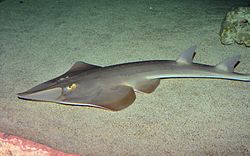
Rhinopristiformes /raɪnoʊˈprɪstɪfɔːrmiːz/ (rhino rays) is an order of rays, cartilaginous fishes related to sharks, containing shovelnose rays and allied groups.
Rhinopristiformes contains the following families:
Two additional families are associated with the order but their phylogenetic relationships have not been fully resolved:
The following fossil genera are also possibly rhinopristiforms, but phylogenetic relationships are uncertain:
The Apolithabatiformes (spinorays), an extinct order of rays from the Late Jurassic of primarily Europe, convergently evolved a guitarfish-like body plan, but likely diverged prior to rhinopristiforms.
Species in the order Rhinopristiformes generally exhibit slow growth, late maturity, and low fecundity. Alone or in combination, such features cause fishes in this group to be susceptible to extinction.
Rhinopristiformes are more prone to being caught in many different types of fishing equipment, including trawl, gillnet, seine net, and hook-and-line.
They are caught for their meat but most importantly their fins. While the meat is mostly consumed locally the white fins are a delicacy and highly sought after. They are the most valuable part of Rhinopristiformes therefore their fins are in high demand. Both the combination of overfishing and the high desire for their fins has caused the Rhinopristiformes population to rapidly decline.
Rhinopristiformes
Rhinopristiformes /raɪnoʊˈprɪstɪfɔːrmiːz/ (rhino rays) is an order of rays, cartilaginous fishes related to sharks, containing shovelnose rays and allied groups.
Rhinopristiformes contains the following families:
Two additional families are associated with the order but their phylogenetic relationships have not been fully resolved:
The following fossil genera are also possibly rhinopristiforms, but phylogenetic relationships are uncertain:
The Apolithabatiformes (spinorays), an extinct order of rays from the Late Jurassic of primarily Europe, convergently evolved a guitarfish-like body plan, but likely diverged prior to rhinopristiforms.
Species in the order Rhinopristiformes generally exhibit slow growth, late maturity, and low fecundity. Alone or in combination, such features cause fishes in this group to be susceptible to extinction.
Rhinopristiformes are more prone to being caught in many different types of fishing equipment, including trawl, gillnet, seine net, and hook-and-line.
They are caught for their meat but most importantly their fins. While the meat is mostly consumed locally the white fins are a delicacy and highly sought after. They are the most valuable part of Rhinopristiformes therefore their fins are in high demand. Both the combination of overfishing and the high desire for their fins has caused the Rhinopristiformes population to rapidly decline.
Recent media
Recent media