



Community hub
Recent from talks
Knowledge base stats:
Talk channels stats:
Members stats:
Transforming protein RhoA
Transforming protein RhoA, also known as Ras homolog family member A (RhoA), is a small GTPase protein in the Rho family of GTPases that in humans is encoded by the RHOA gene. While the effects of RhoA activity are not all well known, it is primarily associated with cytoskeleton regulation, mostly actin stress fibers formation and actomyosin contractility. It acts upon several effectors. Among them, ROCK1 (Rho-associated, coiled-coil containing protein kinase 1) and DIAPH1 (Diaphanous Homologue 1, a.k.a. hDia1, homologue to mDia1 in mouse, diaphanous in Drosophila) are the best described. RhoA, and the other Rho GTPases, are part of a larger family of related proteins known as the Ras superfamily, a family of proteins involved in the regulation and timing of cell division. RhoA is one of the oldest Rho GTPases, with homologues present in the genomes since 1.5 billion years. As a consequence, RhoA is somehow involved in many cellular processes which emerged throughout evolution. RhoA specifically is regarded as a prominent regulatory factor in other functions such as the regulation of cytoskeletal dynamics, transcription, cell cycle progression and cell transformation.
The specific gene that encodes RhoA, RHOA, is located on chromosome 3 and consists of four exons, which has also been linked as a possible risk factor for atherothrombolic stroke.
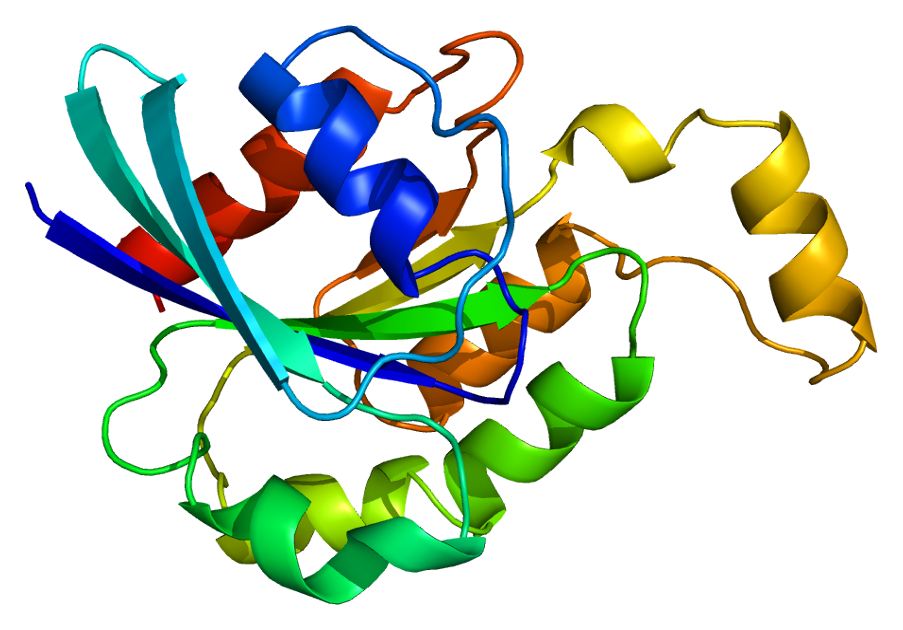
Similar to other GTPases, RhoA presents a Rho insert in its primary sequence in the GTPase domain. RhoA contains also four insertion or deletion sites with an extra helical subdomain; these sites are characteristic of many GTPases in the Rho family. Most importantly, RhoA contains two switch regions, Switch I and Switch II, whose conformational states are modified following the activation or inactivation of the protein. Both of these switches have characteristic folding, correspond to specific regions on the RhoA coil and are uniformly stabilized via hydrogen bonds. The conformations of the Switch domains are modified depending on the binding of either GDP or GTP to RhoA. The nature of the bound nucleotide and the ensuing conformational modification of the Switch domains dictates the ability of RhoA to bind or not with partner proteins (see below).
The primary protein sequences of members of the Rho family are mostly identical, with the N-terminal containing most of the protein coding for GTP binding and hydrolysis. The C-terminal of RhoA is modified via prenylation, anchoring the GTPase into membranes, which is essential for its role in cell growth and cytoskeleton organization. Key amino acids that are involved in the stabilization and regulation of GTP hydrolysis are conserved in RhoA as Gly14, Thr19, Phe30 and Gln63.
Correct localization of the RhoA proteins is heavily dependent on the C-terminus; during prenylation, the anchoring of the prenyl group is essential for the stability, inhibition of and the synthesis of enzymes and proliferation. RhoA is sequestered by dissociation inhibitors (RhoGDIs) which remove the protein from the membrane while preventing its further interaction with other downstream effectors.
RhoA acquires both inactive GDP-bound and active GTP-bound conformational states; these states alternate between the active and inactive states via the exchange of GDP to GTP (conducted simultaneously via guanine nucleotide exchange factors and GTPase activating factor). RhoA is activated primarily by guanine nucleotide exchange factors (GEFs) via phosphorylation; due to large network of overlapping phosphorylation, a multitude of GEFs are utilized to enable specific signaling pathways. These structural arrangements provide interaction sites that can interact with effectors and guanine factors in order to stabilize and signal the hydrolysis of GTP. Activation levels of RhoA and associated GEFs are measured using RhoA and GEF pull down assays that uses Rhotekin and mutant RhoA G17A beads respectively
RhoA is primarily involved in these activities: actin organization, myosin contractility, cell cycle maintenance, cellular morphological polarization, cellular development and transcriptional control.
RhoA is prevalent in regulating cell shape, polarity and locomotion via actin polymerization, actomyosin contractility, cell adhesion, and microtubule dynamics. In addition, RhoA is believed to act primarily at the rear (uropod) of migrating cells to promote detachment, similar to the attachment and detachment process found in the focal adhesion mechanism. Signal transduction pathways regulated via RhoA link plasma membrane receptors to focal adhesion formation and the subsequent activation of relevant actin stress fibers. RhoA directly stimulates actin polymerization through activation of diaphanous-related formins, thereby structurally changing the actin monomers to filaments. ROCK kinases induce actomyosin-based contractility and phosphorylate TAU and MAP2 involved in regulating myosins and other actin-binding proteins in order to assist in cell migration and detachment. The concerted action of ROCK and Dia is essential for the regulation of cell polarity and organization of microtubules. RhoA also regulates the integrity of the extracellular matrix and the loss of corresponding cell-cell adhesions (primarily adherens and tight junctions) required for the migration of epithelial. RhoA's role in signal transduction mediation is also attributed to the establishment of tissue polarity in epidermal structures due to its actin polymerization to coordinate vesicular motion; movement within actin filaments forms webs that move in conjunction with vesicular linear motion. As a result, mutations present in the polarity genes indicate that RhoA is critical for tissue polarity and directed intracellular movement.
Hub AI
Transforming protein RhoA AI simulator
(@Transforming protein RhoA_simulator)
Transforming protein RhoA
Transforming protein RhoA, also known as Ras homolog family member A (RhoA), is a small GTPase protein in the Rho family of GTPases that in humans is encoded by the RHOA gene. While the effects of RhoA activity are not all well known, it is primarily associated with cytoskeleton regulation, mostly actin stress fibers formation and actomyosin contractility. It acts upon several effectors. Among them, ROCK1 (Rho-associated, coiled-coil containing protein kinase 1) and DIAPH1 (Diaphanous Homologue 1, a.k.a. hDia1, homologue to mDia1 in mouse, diaphanous in Drosophila) are the best described. RhoA, and the other Rho GTPases, are part of a larger family of related proteins known as the Ras superfamily, a family of proteins involved in the regulation and timing of cell division. RhoA is one of the oldest Rho GTPases, with homologues present in the genomes since 1.5 billion years. As a consequence, RhoA is somehow involved in many cellular processes which emerged throughout evolution. RhoA specifically is regarded as a prominent regulatory factor in other functions such as the regulation of cytoskeletal dynamics, transcription, cell cycle progression and cell transformation.
The specific gene that encodes RhoA, RHOA, is located on chromosome 3 and consists of four exons, which has also been linked as a possible risk factor for atherothrombolic stroke.
Similar to other GTPases, RhoA presents a Rho insert in its primary sequence in the GTPase domain. RhoA contains also four insertion or deletion sites with an extra helical subdomain; these sites are characteristic of many GTPases in the Rho family. Most importantly, RhoA contains two switch regions, Switch I and Switch II, whose conformational states are modified following the activation or inactivation of the protein. Both of these switches have characteristic folding, correspond to specific regions on the RhoA coil and are uniformly stabilized via hydrogen bonds. The conformations of the Switch domains are modified depending on the binding of either GDP or GTP to RhoA. The nature of the bound nucleotide and the ensuing conformational modification of the Switch domains dictates the ability of RhoA to bind or not with partner proteins (see below).
The primary protein sequences of members of the Rho family are mostly identical, with the N-terminal containing most of the protein coding for GTP binding and hydrolysis. The C-terminal of RhoA is modified via prenylation, anchoring the GTPase into membranes, which is essential for its role in cell growth and cytoskeleton organization. Key amino acids that are involved in the stabilization and regulation of GTP hydrolysis are conserved in RhoA as Gly14, Thr19, Phe30 and Gln63.
Correct localization of the RhoA proteins is heavily dependent on the C-terminus; during prenylation, the anchoring of the prenyl group is essential for the stability, inhibition of and the synthesis of enzymes and proliferation. RhoA is sequestered by dissociation inhibitors (RhoGDIs) which remove the protein from the membrane while preventing its further interaction with other downstream effectors.
RhoA acquires both inactive GDP-bound and active GTP-bound conformational states; these states alternate between the active and inactive states via the exchange of GDP to GTP (conducted simultaneously via guanine nucleotide exchange factors and GTPase activating factor). RhoA is activated primarily by guanine nucleotide exchange factors (GEFs) via phosphorylation; due to large network of overlapping phosphorylation, a multitude of GEFs are utilized to enable specific signaling pathways. These structural arrangements provide interaction sites that can interact with effectors and guanine factors in order to stabilize and signal the hydrolysis of GTP. Activation levels of RhoA and associated GEFs are measured using RhoA and GEF pull down assays that uses Rhotekin and mutant RhoA G17A beads respectively
RhoA is primarily involved in these activities: actin organization, myosin contractility, cell cycle maintenance, cellular morphological polarization, cellular development and transcriptional control.
RhoA is prevalent in regulating cell shape, polarity and locomotion via actin polymerization, actomyosin contractility, cell adhesion, and microtubule dynamics. In addition, RhoA is believed to act primarily at the rear (uropod) of migrating cells to promote detachment, similar to the attachment and detachment process found in the focal adhesion mechanism. Signal transduction pathways regulated via RhoA link plasma membrane receptors to focal adhesion formation and the subsequent activation of relevant actin stress fibers. RhoA directly stimulates actin polymerization through activation of diaphanous-related formins, thereby structurally changing the actin monomers to filaments. ROCK kinases induce actomyosin-based contractility and phosphorylate TAU and MAP2 involved in regulating myosins and other actin-binding proteins in order to assist in cell migration and detachment. The concerted action of ROCK and Dia is essential for the regulation of cell polarity and organization of microtubules. RhoA also regulates the integrity of the extracellular matrix and the loss of corresponding cell-cell adhesions (primarily adherens and tight junctions) required for the migration of epithelial. RhoA's role in signal transduction mediation is also attributed to the establishment of tissue polarity in epidermal structures due to its actin polymerization to coordinate vesicular motion; movement within actin filaments forms webs that move in conjunction with vesicular linear motion. As a result, mutations present in the polarity genes indicate that RhoA is critical for tissue polarity and directed intracellular movement.