
Recent from talks
Rhus copallinum
Knowledge base stats:
Talk channels stats:
Members stats:
Rhus copallinum
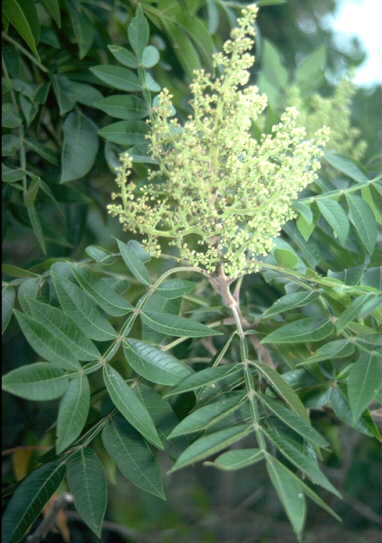
Rhus copallinum, the winged sumac, shining sumac, dwarf sumac or flameleaf sumac, is a species of flowering plant in the cashew family (Anacardiaceae) that is native to eastern North America. It is a deciduous tree growing to 3.5–5.5 metres (11–18 ft) tall and an equal spread with a rounded crown. A 5-year-old sapling will stand about 2.5 metres (8.2 ft). The name Rhus copallina is also used, but this is not consistent with the rules of the International Association for Plant Taxonomy.
Shining sumac is often cultivated, where it is well-suited to natural and informal landscapes because it has underground runners which spread to provide dense, shrubby cover for birds and wildlife. This species is valued for ornamental planting because of its lustrous dark green foliage which turns a brilliant orange-red in fall. The fall color display is frequently enjoyed along interstate highways, as the plant readily colonizes these and other disturbed sites. The tiny, greenish-yellow flowers, borne in compact, terminal panicles, are followed by showy red clusters of berries which persist into the winter and attract wildlife.
The flowers are yellow, flowering in the summer. The fruit attracts birds with no significant litter problem, is persistent on the tree, and is showy.
The bark is thin and easily damaged from mechanical impact; branches droop as the tree grows, and will require pruning for vehicular or pedestrian clearance beneath the canopy; routinely grown with, or trainable to be grown with, multiple trunks. The tree wants to grow with several trunks, but can be trained to grow with a single trunk. It has no thorns.[citation needed]
Its leaves are alternate and pinnately compound. The leaflets are borne on alate rachis that give the plant one of its common names: "winged sumac".
Rhus copallinum belongs to the Anacardiaceae family. This species was named by Carl Linnaeus in Species Plantarum. There are multiple recognized subspecies of Rhus copallium including Rhus copallinum L. var. copallinum, Rhus copallinum L. var. latifolia Engl., Rhus copallinum var. lanceolata Gray and Rhus copallinum L. var. leucantha (Jacq.) DC. The lecotype is located in the British Museum.
Rhus copallinum extends from the Coastal Plain of Florida to Ontario, Canada. Rhus copallinum extends as far west as Texas, Nebraska, Oklahoma, and Kansas. (The R. copallinum var. lanceolata is also found in parts of Mexico.) This species is found in many different ecosystems such as Longleaf-slash pine, Loblolly- shortleaf pine, Oak-pine, Oak-hickory, and Oak-gum-cypress. R. copallinum is found in many plant associations, but does not indicate the presence of a specific habitat. This species grows best in full sunlight and well-drained soils, but is resistant to the effects of pollution, drought, heavy pruning, compacted soil, and transplanting. Additionally, once established, it is difficult to remove from an area. It is also known to be in competition with young pines and other hardwoods in multiple habitats.
The tree can be planted in a container or above-ground planter. It has been recommended for buffer strips around parking lots or for median strip plantings in the highway, as well as for land reclamation. Rhus copallinum can tolerate exposure to salt spray in maritime forests and coastal grasslands; it can grow in serpentine soil and shallow, rocky soil. Rhus copallinum tolerates soil pH ranging from 5.3 to 7.5, requires between 28 and 60 millimeters of water, and can survive a minimum temperature of -28 °F. There are male and female Rhus copallium shrubs: both are needed for reproduction.
Hub AI
Rhus copallinum AI simulator
(@Rhus copallinum_simulator)
Rhus copallinum
Rhus copallinum, the winged sumac, shining sumac, dwarf sumac or flameleaf sumac, is a species of flowering plant in the cashew family (Anacardiaceae) that is native to eastern North America. It is a deciduous tree growing to 3.5–5.5 metres (11–18 ft) tall and an equal spread with a rounded crown. A 5-year-old sapling will stand about 2.5 metres (8.2 ft). The name Rhus copallina is also used, but this is not consistent with the rules of the International Association for Plant Taxonomy.
Shining sumac is often cultivated, where it is well-suited to natural and informal landscapes because it has underground runners which spread to provide dense, shrubby cover for birds and wildlife. This species is valued for ornamental planting because of its lustrous dark green foliage which turns a brilliant orange-red in fall. The fall color display is frequently enjoyed along interstate highways, as the plant readily colonizes these and other disturbed sites. The tiny, greenish-yellow flowers, borne in compact, terminal panicles, are followed by showy red clusters of berries which persist into the winter and attract wildlife.
The flowers are yellow, flowering in the summer. The fruit attracts birds with no significant litter problem, is persistent on the tree, and is showy.
The bark is thin and easily damaged from mechanical impact; branches droop as the tree grows, and will require pruning for vehicular or pedestrian clearance beneath the canopy; routinely grown with, or trainable to be grown with, multiple trunks. The tree wants to grow with several trunks, but can be trained to grow with a single trunk. It has no thorns.[citation needed]
Its leaves are alternate and pinnately compound. The leaflets are borne on alate rachis that give the plant one of its common names: "winged sumac".
Rhus copallinum belongs to the Anacardiaceae family. This species was named by Carl Linnaeus in Species Plantarum. There are multiple recognized subspecies of Rhus copallium including Rhus copallinum L. var. copallinum, Rhus copallinum L. var. latifolia Engl., Rhus copallinum var. lanceolata Gray and Rhus copallinum L. var. leucantha (Jacq.) DC. The lecotype is located in the British Museum.
Rhus copallinum extends from the Coastal Plain of Florida to Ontario, Canada. Rhus copallinum extends as far west as Texas, Nebraska, Oklahoma, and Kansas. (The R. copallinum var. lanceolata is also found in parts of Mexico.) This species is found in many different ecosystems such as Longleaf-slash pine, Loblolly- shortleaf pine, Oak-pine, Oak-hickory, and Oak-gum-cypress. R. copallinum is found in many plant associations, but does not indicate the presence of a specific habitat. This species grows best in full sunlight and well-drained soils, but is resistant to the effects of pollution, drought, heavy pruning, compacted soil, and transplanting. Additionally, once established, it is difficult to remove from an area. It is also known to be in competition with young pines and other hardwoods in multiple habitats.
The tree can be planted in a container or above-ground planter. It has been recommended for buffer strips around parking lots or for median strip plantings in the highway, as well as for land reclamation. Rhus copallinum can tolerate exposure to salt spray in maritime forests and coastal grasslands; it can grow in serpentine soil and shallow, rocky soil. Rhus copallinum tolerates soil pH ranging from 5.3 to 7.5, requires between 28 and 60 millimeters of water, and can survive a minimum temperature of -28 °F. There are male and female Rhus copallium shrubs: both are needed for reproduction.
Recent media