
Recent from talks
Rhythm guitar
Knowledge base stats:
Talk channels stats:
Members stats:
Rhythm guitar
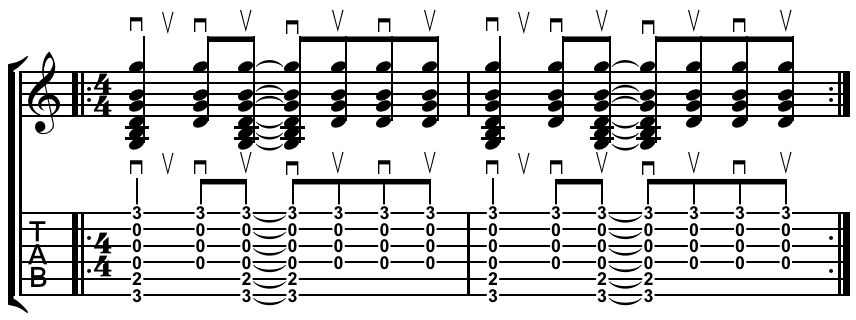
In music performances, rhythm guitar is a guitar technique and role that performs a combination of two functions: to provide all or part of the rhythmic pulse in conjunction with other instruments from the rhythm section (e.g., drum kit, bass guitar); and to provide all or part of the harmony, i.e. the chords from a song's chord progression, where a chord is a group of notes played together. The basic technique of rhythm guitar is to hold down a series of chords with the fretting hand while strumming or fingerpicking rhythmically with the other hand. More developed rhythm techniques include arpeggios, damping, riffs, chord solos, and complex strums.
In ensembles or bands playing within the acoustic, country, blues, rock or metal genres (among others), a guitarist playing the rhythm part of a composition plays the role of supporting the melodic lines and improvised solos played on the lead instrument or instruments, be they strings, wind, brass, keyboard or even percussion instruments, or simply the human voice, in the sense of playing steadily throughout the piece, whereas lead instruments and singers switch between carrying the main or countermelody and falling silent. In big band music, the guitarist is considered part of the rhythm section, alongside bass and drums.
In some musical situations, such as a solo singer-guitarist, the guitar accompaniment provides all the rhythmic drive; in large ensembles it may be only a small part (perhaps one element in a polyrhythm). Likewise, rhythm guitar can supply all of the harmonic input to a singer-guitarist or small band, but in ensembles that have other harmony instruments (such as keyboards) or vocal harmonists, its harmonic input will be less important.
In the most commercially available and consumed genres, electric guitars tend to dominate their acoustic cousins in both the recording studio and live venues. However the acoustic guitar remains a popular choice in country, western and especially bluegrass music, and almost exclusively in folk music.
Most rhythms in rock and blues are based on 4
4 time with a backbeat; however, many variations are possible. A backbeat is a syncopated accentuation on the off beat. In a simple 4
4 rhythm these are beats 2 and 4. Emphasized back beat, a feature of some African styles, defined rhythm and blues recordings in the late 1940s and so became one of the defining characteristics of rock and roll and much of contemporary popular music.
Harmonically, in rock music, the most common way to construct chord progressions is to play major and minor "triads", each comprising a root, third and fifth note of a given scale. An example of a major triad is C major, which contains the notes C, E and G. An example of a minor triad is the A minor chord, which includes the notes A, C and E. Interspersed are some four-note chords, which include the root, third and fifth, as well as a sixth, seventh or ninth note of the scale. The most common chord with four different notes is the dominant seventh chord, which include a root, a major third above the root, a perfect fifth above the root and a flattened seventh. In the key of C major, the dominant seventh chord is a G7, which consists of the notes G, B, D and F.
Three-chord progressions are common in earlier pop and rock, using various combinations of the I, IV and V chords, with the twelve-bar blues particularly common. A four chord progression popular in the 1950s is I–vi–ii–V, which in the key of C major is the chords C major, A minor, D minor and G7. Minor and modal chord progressions such as I–♭VII–♭VI (in the key of E, the chords E major, D major, C major) feature in popular music.
In heavy metal music, rhythm guitarists often play power chords, which feature a root note and a fifth above, or with an octave doubling the root, all without the third of the chord. Power chords are usually played with distortion.
Hub AI
Rhythm guitar AI simulator
(@Rhythm guitar_simulator)
Rhythm guitar
In music performances, rhythm guitar is a guitar technique and role that performs a combination of two functions: to provide all or part of the rhythmic pulse in conjunction with other instruments from the rhythm section (e.g., drum kit, bass guitar); and to provide all or part of the harmony, i.e. the chords from a song's chord progression, where a chord is a group of notes played together. The basic technique of rhythm guitar is to hold down a series of chords with the fretting hand while strumming or fingerpicking rhythmically with the other hand. More developed rhythm techniques include arpeggios, damping, riffs, chord solos, and complex strums.
In ensembles or bands playing within the acoustic, country, blues, rock or metal genres (among others), a guitarist playing the rhythm part of a composition plays the role of supporting the melodic lines and improvised solos played on the lead instrument or instruments, be they strings, wind, brass, keyboard or even percussion instruments, or simply the human voice, in the sense of playing steadily throughout the piece, whereas lead instruments and singers switch between carrying the main or countermelody and falling silent. In big band music, the guitarist is considered part of the rhythm section, alongside bass and drums.
In some musical situations, such as a solo singer-guitarist, the guitar accompaniment provides all the rhythmic drive; in large ensembles it may be only a small part (perhaps one element in a polyrhythm). Likewise, rhythm guitar can supply all of the harmonic input to a singer-guitarist or small band, but in ensembles that have other harmony instruments (such as keyboards) or vocal harmonists, its harmonic input will be less important.
In the most commercially available and consumed genres, electric guitars tend to dominate their acoustic cousins in both the recording studio and live venues. However the acoustic guitar remains a popular choice in country, western and especially bluegrass music, and almost exclusively in folk music.
Most rhythms in rock and blues are based on 4
4 time with a backbeat; however, many variations are possible. A backbeat is a syncopated accentuation on the off beat. In a simple 4
4 rhythm these are beats 2 and 4. Emphasized back beat, a feature of some African styles, defined rhythm and blues recordings in the late 1940s and so became one of the defining characteristics of rock and roll and much of contemporary popular music.
Harmonically, in rock music, the most common way to construct chord progressions is to play major and minor "triads", each comprising a root, third and fifth note of a given scale. An example of a major triad is C major, which contains the notes C, E and G. An example of a minor triad is the A minor chord, which includes the notes A, C and E. Interspersed are some four-note chords, which include the root, third and fifth, as well as a sixth, seventh or ninth note of the scale. The most common chord with four different notes is the dominant seventh chord, which include a root, a major third above the root, a perfect fifth above the root and a flattened seventh. In the key of C major, the dominant seventh chord is a G7, which consists of the notes G, B, D and F.
Three-chord progressions are common in earlier pop and rock, using various combinations of the I, IV and V chords, with the twelve-bar blues particularly common. A four chord progression popular in the 1950s is I–vi–ii–V, which in the key of C major is the chords C major, A minor, D minor and G7. Minor and modal chord progressions such as I–♭VII–♭VI (in the key of E, the chords E major, D major, C major) feature in popular music.
In heavy metal music, rhythm guitarists often play power chords, which feature a root note and a fifth above, or with an octave doubling the root, all without the third of the chord. Power chords are usually played with distortion.
Recent media