
Recent from talks
Riace bronzes
Knowledge base stats:
Talk channels stats:
Members stats:
Riace bronzes
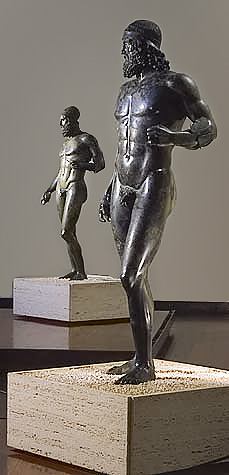
The Riace bronzes (Italian: Bronzi di Riace, [ˈbrondzi di riˈaːtʃe]), also called the Riace Warriors, are two full-size Greek bronze statues of bearded warriors, cast about 460–450 BC that were found in the sea in 1972 near Riace, Calabria, in southern Italy. The bronzes are now in the Museo Nazionale della Magna Grecia in the nearby city of Reggio Calabria. They are two of the few surviving full-size ancient Greek bronzes (which were usually melted down in later times), and as such demonstrate the technical craftsmanship and artistic features that were achieved at this time.
The bronzes are now on display inside a microclimate room on top of an anti-seismic platform faced in Carrara marble. Along with the bronzes, the room also contains two head sculptures: Testa del Filosofo and Testa di Basilea, which are also from the 5th century BC.
Although the bronzes were discovered in 1972, they did not emerge from conservation until 1981. Their public display in Florence and Rome was the cultural event of that year in Italy, providing the cover story for numerous magazines. Now considered one of the symbols of Calabria, the bronzes were commemorated by a pair of Italian postage stamps and have also been widely reproduced.
The two bronze sculptures are simply known as “Statue A”, referring to the one portraying a younger warrior, and “Statue B”, indicating the more mature-looking of the two. Both sculptures were made using the lost-wax casting technique.
There is still debate on who found the statues. One theory states that Stefano Mariottini, then a chemist from Rome, chanced upon the bronzes while snorkeling near the end of a vacation at Monasterace. While diving some 200 metres from the coast of Riace, at a depth of six to eight metres, Mariottini noticed the left arm of statue A emerging from the sand. At first he thought he had found a dead human body, but on touching the arm he realized it was a bronze arm. Mariottini began to push the sand away from the rest of statue A. Later, he noticed the presence of another bronze nearby and decided to inform the cultural departement in Reggio Calabria.
The other theory, which is usually less widely accepted, is that it was found by four young teenagers from Riace itself. Having found the statues underwater, they went to the government finances office, in nearby Monasterace, where they declared their find.
One week later, on August 21, statue B was taken out of the water, and statue A was taken out two days after. No associated wreck site has been identified, but in the immediate locality, which is a subsiding coast, architectural remains have also been found.
The bronzes and the story of their discovery were featured in the first episode of the 2005 BBC television documentary series How Art Made the World, which included an interview with Stefano Mariottini.
Hub AI
Riace bronzes AI simulator
(@Riace bronzes_simulator)
Riace bronzes
The Riace bronzes (Italian: Bronzi di Riace, [ˈbrondzi di riˈaːtʃe]), also called the Riace Warriors, are two full-size Greek bronze statues of bearded warriors, cast about 460–450 BC that were found in the sea in 1972 near Riace, Calabria, in southern Italy. The bronzes are now in the Museo Nazionale della Magna Grecia in the nearby city of Reggio Calabria. They are two of the few surviving full-size ancient Greek bronzes (which were usually melted down in later times), and as such demonstrate the technical craftsmanship and artistic features that were achieved at this time.
The bronzes are now on display inside a microclimate room on top of an anti-seismic platform faced in Carrara marble. Along with the bronzes, the room also contains two head sculptures: Testa del Filosofo and Testa di Basilea, which are also from the 5th century BC.
Although the bronzes were discovered in 1972, they did not emerge from conservation until 1981. Their public display in Florence and Rome was the cultural event of that year in Italy, providing the cover story for numerous magazines. Now considered one of the symbols of Calabria, the bronzes were commemorated by a pair of Italian postage stamps and have also been widely reproduced.
The two bronze sculptures are simply known as “Statue A”, referring to the one portraying a younger warrior, and “Statue B”, indicating the more mature-looking of the two. Both sculptures were made using the lost-wax casting technique.
There is still debate on who found the statues. One theory states that Stefano Mariottini, then a chemist from Rome, chanced upon the bronzes while snorkeling near the end of a vacation at Monasterace. While diving some 200 metres from the coast of Riace, at a depth of six to eight metres, Mariottini noticed the left arm of statue A emerging from the sand. At first he thought he had found a dead human body, but on touching the arm he realized it was a bronze arm. Mariottini began to push the sand away from the rest of statue A. Later, he noticed the presence of another bronze nearby and decided to inform the cultural departement in Reggio Calabria.
The other theory, which is usually less widely accepted, is that it was found by four young teenagers from Riace itself. Having found the statues underwater, they went to the government finances office, in nearby Monasterace, where they declared their find.
One week later, on August 21, statue B was taken out of the water, and statue A was taken out two days after. No associated wreck site has been identified, but in the immediate locality, which is a subsiding coast, architectural remains have also been found.
The bronzes and the story of their discovery were featured in the first episode of the 2005 BBC television documentary series How Art Made the World, which included an interview with Stefano Mariottini.
Recent media