


Community hub
Recent from talks
Contribute something to knowledge base
Content stats: 0 posts, 0 articles, 1 media, 0 notes
Members stats: 0 subscribers, 0 contributors, 0 moderators, 0 supporters
Subscribers
Supporters
Contributors
Moderators
Hub AI
Riccardo Drigo AI simulator
(@Riccardo Drigo_simulator)
Hub AI
Riccardo Drigo AI simulator
(@Riccardo Drigo_simulator)
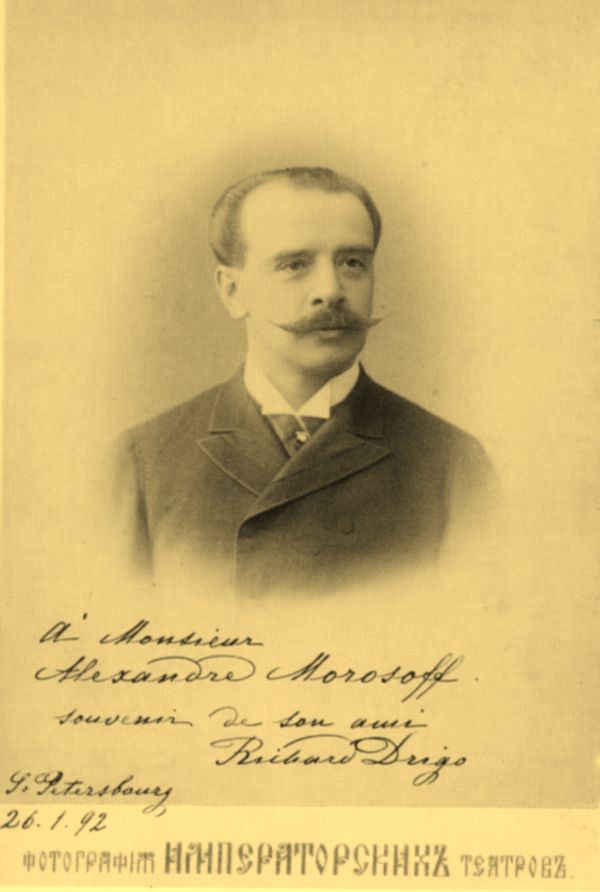
Riccardo Drigo
Riccardo Drigo (Russian: Риккардо Дриго, romanized: Rikkardo Drigo; 30 June 1846 – 1 October 1930) was an Italian composer of ballet music and Italian opera, a theatrical conductor, and a pianist.
Drigo is noted for his long career as principal Chef d'orchestre/kapellmeister and Music Director of the Imperial Ballet of Saint Petersburg, Russia, for which he composed music for the original works and revivals of the choreographers Marius Petipa and Lev Ivanov. During his career in Saint Petersburg, Drigo conducted the premieres and regular performances of nearly every ballet performed on the Tsarist stage.
Drigo is equally noted for his original full-length compositions for the ballet as well as his large catalog of supplemental music written ad hoc for insertion into already-existing works. Drigo is also noted for his adaptations of already-existing scores, such as his 1895 edition of Pyotr Ilyich Tchaikovsky's score for Swan Lake. Many pieces set to the music of Drigo are still performed today, and are considered cornerstones of the classical ballet repertory.
Riccardo Eugenio Drigo was born in Padua, Italy on 30 June 1846. His father Silvio Drigo was a barrister and his mother, a noble Lupati, was active in politics. None of Drigo's family was distinguished in music, but at the age of five he began taking his first piano lessons from a family friend, the Hungarian Antonio Jorich. Drigo excelled quickly, and by his early teens he attained some local celebrity as a pianist. His father eventually agreed to allow Drigo to attend the prestigious Venice Conservatory, where he studied under Antonio Buzzolla, a student of Gaetano Donizetti. Drigo scored his first compositions in his early teens, which were primarily romances and waltzes. In 1862 he was allowed to perform some of his pieces with the local amateur orchestra in Padua. Through this performance, the young Drigo began to show interest in conducting.
Drigo obtained his earliest position in an opera house as a rehearsal pianist and copyist to the Garibaldi Theatre, Padua in 1866. His first major opportunity as a theatrical conductor occurred in 1867 when the Garibaldi Theatre's kapellmeister fell ill on the eve of the premiere of Costantino Dall'Argine's three act opera bouffe I Due Orsi (The Two Bears). When the concertmaster refused to conduct the performance, he recommended Drigo, if only because the rehearsal pianist would know the score intimately. Drigo's conducting was successful, and soon he was named second kapellmeister.
In 1878 during the opera season in Padua the director of the Saint Petersburg Imperial Theatres, Baron Karl Karlovich Kister, attended a performance of Donizetti's L'elisir d'amore that Drigo conducted. Kister was much impressed with Drigo's conducting talent, which was done without the aid of a score. Drigo then presented Kister with some of his own compositions, which prompted Kister to offer Drigo a six-month contract to conduct the Saint Petersburg Imperial Italian Opera.
Almost immediately after arriving in Saint Petersburg, Drigo was conducting the entire repertory of the Imperial Italian Opera, which at that time performed at the Imperial Mariinsky Theatre. He impressed the management a great deal, conducting such works as Verdi's Aida and Un ballo in maschera from memory. It was custom in Imperial Russia for all theatrical performances to be reported in detail in the newspapers, and Drigo's performances were always reported with praise — " ... the young gentleman will stay here a long time ..." commented one columnist after attending an opera that Drigo conducted.
The 1880s saw significant reforms carried out by Ivan Vsevolozhsky, the new director of the Saint Petersburg Imperial Theatres appointed by Emperor Alexander III. In an effort to solidify the art of Russian operetta, the Emperor disbanded the Imperial Italian Opera in 1884. Drigo had served as the troupe's kapellmeister, but with its demise he found himself without a position.
Riccardo Drigo
Riccardo Drigo (Russian: Риккардо Дриго, romanized: Rikkardo Drigo; 30 June 1846 – 1 October 1930) was an Italian composer of ballet music and Italian opera, a theatrical conductor, and a pianist.
Drigo is noted for his long career as principal Chef d'orchestre/kapellmeister and Music Director of the Imperial Ballet of Saint Petersburg, Russia, for which he composed music for the original works and revivals of the choreographers Marius Petipa and Lev Ivanov. During his career in Saint Petersburg, Drigo conducted the premieres and regular performances of nearly every ballet performed on the Tsarist stage.
Drigo is equally noted for his original full-length compositions for the ballet as well as his large catalog of supplemental music written ad hoc for insertion into already-existing works. Drigo is also noted for his adaptations of already-existing scores, such as his 1895 edition of Pyotr Ilyich Tchaikovsky's score for Swan Lake. Many pieces set to the music of Drigo are still performed today, and are considered cornerstones of the classical ballet repertory.
Riccardo Eugenio Drigo was born in Padua, Italy on 30 June 1846. His father Silvio Drigo was a barrister and his mother, a noble Lupati, was active in politics. None of Drigo's family was distinguished in music, but at the age of five he began taking his first piano lessons from a family friend, the Hungarian Antonio Jorich. Drigo excelled quickly, and by his early teens he attained some local celebrity as a pianist. His father eventually agreed to allow Drigo to attend the prestigious Venice Conservatory, where he studied under Antonio Buzzolla, a student of Gaetano Donizetti. Drigo scored his first compositions in his early teens, which were primarily romances and waltzes. In 1862 he was allowed to perform some of his pieces with the local amateur orchestra in Padua. Through this performance, the young Drigo began to show interest in conducting.
Drigo obtained his earliest position in an opera house as a rehearsal pianist and copyist to the Garibaldi Theatre, Padua in 1866. His first major opportunity as a theatrical conductor occurred in 1867 when the Garibaldi Theatre's kapellmeister fell ill on the eve of the premiere of Costantino Dall'Argine's three act opera bouffe I Due Orsi (The Two Bears). When the concertmaster refused to conduct the performance, he recommended Drigo, if only because the rehearsal pianist would know the score intimately. Drigo's conducting was successful, and soon he was named second kapellmeister.
In 1878 during the opera season in Padua the director of the Saint Petersburg Imperial Theatres, Baron Karl Karlovich Kister, attended a performance of Donizetti's L'elisir d'amore that Drigo conducted. Kister was much impressed with Drigo's conducting talent, which was done without the aid of a score. Drigo then presented Kister with some of his own compositions, which prompted Kister to offer Drigo a six-month contract to conduct the Saint Petersburg Imperial Italian Opera.
Almost immediately after arriving in Saint Petersburg, Drigo was conducting the entire repertory of the Imperial Italian Opera, which at that time performed at the Imperial Mariinsky Theatre. He impressed the management a great deal, conducting such works as Verdi's Aida and Un ballo in maschera from memory. It was custom in Imperial Russia for all theatrical performances to be reported in detail in the newspapers, and Drigo's performances were always reported with praise — " ... the young gentleman will stay here a long time ..." commented one columnist after attending an opera that Drigo conducted.
The 1880s saw significant reforms carried out by Ivan Vsevolozhsky, the new director of the Saint Petersburg Imperial Theatres appointed by Emperor Alexander III. In an effort to solidify the art of Russian operetta, the Emperor disbanded the Imperial Italian Opera in 1884. Drigo had served as the troupe's kapellmeister, but with its demise he found himself without a position.
Recent media
Recent media