
Recent from talks
Richard Maurice Bucke
Knowledge base stats:
Talk channels stats:
Members stats:
Richard Maurice Bucke
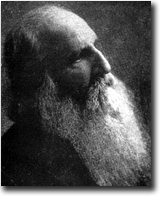
Richard Maurice Bucke (18 March 1837 – 19 February 1902) was a Canadian psychiatrist in the late 19th century. An adventurer during his youth, Bucke later studied medicine. Eventually, as a psychiatrist, he headed the provincial Asylum for the Insane in London, Ontario. Bucke was a friend of several noted men of letters in Canada, the United States, and England. Besides publishing professional articles, Bucke wrote three non-fiction books: Man's Moral Nature, Walt Whitman, and Cosmic Consciousness: A Study in the Evolution of the Human Mind, which is his best-known work.
Richard Maurice Bucke was born in 1837 in Methwold, England, the son of Rev. Horatio Walpole Bucke (a parish curate) and his wife Clarissa Andrews. The parents and their children emigrated to Canada when he was a year old, settling near London, Upper Canada.
Horatio W. Bucke had given up the profession of religious minister, and trusted his family's income to their Ontario farm. A sibling in a large family, Richard Maurice Bucke was a typical farm boy of that era. He was an athletic boy who enjoyed a good ball game. When he left home at the age of 16, he traveled to Columbus, Ohio and then to California. Along the way, Bucke worked at various odd jobs. He was part of a travelling party who had to fight for their lives when they were attacked by a group of Shoshone people, on whose territory they were trespassing.
In the winter of 1857–58, he was nearly frozen to death in the mountains of California, where he was the sole survivor of a silver-mining party. He had to walk out over the mountains and suffered extreme frostbite. As a result, a foot and several of his toes were amputated. He then returned to Canada via the Isthmus of Panama, probably in 1858. Henry Mills Hurd says he returned to Canada in 1860.
Bucke enrolled in McGill University's medical school in Montreal, where he delivered a distinguished thesis in 1862. Although he practiced general medicine briefly as a ship's surgeon (in order to pay for his sea travel), he later specialized in psychiatry. He did his internship in London (1862–63) at University College Hospital. During that time he visited France.
He was for several years an enthusiast of Auguste Comte's positivist philosophy. Comte's belief that religion, if by that is meant spirituality, had been outmoded by science contrasts with Bucke's later belief concerning the nature of reality.
Bucke returned to Canada in 1864 and married Jessie Gurd in 1865; they had eight children. In January 1876, Bucke became the superintendent of the Asylum for the Insane in Hamilton, Ontario. In 1877, he was appointed head of the provincial Asylum for the Insane in London, Ontario, a post he held for nearly the remainder of his life. In his work with asylum inmates, he was a reformer who encouraged organized sports and what is now called occupational therapy. Some of his surgical treatments proved deeply controversial. After adopting the Victorian-era theory that mental illness in women was often due to defective reproductive organs, Bucke began performing surgical removals of these organs from female patients. He continued this practice until his death, despite receiving increasing amounts of criticism from the medical health care community.
In 1872, after an evening of stimulating conversation with his friend Walt Whitman in the countryside, Richard M Bucke was traveling back to London in a buggy when he had a religious experience. He later described the characteristics and effects of the faculty of experiencing this type of consciousness as:[citation needed]
Hub AI
Richard Maurice Bucke AI simulator
(@Richard Maurice Bucke_simulator)
Richard Maurice Bucke
Richard Maurice Bucke (18 March 1837 – 19 February 1902) was a Canadian psychiatrist in the late 19th century. An adventurer during his youth, Bucke later studied medicine. Eventually, as a psychiatrist, he headed the provincial Asylum for the Insane in London, Ontario. Bucke was a friend of several noted men of letters in Canada, the United States, and England. Besides publishing professional articles, Bucke wrote three non-fiction books: Man's Moral Nature, Walt Whitman, and Cosmic Consciousness: A Study in the Evolution of the Human Mind, which is his best-known work.
Richard Maurice Bucke was born in 1837 in Methwold, England, the son of Rev. Horatio Walpole Bucke (a parish curate) and his wife Clarissa Andrews. The parents and their children emigrated to Canada when he was a year old, settling near London, Upper Canada.
Horatio W. Bucke had given up the profession of religious minister, and trusted his family's income to their Ontario farm. A sibling in a large family, Richard Maurice Bucke was a typical farm boy of that era. He was an athletic boy who enjoyed a good ball game. When he left home at the age of 16, he traveled to Columbus, Ohio and then to California. Along the way, Bucke worked at various odd jobs. He was part of a travelling party who had to fight for their lives when they were attacked by a group of Shoshone people, on whose territory they were trespassing.
In the winter of 1857–58, he was nearly frozen to death in the mountains of California, where he was the sole survivor of a silver-mining party. He had to walk out over the mountains and suffered extreme frostbite. As a result, a foot and several of his toes were amputated. He then returned to Canada via the Isthmus of Panama, probably in 1858. Henry Mills Hurd says he returned to Canada in 1860.
Bucke enrolled in McGill University's medical school in Montreal, where he delivered a distinguished thesis in 1862. Although he practiced general medicine briefly as a ship's surgeon (in order to pay for his sea travel), he later specialized in psychiatry. He did his internship in London (1862–63) at University College Hospital. During that time he visited France.
He was for several years an enthusiast of Auguste Comte's positivist philosophy. Comte's belief that religion, if by that is meant spirituality, had been outmoded by science contrasts with Bucke's later belief concerning the nature of reality.
Bucke returned to Canada in 1864 and married Jessie Gurd in 1865; they had eight children. In January 1876, Bucke became the superintendent of the Asylum for the Insane in Hamilton, Ontario. In 1877, he was appointed head of the provincial Asylum for the Insane in London, Ontario, a post he held for nearly the remainder of his life. In his work with asylum inmates, he was a reformer who encouraged organized sports and what is now called occupational therapy. Some of his surgical treatments proved deeply controversial. After adopting the Victorian-era theory that mental illness in women was often due to defective reproductive organs, Bucke began performing surgical removals of these organs from female patients. He continued this practice until his death, despite receiving increasing amounts of criticism from the medical health care community.
In 1872, after an evening of stimulating conversation with his friend Walt Whitman in the countryside, Richard M Bucke was traveling back to London in a buggy when he had a religious experience. He later described the characteristics and effects of the faculty of experiencing this type of consciousness as:[citation needed]
Recent media