
.jpg/250px-London_Ontario_Skyline_2017_(cropped).jpg)


.jpg/2000px-London_Ontario_Skyline_2017_(cropped).jpg)
Community hub
Recent from talks
Contribute something
Nothing was collected or created yet.
London, Ontario
View on Wikipedia
Key Information

.jpg)


.jpg)


London is a city in southwestern Ontario, Canada, along the Quebec City–Windsor Corridor. The city had a population of 422,324 according to the 2021 Canadian census. London is at the confluence of the Thames River and North Thames River, approximately 200 km (120 mi) from both Toronto and Detroit; and about 230 km (140 mi) from Buffalo, New York. The city of London is politically separate from Middlesex County, though it remains the county seat.
London and the Thames were named after the English city and river in 1793 by John Graves Simcoe, who proposed the site for the capital city of Upper Canada. The first European settlement was between 1801 and 1804 by Peter Hagerman.[8] The village was founded in 1826 and incorporated in 1855. Since then, London has grown to be the largest southwestern Ontario municipality and Canada's 11th largest metropolitan area, having annexed many of the smaller communities that surround it.
London is a regional centre of healthcare and education, being home to the University of Western Ontario (which brands itself "Western University"), Fanshawe College, and three major hospitals: Victoria Hospital, University Hospital and St. Joseph's Hospital. The city hosts a number of musical and artistic exhibits and festivals, which contribute to its tourism industry, but its economic activity is centered on education, medical research, manufacturing, financial services, and information technology. London's university and hospitals are among its top ten employers. London lies at the junction of Highways 401 and 402, connecting it to Toronto, Windsor, and Sarnia; these highways also make the Detroit-Windsor, Port Huron-Sarnia, and Niagara Falls border crossings with the United States easily accessible. The city also has railway stations and bus stations and is home to the London International Airport.
History
[edit]A series of archaeological sites throughout southwestern Ontario, named for the Parkhill Complex excavated near Parkhill, indicate the presence of Paleo-Indians in the area dating back approximately 11,000 years.[9][10] Just prior to European settlement, the London area was the site of several Attawandaron, Odawa, and Ojibwe villages. The Lawson Site in northwest London is an archaeological excavation and partial reconstruction of an approximately 500-year-old Neutral Iroquoian village, estimated to have been home to 2,000 people.[11][12] These groups were driven out by the Iroquois by c. 1654 in the Beaver Wars. The Iroquois abandoned the region some 50 years later, driven out by the Ojibwa.[13] An Anishinaabeg community site was described as located near the forks of Thames River (Anishinaabe language: Eshkani-ziibi, "Antler River") in c. 1690[14] and was referred to as Pahkatequayang[15] ("Baketigweyaang":"At the River Fork" (lit: at where the by-stream is)).
The Oneida Nation of the Thames, Chippewas of the Thames First Nation, and Munsee-Delaware Nation reserves are located south-west of the city.
Settlement
[edit]The current location of London was selected as the site of the future capital of Upper Canada in 1793 by Lieutenant-Governor John Graves Simcoe, who also named the village which was founded in 1826.[16] Originally, Simcoe had proposed to call it Georgiana, in honour of George III, the reigning monarch at that time.[17] It did not become the capital Simcoe envisioned. Rather, it was an administrative seat for the area west of the actual capital, York (now Toronto). The London Township Treaty of 1796 with the Chippewa ceded the original town site on the north bank of the Thames (then known as the Escunnisepe) to Upper Canada.[18][19]
London was part of the Talbot Settlement, named for Colonel Thomas Talbot, the chief administrator of the area, who oversaw the land surveying and built the first government buildings for the administration of the western Ontario peninsular region. Together with the rest of southwestern Ontario, the village benefited from Talbot's provisions not only for building and maintaining roads but also for assignment of access priorities to main routes to productive land.[20] Crown and clergy reserves then received preference in the rest of Ontario.
In 1814, the Battle of Longwoods took place during the War of 1812 in what is now Southwest Middlesex, near London.[21] The retreating British Army were staying at Hungerford Hill when they were attacked by the Kentucky Mounted Riflemen.[22] In 1827, a settlement was started Bryon when Cyrenius Hall built a gristmill.[23]
In 1832, the new settlement suffered an outbreak of cholera.[24] London proved a centre of strong Tory support during the Upper Canada Rebellion of 1837, notwithstanding a brief rebellion led by Charles Duncombe. Consequently, the British government located its Ontario peninsular garrison there in 1838, increasing its population with soldiers and their dependents, and the business support populations they required.[20] London was incorporated as a town in 1840.[24]
On 13 April 1845, a fire destroyed much of London, which was then largely constructed of wooden buildings.[25] One of the first casualties was the town's only fire engine. The fire burned nearly 30 acres (12 ha) of land, destroying 150 buildings, before it burned itself out later that day. One fifth of London was destroyed in the province's first million-dollar fire.[26]
Development
[edit]
John Carling, Tory MP for London, gave three events to explain the development of London in a 1901 speech: the location of the court and administration in London in 1826, the arrival of the military garrison in 1838, and the arrival of the railway in 1853.[27]
The population in 1846 was 3,500. Brick buildings included a jail and court house, and large barracks. London had a fire company, a theatre, a large Gothic church, nine other churches or chapels, and two market buildings. The buildings that were destroyed by fire in 1845 were mostly rebuilt by 1846. Connection with other communities was by road, using mainly stagecoaches that ran daily. A weekly newspaper was published and mail was received daily by the post office.[28] Two villages named Petersville and Kensington once stood where downtown London now is.[29] Petersville was founded by Samuel Peters in 1853.[29] Kensington was founded around about 1878.[30] Petersville and Kensington were amalgamated on 4 March 1881 to form London West.[31]
On 1 January 1855, London was incorporated as a city (10,000 or more residents).[20] In the 1860s, a sulphur spring was discovered at the forks of the Thames River while industrialists were drilling for oil.[32] The springs became a popular destination for wealthy Ontarians, until the turn of the 20th century when a textile factory was built at the site, replacing the spa.
Records from 1869 indicate a population of about 18,000 served by three newspapers, churches of all major denominations and offices of all the major banks. Industries included several tanneries, oil refineries and foundries, four flour mills, the Labatt Brewing Company and the Carling brewery in addition to other manufacturing companies such as EMCO Wheaton.[33] Both the Great Western and Grand Trunk railways had stops here. Several insurance companies also had offices in the city.

The Crystal Palace Barracks, an octagonal brick building with eight doors and forty-eight windows built in 1861, was used for events such the Provincial Agricultural Fair of Canada West held in London that year. It was visited by Prince Arthur, Duke of Connaught and Strathearn, Governor-General John Young, 1st Baron Lisgar and Prime Minister John A. Macdonald.[36][37]
Long before the Royal Military College of Canada was established in 1876, there were proposals for military colleges in Canada. Staffed by British Regulars, adult male students underwent three-month-long military courses from 1865 at the School of Military Instruction in London. Established by Militia General Order in 1865, the school enabled Officers of Militia or Candidates for Commission or promotion in the Militia to learn Military duties, drill and discipline, to command a Company at Battalion Drill, to Drill a Company at Company Drill, the internal economy of a Company and the duties of a Company's Officer.[38] The school was not retained at Confederation, in 1867.[39]


In 1875, London's first iron bridge, the Blackfriars Street Bridge, was constructed.[25] It replaced a succession of flood-failed wooden structures that had provided the city's only northern road crossing of the river. A rare example of a wrought iron bowstring arch through truss bridge, the Blackfriars remains open to pedestrian and bicycle traffic, though it was temporarily closed indefinitely to vehicular traffic due to various structural problems[40] and was once again reopened to vehicular traffic 1 December 2018. The Blackfriars, amidst the river-distance between the Carling Brewery and the historic Tecumseh Park (including a major mill), linked London with its western suburb of Petersville, named for Squire Peters of Grosvenor Lodge. That community joined with the southern subdivision of Kensington in 1874, formally incorporating as the municipality of Petersville. Although it changed its name in 1880 to the more inclusive "London West", it remained a separate municipality until ratepayers voted for amalgamation with London in 1897,[20] largely due to repeated flooding. The most serious flood was in July 1883, which resulted in serious loss of life and property devaluation.[41] This area retains much original and attractively maintained 19th-century tradespeople's and workers' housing, including Georgian cottages as well as larger houses, and a distinct sense of place. In 1897, London West was annexed to London.[42]

London's eastern suburb, London East, was (and remains) an industrial centre, which also incorporated in 1874.[20] It was founded as Lilley's Corners by Charles Lilley in 1854.[43] Oil was discovered in the Petrolia area and Lilley's Corners was chosen as the refining site because it was close to the railroad.[44] The Ontario Car Works, the Great Western Gasworks and the London Street Railroad all had their headquarters in Lilley's Corners.[44] In 1872, Lilley's Corners became a village.[44] It was annexed to London in 1885.[43] Attaining the status of town in 1881,[45] it continued as a separate municipality until concerns over expensive waterworks and other fiscal problems led to amalgamation in 1885.[46] The southern suburb of London, including Wortley Village, was collectively known as "London South". Never incorporated, the South was annexed to the city in 1890,[20] although Wortley Village still retains a distinct sense of place. The area started to be settled in the 1860s.[47] In 1880, Polk's Directory called London South "a charming suburb of the City of London.".[47] By contrast, the settlement at Broughdale on the city's north end had a clear identity, adjoined the university, and was not annexed until 1961.[48] Broughdale was named after Reverend Charles C. Brough, the Anglican Archdeacon of London who settled there in 1854.[49] Broughdale started to grow when it was connected to the London Street Railroad in 1901, leading to a real estate bubble.[50] A post office was opened in Broughdale on 1 July 1904 with Charles Watlers as postmaster.[51] Broughdale was initially named Brough, but was renamed Broughdale in 1906 because it sounded better.[51] In 1924, the University of Western Ontario was founded in the former Broughdale.[51] After the founding of the university, Broughdale became more like a city and less like a village.[51] Broughdale was incorporated as a village in 1930.[51] In 1961, Broughdale was annexed to London.[52]
Ivor F. Goodson and Ian R. Dowbiggin have explored the battle over vocational education in London, Ontario, in the 1900–1930 era. The London Technical and Commercial High School came under heavy attack from the city's social and business elite, which saw the school as a threat to the budget of the city's only academic high school, London Collegiate Institute.[53]
The Banting House, a National Historic Site of Canada, is where Frederick Banting developed the ideas that led to the discovery of insulin. Banting lived and practiced in London for ten months, from July 1920 to May 1921. London is also the site of the Flame of Hope, which is intended to burn until a cure for diabetes is discovered.[54]
London's role as a military centre continued into the 20th century during the two World Wars, serving as the administrative centre for the Western Ontario district. In 1905, the London Armoury was built and housed the First Hussars until 1975. A private investor purchased the historic site and built a new hotel (Delta London Armouries, 1996) in its place, preserving the shell of the historic building. In the 1950s, two reserve battalions amalgamated and became London and Oxford Rifles (3rd Battalion), The Royal Canadian Regiment.[55] This unit continues to serve today as 4th Battalion, The Royal Canadian Regiment. The Regimental Headquarters of The Royal Canadian Regiment remains in London at Wolseley Barracks on Oxford Street. The barracks are home to the First Hussars militia regiment as well.[55]
Annexation to present
[edit]London annexed many of the surrounding communities in 1961, including Byron and Masonville, adding 60,000 people and more than doubling its area.[20] After this amalgamation, suburban growth accelerated as London grew outward in all directions, creating expansive new subdivisions such as Westmount, Oakridge, Whitehills, Pond Mills, White Oaks and Stoneybrook.[20]
On 1 January 1993, London annexed nearly the entire township of Westminster, a large, primarily rural municipality directly south of the city, including the police village of Lambeth.[56] With this massive annexation, which also included part of London township, London almost doubled in area again, adding several thousand more residents. In the present day, London stretches south to the boundary with Elgin County, north and east to Fanshawe Lake, north and west to the township of Middlesex Centre (the nearest developed areas of it being Arva to the north and Komoka to the west) and east to Nilestown and Dorchester.
The 1993 annexation, made London one of the largest urban municipalities in Ontario.[57] Intense commercial and residential development is presently occurring in the southwest and northwest areas of the city. Opponents of this development cite urban sprawl,[58] destruction of rare Carolinian zone forest and farm lands,[59] replacement of distinctive regions by generic malls, and standard transportation and pollution concerns as major issues facing London. The City of London is currently the eleventh-largest urban area in Canada, eleventh-largest census metropolitan area in Canada, and the sixth-largest city in Ontario.[60][61]
Disasters
[edit]On Victoria Day, 24 May 1881, the stern-wheeler ferry SS Victoria capsized in the Thames River close to Cove Bridge in West London. Approximately 200 passengers drowned in the shallow river, making it one of the worst disasters in London's history, and is now dubbed "The Victoria Day Disaster". At the time, London's population was relatively small; therefore it was hard to find a person in the city who did not have a family member affected by the tragedy.
Two years later, on 12 July 1883,[25] the first of the two most devastating floods in London's history killed 17 people. The second major flood, on 26 April 1937, destroyed more than a thousand houses across London, and caused over $50 million in damages, particularly in West London.[62][63]
On 3 January 1898, the floor of the assembly hall at London City Hall collapsed, killing 23 people and leaving more than 70 injured. Testimony at a coroner's inquest described the wooden beam under the floor as unsound, with knots and other defects reducing its strength by one fifth to one third.[64]
After repeated floods, the Upper Thames River Conservation Authority in 1953 built Fanshawe Dam on the North Thames to control the downstream rivers.[65] Financing for this project came from the federal, provincial, and municipal governments. Other natural disasters include a 1984 tornado that led to damage on several streets in the White Oaks area of South London.[66]
On 11 December 2020, a partially-constructed apartment building just off of Wonderland Road in southwest London collapsed, killing two people and injuring at least four others.[67][68] In January 2024, both Oxford County companies involved in the building's construction were fined $400,000, with The Ministry of Labour, Immigration, Training and Skills Development declaring the companies had failed to "provide proper information, instruction and supervision, specifically on the use of proper concrete measuring techniques on the project."[69]
Geography
[edit]The area was formed during the retreat of the glaciers during the last ice age, which produced areas of marshland, notably the Sifton Bog, as well as some of the most agriculturally productive areas of farmland in Ontario.[70]

The Thames River dominates London's geography. The North and South branches of the Thames River meet at the centre of the city, a location known as "The Forks" or "The Fork of the Thames".[71] The North Thames runs through the man-made Fanshawe Lake in northeast London. Fanshawe Lake was created by Fanshawe Dam, constructed to protect the downriver areas from the catastrophic flooding which affected the city in 1883 and 1937.[72]
Climate
[edit]London has a humid continental climate (Köppen Dfb), with modestly warm summers, and cold and cloudy winters with frequent snow.
Because of its location in the continent, London experiences large seasonal contrast, tempered to a point by the surrounding Great Lakes. The proximity of the lakes also ensure abundant cloud cover, particularly in late Fall and Winter. The summers are usually warm to hot and humid, with a July average of 21.0 °C (69.8 °F), and temperatures above 30 °C (86 °F) occur on average 11 days per year.[73] In 2016, however, temperatures rose above this temperature on more than 35 days, and in 2018, four heatwaves led to a peak humidex of 46 °C (115 °F). The city is affected by frequent thunderstorms due to hot, humid summer weather, as well as the convergence of breezes originating from Lake Huron and Lake Erie. The same convergence zone is responsible for spawning funnel clouds and the occasional tornado. Spring and autumn in between are not long, and winters are cold but with frequent thaws.
Annual precipitation averages 1,011.5 mm (39.82 in). Its winter snowfall totals are heavy, averaging about 194 cm (76 in) per year,[74] although the localized nature of snow squalls means the total can vary widely from year to year as do accumulations over different areas of the city.[75] Some of the snow accumulation comes from lake effect snow and snow squalls originating from Lake Huron, some 60 km (37 mi) to the northwest, which occurs when strong, cold winds blow from that direction. From 5 December 2010, to 9 December 2010, London experienced record snowfall when up to 2 m (79 in) of snow fell in parts of the city. Schools and businesses were closed for three days and bus service was cancelled after the second day of snow.[76]
The highest temperature ever recorded in London was 41.1 °C (106 °F) on 6 August 1918.[77][78] The lowest temperature ever recorded was −32.8 °C (−27 °F) on 9 February 1934.[77]
| Climate data for London (London International Airport) WMO ID: 71623; coordinates 43°01′59″N 81°09′04″W / 43.03306°N 81.15111°W; elevation: 278.0 m (912.1 ft); 1991–2020 normals, extremes 1871–present[a] | |||||||||||||
|---|---|---|---|---|---|---|---|---|---|---|---|---|---|
| Month | Jan | Feb | Mar | Apr | May | Jun | Jul | Aug | Sep | Oct | Nov | Dec | Year |
| Record high °C (°F) | 16.7 (62.1) |
18.3 (64.9) |
27.5 (81.5) |
30.6 (87.1) |
34.4 (93.9) |
38.2 (100.8) |
38.9 (102.0) |
41.1 (106.0) |
36.7 (98.1) |
30.3 (86.5) |
24.4 (75.9) |
22.2 (72.0) |
41.1 (106.0) |
| Mean daily maximum °C (°F) | −1.6 (29.1) |
−0.6 (30.9) |
4.6 (40.3) |
12.2 (54.0) |
19.3 (66.7) |
24.4 (75.9) |
26.6 (79.9) |
25.7 (78.3) |
22.1 (71.8) |
14.7 (58.5) |
7.5 (45.5) |
1.4 (34.5) |
13.0 (55.4) |
| Daily mean °C (°F) | −5.4 (22.3) |
−4.8 (23.4) |
0.1 (32.2) |
6.8 (44.2) |
13.5 (56.3) |
18.8 (65.8) |
21.0 (69.8) |
20.1 (68.2) |
16.3 (61.3) |
9.9 (49.8) |
3.6 (38.5) |
−2.0 (28.4) |
8.2 (46.8) |
| Mean daily minimum °C (°F) | −9.1 (15.6) |
−9.0 (15.8) |
−4.5 (23.9) |
1.4 (34.5) |
7.7 (45.9) |
13.2 (55.8) |
15.3 (59.5) |
14.4 (57.9) |
10.5 (50.9) |
5.0 (41.0) |
−0.3 (31.5) |
−5.2 (22.6) |
3.3 (37.9) |
| Record low °C (°F) | −32.2 (−26.0) |
−32.8 (−27.0) |
−28.3 (−18.9) |
−17.8 (0.0) |
−6.7 (19.9) |
−1.1 (30.0) |
2.2 (36.0) |
1.1 (34.0) |
−3.3 (26.1) |
−12.2 (10.0) |
−22.2 (−8.0) |
−30.0 (−22.0) |
−32.8 (−27.0) |
| Average precipitation mm (inches) | 74.2 (2.92) |
65.5 (2.58) |
71.5 (2.81) |
83.4 (3.28) |
89.8 (3.54) |
91.7 (3.61) |
82.7 (3.26) |
82.9 (3.26) |
103.0 (4.06) |
81.3 (3.20) |
98.0 (3.86) |
87.5 (3.44) |
1,011.5 (39.82) |
| Average rainfall mm (inches) | 33.4 (1.31) |
33.6 (1.32) |
46.3 (1.82) |
74.7 (2.94) |
89.4 (3.52) |
91.7 (3.61) |
82.7 (3.26) |
82.9 (3.26) |
103.0 (4.06) |
78.1 (3.07) |
83.2 (3.28) |
46.9 (1.85) |
845.9 (33.30) |
| Average snowfall cm (inches) | 49.3 (19.4) |
38.4 (15.1) |
29.4 (11.6) |
9.4 (3.7) |
0.4 (0.2) |
0.0 (0.0) |
0.0 (0.0) |
0.0 (0.0) |
0.0 (0.0) |
3.2 (1.3) |
16.6 (6.5) |
47.6 (18.7) |
194.3 (76.5) |
| Average precipitation days (≥ 0.2 mm) | 18.8 | 15.1 | 15.3 | 14.1 | 12.7 | 11.6 | 11.2 | 10.4 | 12.1 | 13.1 | 15.8 | 18.0 | 168.0 |
| Average rainy days (≥ 0.2 mm) | 6.3 | 5.4 | 8.3 | 12.0 | 12.7 | 11.6 | 11.3 | 10.4 | 12.1 | 13.0 | 11.6 | 7.8 | 122.4 |
| Average snowy days (≥ 0.2 cm) | 15.3 | 12.1 | 9.1 | 3.5 | 0.18 | 0.0 | 0.0 | 0.0 | 0.0 | 1.2 | 5.7 | 13.2 | 60.3 |
| Average relative humidity (%) | 75.9 | 71.9 | 65.0 | 56.9 | 54.8 | 57.0 | 57.6 | 59.7 | 59.9 | 63.1 | 72.0 | 76.9 | 64.2 |
| Mean monthly sunshine hours | 64.4 | 89.9 | 124.0 | 158.0 | 219.6 | 244.3 | 261.6 | 217.7 | 165.1 | 128.7 | 67.4 | 52.1 | 1,792.6 |
| Percentage possible sunshine | 22.1 | 30.4 | 33.6 | 39.4 | 48.4 | 53.2 | 56.2 | 50.4 | 43.9 | 37.5 | 23.0 | 18.5 | 38.1 |
| Source: Environment and Climate Change Canada (precipitation/rain/snow/sunshine 1981–2010)[73][74][79][77] | |||||||||||||
Parks
[edit]London has a number of parks. Victoria Park in downtown London is a major centre of community events, attracting an estimated 1 million visitors per year. Other major parks include Harris Park, Gibbons Park, Fanshawe Conservation Area (Fanshawe Pioneer Village), Springbank Park, White Oaks Park and Westminster Ponds. The city also maintains a number of gardens and conservatories.[71] One of these, the Remembrance Gardens, commemorates those who died fighting in wars. In addition to an annual Remembrance Day gathering,[80] it contains a poppy garden as a memorial to 1,200 who died in World War I,[81] as well as a refurbished bell from the Netherlands.[82]
Demographics
[edit]| Year | Pop. | ±% |
|---|---|---|
| 1856 | 5,000 | — |
| 1861 | 7,200 | +44.0% |
| 1866 | 8,000 | +11.1% |
| 1871 | 18,000 | +125.0% |
| 1881 | 26,266 | +45.9% |
| 1891 | 31,977 | +21.7% |
| 1901 | 37,976 | +18.8% |
| 1911 | 46,509 | +22.5% |
| 1921 | 60,959 | +31.1% |
| 1931 | 71,148 | +16.7% |
| 1941 | 78,134 | +9.8% |
| 1951 | 95,343 | +22.0% |
| 1956 | 101,693 | +6.7% |
| 1961 | 169,569 | +66.7% |
| 1966 | 194,416 | +14.7% |
| 1971 | 223,222 | +14.8% |
| 1976 | 240,392 | +7.7% |
| 1981 | 254,280 | +5.8% |
| 1986 | 269,140 | +5.8% |
| 1991 | 311,620 | +15.8% |
| 1996 | 325,699 | +4.5% |
| 2001 | 336,539 | +3.3% |
| 2006 | 352,395 | +4.7% |
| 2011 | 366,151 | +3.9% |
| 2016 | 383,822 | +4.8% |
| 2021 | 422,324 | +10.0% |
| [83][84][85][86][87][88][89] | ||
In the 2021 Census of Population conducted by Statistics Canada, London had a population of 422,324 living in 174,657 of its 186,409 total private dwellings, a change of 10% from its 2016 population of 383,822. With a land area of 420.5 km2 (162.4 sq mi), it had a population density of 1,004.3/km2 (2,601.2/sq mi) in 2021.[90]
At the census metropolitan area (CMA) level in the 2021 census, the London CMA had a population of 543,551 living in 222,239 of its 235,522 total private dwellings, a change of 10% from its 2016 population of 494,069. With a land area of 2,661.48 km2 (1,027.60 sq mi), it had a population density of 204.2/km2 (529.0/sq mi) in 2021.[91]
Ethnicity
[edit]As per the 2021 census, the most common ethnic or cultural origins in London are English (21.9%), Scottish (17.4%), Irish (16.8%), Canadian (12.1%), German (9.3%), French (6.6%), Dutch (5.0%), Italian (4.5%), British Isles (4.3%), Indian (3.7%), Polish (3.6%), and Chinese.[92] Indigenous people made up 2.6% of the population, with most being First Nations (1.9%). Ethnocultural backgrounds in the city included European (68.7%), South Asian (6.5%), Arab (5.3%), Black (4.2%), Latin American (3.0%), Chinese (2.9%), Southeast Asian (1.4%), Filipino (1.4%), West Asian (1.3%), and Korean (1.0%).[93]
| Panethnic group |
2021[94] | 2016[95] | 2011[96] | 2006[97] | 2001[98] | |||||||||
|---|---|---|---|---|---|---|---|---|---|---|---|---|---|---|
| Pop. | % | Pop. | % | Pop. | % | Pop. | % | Pop. | % | |||||
| European[b] | 285,955 | 68.7% | 293,190 | 77.56% | 295,905 | 82.03% | 295,695 | 84.8% | 291,920 | 87.68% | ||||
| Middle Eastern[c] | 27,245 | 6.55% | 16,910 | 4.47% | 12,275 | 3.4% | 9,920 | 2.84% | 7,400 | 2.22% | ||||
| South Asian | 27,085 | 6.51% | 11,660 | 3.08% | 8,010 | 2.22% | 6,195 | 1.78% | 4,660 | 1.4% | ||||
| African | 17,450 | 4.19% | 11,325 | 3% | 8,760 | 2.43% | 7,620 | 2.19% | 7,140 | 2.14% | ||||
| East Asian[d] | 16,930 | 4.07% | 14,320 | 3.79% | 10,625 | 2.95% | 8,735 | 2.51% | 6,455 | 1.94% | ||||
| Latin American | 12,575 | 3.02% | 9,050 | 2.39% | 9,640 | 2.67% | 7,730 | 2.22% | 4,330 | 1.3% | ||||
| Southeast Asian[e] | 11,885 | 2.86% | 7,920 | 2.1% | 6,020 | 1.67% | 5,490 | 1.57% | 4,465 | 1.34% | ||||
| Indigenous | 10,955 | 2.63% | 9,725 | 2.57% | 6,845 | 1.9% | 5,040 | 1.45% | 4,600 | 1.38% | ||||
| Other/Multiracial[f] | 6,180 | 1.48% | 3,960 | 1.05% | 2,635 | 0.73% | 2,260 | 0.65% | 1,970 | 0.59% | ||||
| Total responses | 416,265 | 98.57% | 378,040 | 98.49% | 360,715 | 98.52% | 348,690 | 98.95% | 332,940 | 98.93% | ||||
| Total population | 422,324 | 100% | 383,822 | 100% | 366,151 | 100% | 352,395 | 100% | 336,539 | 100% | ||||
| Note: Totals greater than 100% due to multiple origin responses | ||||||||||||||
Language
[edit]The 2021 census found English to be the mother tongue of 71.1% of the population. This was followed by Arabic (3.7%), Spanish (2.7%), Mandarin (1.6%), Portuguese (1.3%), French (1.1%), Polish (1.1%), Korean (0.8%), Punjabi (0.8%), Malayalam (0.8%), and Urdu (0.7%). Of the official languages, 98% of the population reported knowing English and 7.2% French.[99]
Religion
[edit]In 2021, 48.8% of the population identified as Christian, with Catholics (21.5%) making up the largest denomination, followed by United Church (4.7%), Anglican (4.4%), Orthodox (2.0%), Presbyterian (1.5%), Baptist (1.4%), and other denominations. 37.2% of the population reported no religious affiliation. Others identified as Muslim (8.4%), Hindu (2.1%), Sikh (1.0%), Buddhist (0.9%), Jewish (0.5%), and with other religions.[100]
Economy
[edit]Medicine
[edit]
London's economy is dominated by medical research, financial services, manufacturing,[101] and information technology.[citation needed] Much of the life sciences and biotechnology related research is conducted or supported by the University of Western Ontario (partly through the Robarts Research Institute), which adds about C$1.5 billion to the London economy annually.[102] Private companies in the industry like Alimentiv, PolyAnalytik, KGK Sciences and Sernova are also based in London. The largest employer in London is the London Health Sciences Centre, which employs 10,555 people.[103]
Technology
[edit]
Since the economic crisis of 2009, the city has transitioned to become a technology hub with a focus on the Digital Creative sector.[104] As of 2016, London is home to 300 technology companies that employ 3% of the city's labour force.[105] Many of these companies have moved into former factories and industrial spaces in and around the downtown core, and have renovated them as modern offices. For example, Info-Tech Research Group's London office is in a hosiery factory, and Arcane Digital moved into a 1930s industrial building in 2015.[106] The Historic London Roundhouse, a steam locomotive repair shop built in 1887, is now home to Royal LePage Triland Realty, rTraction and more. Its redesign, which opened in 2015, won the 2015 Paul Oberman Award for Adaptive Re-Use from the Architectural Conservancy of Ontario.[107] London is also home to StarTech.com, Diply, video game companies like Digital Extremes, Big Blue Bubble and Big Viking Games, and Voices.com, which provides voiceover artists a platform to advertise and sell their services to those looking for voiceover work. Other tech companies located in London include AutoData, Carfax Canada, HRDownloads, Mobials, Northern Commerce and Paystone which recently raised $100M.[108]
Petroleum
[edit]One of Canada's largest domestic integrated oil companies, Imperial Oil, was founded in London in 1880. The company was headquartered in London only until 1883, when it moved its offices to Petrolia. It is now headquartered in Calgary.
In 1925, Supertest Petroleum was founded in London. It was acquired in 1971 by BP Canada.
Finance
[edit]
Several financial houses have been founded in London. In May 1883, a groups of Londoners founded the Bank of London. It lasted only until August 1887, when it failed.[109] The Libro Financial Group was founded in London 1951 and is the second largest credit union in Ontario and employs over 600 people.[110] VersaBank is also headquartered in the city.
In the late 19th century, London became a major centre for the trust and loan industry. Companies founded in London included:[111]
- Huron & Erie Mortgage Corporation (1864) – became Canada Trustco Mortgage Company, acquired by the Toronto-Dominion Bank in 2000
- Ontario Loan & Debenture Company (1870) – acquired by Royal Trust in 1968
- Dominion Savings and Investment Society (1872) – acquired by Ontario Loan in 1922
- Agricultural Savings and Loan Company (1872) – acquired by Ontario Loan in 1911
- Canadian Savings and Loan Company (1875) – acquired by Huron & Erie in 1906
- London Loan Company of Canada (1877) – acquired by Huron & Erie in 1929
- People's Building and Loan Association (1887) – acquired by Huron & Erie in 1931
In 1899, Huron & Erie purchased Canada Trust, which was founded in Calgary in 1894, and moved it to London. Canada Trust would go on to become one of the country's largest trust companies.
One of London's most iconic companies was London Life, which was founded in 1874. In 1997, the Power Corporation of Canada acquired control of London Life, and in 2020, London Life and Great-West Life merged into Canada Life. Other London insurance companies include Northern Life (1894–1986) and the London-Canada Insurance Company (1859–1987).

Brewing
[edit]Two of Canada's largest breweries were founded in London. The Carling Brewery was founded in 1840 by Thomas Carling, and the Labatt Brewing Company was founded in 1847 by John Kinder Labatt.
Industrials
[edit]The headquarters of the Canadian division of 3M are in London. General Dynamics Land Systems (GDLS) builds armoured personnel carriers in the city.[112] GDLS has a 14-year $15-billion deal to supply light armored vehicles and employs over 2,400 people.[113] McCormick Canada, formerly Club House Foods, was founded in 1883 and currently employs more than 600 Londoners. A portion of the city's population work in factories outside of the city limits, including the General Motors automotive plant CAMI, and a Toyota plant in Woodstock. A Ford plant in Talbotville became one of the casualties of the economic crisis in 2011,[114] the site will soon be home to a major Amazon distribution center employing 2,000 workers by 2023.[115] London's city centre mall was first opened in 1960 as Wellington Square with 400,000 sq ft (37,000 m2) of leasable area, with Eaton's and Woolworths as anchors. From 1986 to 1989, Campeau expanded Wellington Square into Galleria London with 1,000,000 sq ft (93,000 m2) of leasable area and 200 stores including The Bay and Eaton's. However, the early 1990s recession, following by the bankruptcy of Eaton's in 1999 and then the departure of The Bay in 2000 resulted in only 20 stores left by 2001. Galleria London then began seeking non-retail tenants, becoming the home for London's central library branch, and satellite campuses for both Fanshawe College and Western University. The complex was purchased and renamed to Citi Plaza by Citigroup in 2009.[116] Citi Plaza has been redeveloped as a mixed use complex that blends retail, office, businesses, and education providers. Alongside Citi Cards Canada's offices, in November 2016, CBC announced plans to move its expanded operations into the building.[117]
The confectionary company O-Pee-Chee was founded in London in 1911.
There are many large Real Estate Development firms based in London which are active across Southwestern Ontario. These include Sifton Properties, Drewlo Holdings, Old Oak Properties, Tricar Developments, York Developments, Farhi Holdings and Westdell Developments. Combined, they own or operate over 300 million square feet of commercial and residential real estate.
On 11 December 2009, Minister of State Gary Goodyear announced a new $11-million cargo terminal at the London International Airport.[118]
Culture
[edit]Film production
[edit]In 2021, the city established FilmLondon[119] through the London Economic Development Corporation in order to attract film and television productions to the city as an alternative to filming in the Greater Toronto Area.[120] Notable productions that have resulted from this effort include The Amazing Race Canada 8[121] and The Changeling.[122] Notable actors born in London include Ryan Gosling, Rachel McAdams, Victor Garber, Hume Cronyn, Michael McManus, and director Paul Haggis.
Festivals
[edit]
The city is home to many festivals including SunFest, the London Fringe Theatre Festival, the Forest City Film Festival, the London Ontario Live Arts Festival (LOLA), the Home County Folk Festival, Rock the Park London, Western Fair, Pride London,[123] and others. The London Rib Fest is the second largest barbecue rib festival in North America.[124] SunFest, a world music festival, is the second largest in Canada after Toronto Caribbean Carnival (Caribana) and is among the top 100 summer destinations in North America.[125]
Music
[edit]London has a rich musical history. Guy Lombardo, the internationally acclaimed Big-Band leader, was born in London, as was jazz musician Rob McConnell, country music legend Tommy Hunter, singer-songwriter Meaghan Smith, the heavy metal band Kittie, film composer Trevor Morris, and DJ duo Loud Luxury; it is also the adopted hometown of hip-hop artist Shad Kabango, rock-music producer Jack Richardson, and 1960s folk-funk band Motherlode.[citation needed]
American country-music icon Johnny Cash proposed to his wife June Carter Cash onstage at the London Gardens—site of the famous 26 April 1965, fifteen-minute Rolling Stones concert—during his 22 February 1968 performance in the city (the hometown of his manager Saul Holiff).[citation needed]
Avant-garde noise-pioneers The Nihilist Spasm Band formed in downtown London in 1965. Between 1966 and 1972, the group held a Monday night residency at the York Hotel in the city's core, which established it as a popular venue for emerging musicians and artists; known as Call the Office, the venue served as a hotbed for punk music in the late 1970s and 1980s and hosted college rock bands and weekly alternative-music nights until closing indefinitely in 2020.[126]
In 2003, CHRW-FM developed The London Music Archives, an online music database that chronicled every album recorded in London between 1966 and 2006,[127] and in 2019 the CBC released a documentary entitled "London Calling" which outlined "The Secret Musical History of London Ontario" (including its importance for the massively popular electronic-music duo Richie Hawtin and John Acquaviva). London also had (and still has, in an unofficial capacity) a professional symphony orchestra – Orchestra London – which was founded in 1937; although the organization filed for bankruptcy in 2015, members of the orchestra continue to play self-produced concerts under the moniker London Symphonia. In addition, the city is home to the London Community Orchestra, the London Youth Symphony, and the Amabile Choirs of London, Canada.
The Juno Awards of 2019 were hosted in London in March 2019, hosted by singer-songwriter Sarah McLachlan. In 2021, London was named Canada's first City of Music, by UNESCO.[128] The labor union representing entertainment venue workers in London is IATSE Local 105.[129]
Art
[edit]
London artists Jack Chambers and Greg Curnoe co-founded The Forest City Gallery in 1973 and the Canadian Artists' Representation society in 1968. Museum London, the city's central Art Gallery, was established in 1940 (initially operated from the London Public Library, until 1980, when Canadian architect Raymond Moriyama was commissioned to design its current home at the forks of the Thames River). London is also home to the Museum of Ontario Archaeology, owned and operated by Western University; it is Canada's only ongoing excavation and partial reconstruction of a prehistoric village—in this case, a Neutral Nation village.[130] The Royal Canadian Regiment Museum is a military museum at Wolseley Barracks (a Canadian former Forces Base in the city's Carling neighbourhood). The Secrets of Radar Museum was opened at Parkwood Hospital in 2003, and tells the story of the more than 6,000 Canadian World War II veterans who were recruited into a top-secret project during World War II involving radar. The London Regional Children's Museum in South London provides hands-on learning experiences for children and was one of the first children's museums established in Canada. The Canadian Medical Hall of Fame has its headquarters in downtown London and features a medical history museum.

Eldon House is the former residence of the prominent Harris Family and oldest surviving such building in London. The entire property was donated to the city of London in 1959 and is now a heritage site. An Ontario Historical Plaque was erected by the province to commemorate The Eldon House's role in Ontario's heritage.[131]
In addition to Museum London and The Forest City Gallery, London is also home to a number of other galleries and art spaces, including the McIntosh Gallery at Western University, TAP Centre for Creativity, and various smaller galleries such as the Thielsen Gallery, the Westland Gallery, the Michael Gibson Gallery, the Jonathon Bancroft-Snell Gallery, The Art Exchange, Strand Fine Art and others. London also hosts an annual Nuit Blanche every June.[citation needed]
Theatre
[edit]
London is home to the Grand Theatre, a professional proscenium arch theatre in Central London. The building underwent renovations in 1975 to restore the stage proscenium arch and to add a secondary performance space. The architectural firm responsible for the redesign was awarded a Governor General's award in 1978 for their work on the venue. In addition to professional productions, the Grand Theatre also hosts the High School Project, a program unique to North America that provides high school students an opportunity to work with professional directors, choreographers, musical directors, and stage managers. The Palace Theatre, in Old East Village, originally opened as a silent movie theatre in 1929 and was converted to a live theatre venue in 1991.[132] It is currently the home of the London Community Players, and as of 2016 is undergoing extensive historical restoration. The Original Kids Theatre Company, a nonprofit charitable youth organisation, currently puts on productions at the Spriet Family Theatre in the Covent Garden Market.[133]
Literature
[edit]London serves as a core setting in Southern Ontario Gothic literature, most notably in the works of James Reaney. The psychologist Richard Maurice Bucke, author of Cosmic Consciousness: A Study in the Evolution of the Human Mind and Walt Whitman's literary executor, lived and worked in London, where he was often visited by Whitman[134] (the Maurice Bucke Archive are part of the Special Collections in The Weldon Library of Western University). Modern writers from this city include fantasy-fiction authors R. Scott Bakker and Kelley Armstrong, Man Booker Prize winner Eleanor Catton, Scotiabank Giller Prize winner Bonnie Burnard and distinguished nominee Joan Barfoot. Emma Donoghue, whose 2010 novel, Room, was adapted into a 2015 Academy Award-winning film of the same name, also lives in London. WordFest is an annual literary and creative arts festival that takes place each November.
Livability
[edit]
In 2020 and 2021, house prices rose significantly across Canada. The average price of a home in Canada in March 2021 was $716,828, a 31.6% year-over-year increase.[135] Meanwhile, the average cost to purchase a home in London was $607,000 in January 2021; since then increasing to $641,072 in June 2021 according to LSTAR.[136] As the COVID-19 pandemic has begun to decrease in severity, the housing market in London is showing signs of a cool-down according to some realtors.[137] In April 2021, the Bank of Canada reported that the primary reason house prices had increased to such an unprecedented extent was due to housing inventory reaching record lows.[138]


Nevertheless, the city's cost of living remains lower than many other southern Ontario cities. London is known for being a medium-sized city with big city amenities, having over 422,000 residents as of the 2021 census yet having all of the services one could find in a large city, including two large-scale shopping malls, Masonville Place and White Oaks Mall, regional health care centres, the London International Airport, Boler Mountain skiing center and post secondary education hubs such as the University of Western Ontario and Fanshawe College. In mid-2021, London had an 8.75% cheaper cost of living, and 27.5% cheaper cost of rent, compared to nearby Toronto.[139]
London has nine major parks and gardens throughout the city, many of which run along the Thames River and are interconnected by a series of pedestrian and bike paths, known as the Thames Valley Parkway.[140] This path system is 40 km (25 mi) in length, and connects to an additional 150 km (93 mi) of bike and hiking trails throughout the city.[141] The city's largest park, Springbank Park, is 140-hectare (350-acre) and contains 30 km (19 mi) of trails. It is also home to Storybook Gardens, a family attraction open year-round.
The city includes many pedestrian walkways throughout its neighbourhoods. Newer settled areas in the northwest end of the city include long pathways between housing developments and tall grass bordering Snake Creek, a thin waterway connected to the Thames River. These walkways connect the neighbourhoods of Fox Hollow, White Hills, Sherwood Forest and the western portion of Masonville, also running through parts of Medway Valley Heritage Forest.
Sports
[edit]London is the home of the London Knights of the Ontario Hockey League, who play at the Canada Life Place. The Knights are 2004–2005, 2015–2016 and 2024-2025 OHL and Memorial Cup Champions. During the summer months, the London Majors of the Intercounty Baseball League play at Labatt Park. FC London of League1 Ontario and founded in 2008 is the highest level of soccer in London. The squad plays at German Canadian Club of London Field. Other sports teams include the London Silver Dolphins Swim Team, the Forest City Volleyball Club, London Cricket Club, the London St. George's Rugby Club, the London Aquatics Club, the London Rhythmic Gymnastics Club, the London Rowing Club, London City Soccer Club and Forest City London.

The Eager Beaver Baseball Association (EBBA) is a baseball league for youths in London. It was first organized in 1955 by former Major League Baseball player Frank Colman, and London sportsman Gordon Berryhill.[142]
Football teams include the London Beefeaters (Ontario Football Conference).
London's basketball team, the London Lightning plays at Canada Life Place. Originally members of the National Basketball League of Canada until the league folded in 2023, they are now members of the Basketball Super League. As members of the NBLC, the London Lightning became six time NBL Canada champions.

There are also a number of former sports teams that have moved or folded. London's four former baseball teams are the London Monarchs (Canadian Baseball League), the London Werewolves (Frontier League), the London Tecumsehs (International Association) and the London Tigers (AA Eastern League). Other former sports teams include the London Lasers (Canadian Soccer League)
_-_London,_ON.jpg)
In March 2013, London hosted the 2013 World Figure Skating Championships. The University of Western Ontario's teams play under the name Mustangs. The university's football team plays at TD Stadium.[143] Western's Rowing Team rows out of a boathouse at Fanshawe Lake. Fanshawe College teams play under the name Falcons. The Women's Cross Country team has won 3 consecutive Canadian Collegiate Athletic Association (CCAA) National Championships.[144] In 2010, the program cemented itself as the first CCAA program to win both Men's and Women's National team titles, as well as CCAA Coach of the Year.[145]
The Western Fair Raceway, about 85 acres harness racing track and simulcast centre, operates year-round.[146] The grounds include a coin slot casino, a former IMAX theatre, and Sports and Agri-complex. Labatt Memorial Park the world's oldest continuously used baseball grounds[147][148] was established as Tecumseh Park in 1877; it was renamed in 1937, because the London field has been flooded and rebuilt twice (1883 and 1937), including a re-orientation of the bases (after the 1883 flood). The Forest City Velodrome, at the former London Ice House, is the only indoor cycling track in Ontario and the third to be built in North America, opened in 2005.[149] London is also home to World Seikido, the governing body of a martial art called Seikido which was developed in London in 1987.[150]

Current franchises
[edit]| Club | League | Sport | Venue | Established | Championships |
|---|---|---|---|---|---|
| London Knights | OHL | Ice hockey | Canada Life Place | 1965 | 4 |
| London Nationals | GOJHL | Ice hockey | Western Fair District | 1950 | 7 |
| London Lightning | BSL | Basketball | Canada Life Place | 2011 | 7 |
| London Majors | IBL | Baseball | Labatt Memorial Park | 1925 | 9 |
| London St. George's RFC | ORU (Marshall Premiership) | Rugby Union | London St. George's Club | 1959 | 1 |
| FC London | League1 Ontario | Soccer | Western Alumni Stadium | 2009 | 1 |
| London Beefeaters | CJFL | Canadian football | Western Alumni Stadium | 1975 | 1 |
| London Blue Devils | Ontario Junior B Lacrosse League | Lacrosse | Earl Nichols Recreation Centre | 2003 | 0 |
Government and law
[edit]
London's municipal government is divided among fourteen councillors (one representing each of London's fourteen wards) and the mayor. Josh Morgan was elected mayor in the 2022 municipal election. Until the elections in 2010, there was a Board of Control, consisting of four controllers and the mayor, all elected citywide.[151]

Although London has many ties to Middlesex County, it has been a separate entity since 1855.[152] The exception is the Middlesex County Courthouse and former jail, as the judiciary is administered directly by the province.[153]
London was the first city in Canada (in May 2017) to decide to move a ranked choice ballot for municipal elections starting in 2018. Voters mark their ballots in order of preference, ranking their top three favourite candidates. An individual must reach 50 per cent of the total to be declared elected; in each round of counting where a candidate has not yet reached that target, the person with the fewest votes is dropped from the ballot and their second or third choice preferences reallocated to the remaining candidates, with this process repeating until a candidate has reached 50 per cent.[154]
In 2001, the City of London first published their Facilities Accessibility Design Standards (FADS) which was one of the first North American municipal accessibility requirements to include Universal Design. It has since been adopted by over 50 municipalities in Canada and the United States.[155]
City councillors
[edit]In addition to mayor Josh Morgan, the following councillors were elected in the 2022 municipal election for the 2022–2026 term:
| Councillor | Office | Communities |
|---|---|---|
| Hadleigh McAlister | Ward 1 | Hamilton Road, Chelsea Green, Fairmont, River Run, Glen Cairn |
| Shawn Lewis | Ward 2 | Pottersburg, Nelson Park, Trafalgar Heights |
| Peter Cuddy | Ward 3 | Huron Heights |
| Susan Stevenson | Ward 4 | East London |
| Jerry Pribil | Ward 5 | Stoneybrook, Northdale, Northerest, Uplands |
| Sam Trosow | Ward 6 | Broughdale, University Heights, Orchard Park, Sherwood Forest |
| Corrine Rahman | Ward 7 | White Hills, Medway Heights, Masonville, Hyde Park |
| Steve Lehman | Ward 8 | Oakridge Park, Oakridge Acres, |
| Anna Hopkins | Ward 9 | Byron, Lambeth |
| Paul Van Meerbergen | Ward 10 | Westmount |
| Skylar Franke | Ward 11 | Cleardale, Southcrest Estates, Berkshire Village, Kensal Park, Manor Park |
| Elizabeth Peloza | Ward 12 | Glendale, Southdale, Lockwood Park, White Oak, Cleardale |
| David Ferreira | Ward 13 | Downtown London, Midtown, Blackfriars, Piccadilly/Adelaide, SoHo, KeVa, Woodfield, Oxford Park |
| Steve Hillier | Ward 14 | Glen Cairn Woods, Pond Mills, Wilton Grove, Summerside, Glanworth |
Provincial ridings
[edit]| Year | Liberal | Conservative | New Democratic | Green | |||||
|---|---|---|---|---|---|---|---|---|---|
| 2021 | 34% | 62,780 | 29% | 53,985 | 30% | 56,020 | 1% | 1,410 | |
| 2019 | 38% | 75,667 | 26% | 51,832 | 27% | 53,918 | 6% | 11,803 | |
| Year | PC | New Democratic | Liberal | Green | |||||
|---|---|---|---|---|---|---|---|---|---|
| 2022 | 33% | 44,211 | 43% | 56,872 | 15% | 19,891 | 4% | 5,202 | |
| 2018 | 31% | 50,294 | 52% | 86,038 | 11% | 18,819 | 4% | 6,954 | |
The city includes four provincial ridings. In the provincial government, London is represented by New Democrats Terence Kernaghan (London North Centre), Teresa Armstrong (London—Fanshawe) and Peggy Sattler (London West), and Progressive Conservative Rob Flack (Elgin—Middlesex—London).[158]
Federal ridings
[edit]The London and surrounding area includes four federal ridings.[159] In the federal government, London is represented by Conservative Karen Vecchio (Elgin—Middlesex—London), Liberals Peter Fragiskatos (London North Centre) and Arielle Kayabaga (London West), and New Democrat Lindsay Mathyssen (London—Fanshawe).[160]
Law enforcement and crime
[edit]
Law enforcement
[edit]As of 1 June 2023[update] the London Police Service (LPS) is headed by Chief of Police Thai Truong. He is supported by two deputy chiefs: Paul Bastien, in charge of operations, and Trish McIntyre, in charge of administration.[161] The service is governed by a seven-member civilian police board, of which the current board chair is Ali Chabar, General Legal Counsel and Executive Officer with the Thames Valley District School Board c.[162] As of December 2020, the LPS had the fewest police officers per capita in Southwestern Ontario.[163] Its vehicles include light armoured vehicles donated by General Dynamics Land Systems, which the CBC observed in 2019 were rarely used.[164]
Crime
[edit]Statistics from police indicate that total overall crimes in London held steady between 2010 and 2016, at roughly 24,000 to 27,000 incidents per year.[165] The majority of incidents are property crimes, with violent crimes dropping markedly (up to about 20%) between 2012 and 2014 but rising again in 2015–2016. In July 2018, Police Deputy Chief Steve Williams was quoted as saying many crimes go unreported to police.[166] However, in 2021, the city surpassed its 2005 homicide record, with the city reporting 16 murders with a rate of 3.8 per 100,000 people.[167]
The city has been home to several high-profile incidents over the years such as the Ontario Biker War and the London Conflict, it was also the location where most of the trial for the Shedden Massacre took place.
Research by Michael Andrew Arntfield, a police officer turned criminology professor, has determined that on a per-capita basis, London had more active serial killers than any locale in the world from 1959 to 1984.[168] Arntfield determined there were at least six serial killers active in London during this era. Some went unidentified, but known killers in London included Russell Maurice Johnson, Gerald Thomas Archer, and Christian Magee.[169]
On 6 June 2021, the London, Ontario truck attack took place in the North West of the city. Four members of a Canadian Muslim family, two women aged 74 and 44, a 46-year-old man and a 15-year-old girl were all killed by a pickup truck, which jumped the curb and ran them over. The sole survivor was a 9-year-old boy. According to the London Police Service, they were deliberately targeted in anti-Islamic hate crime. Later on the same day, 20-year-old Nathaniel Veltman was arrested in the parking lot of a nearby mall. He was charged with four counts of first-degree murder and one count of attempted murder.[170][171]
In September 2023, the trial for the accused began in Windsor, ON. This was the first time Canadian jurors heard legal arguments for terrorism related to white supremacy.[172] Shortly after the attack, the accused told police, "I admit it was terrorism...I was a ticking bomb, ready to go off." He also admitted that his hate towards minority groups began with looking for information online about Donald Trump's election for U.S. president.[173]
In February 2024 Veltman was sentenced to five life sentences with no possibility of parole for 25 years.[174]
Civic initiatives
[edit]
The City of London initiatives in Old East London are helping to create a renewed sense of vigour in the East London Business District. Specific initiatives include the creation of the Old East Heritage Conservation District under Part V of the Ontario Heritage Act, special Building Code policies and Facade Restoration Programs.[175]
London is home to heritage properties representing a variety of architectural styles,[176] including Queen Anne, Art Deco, Modern, and Brutalist.
Londoners have become protective of the trees in the city, protesting "unnecessary" removal of trees.[177] The City Council and tourist industry have created projects to replant trees throughout the city. As well, they have begun to erect metal trees of various colours in the downtown area, causing some controversy.[178]
Transportation
[edit]Road transportation
[edit]
London is at the junction of Highway 401 that connects the city to Toronto and Windsor, and Highway 402 to Sarnia.[179][180] Also, Highway 403, which diverges from the 401 at nearby Woodstock, provides ready access to Brantford, Hamilton, and the Niagara Peninsula.[181] Many smaller two-lane highways also pass through or near London, including Kings Highways 2, 3, 4, 7 and 22. Some of these are no longer highways, as provincial downloading in the 1980s and 1990s put responsibility for most provincial highways on municipal governments.[182] Nevertheless, these roads continue to provide access from London to nearby communities and locations in much of Western Ontario, including Goderich, Port Stanley and Owen Sound. A 4.5 km long section of Highbury Ave., connecting the east end of London to Highway 401, consists of an controlled-access highway with 100 km/h speed limits.[183]

Wellington Road between Commissioners Road East and Southdale Road E is London's busiest section of roadway, with more than 46,000 vehicles using the span on an average day[184] London does not have any freeways passing directly through the city. City council rejected early plans for the construction of a freeway, and instead accepted the Veterans Memorial Parkway to serve the east end.[185] Some Londoners have expressed concern the absence of a local freeway may hinder London's economic and population growth, while others have voiced concern such a freeway would destroy environmentally sensitive areas and contribute to London's suburban sprawl.[186] Road capacity improvements have been made to Veterans Memorial Parkway (formerly named Airport Road and Highway 100) in the industrialized east end.[187] However, the Parkway has received criticism for not being built as a proper highway; a study conducted in 2007 suggested upgrading it by replacing the intersections with interchanges.[188]

Public transit
[edit]In the late 19th century, and the early 20th century, an extensive network of streetcar routes served London.[189][190]
London's public transit system is run by the London Transit Commission, which has 44 bus routes throughout the city.[191] Although the city has lost ridership over the last few years, the commission is making concerted efforts to enhance services by implementing a five-year improvement plan. In 2015, an additional 17,000 hours of bus service was added throughout the city. In 2016, 11 new operators, 5 new buses, and another 17,000 hours of bus service were added to the network.[192] London has started construction of a bus rapid transit network.[193] Construction of this network was initially anticipated to begin in 2019,[194] but after delays, changes to the design,[195] construction started on the first BRT project, the Downtown Loop, in spring 2021 and will continue in phases until 2030.[196] The project received C$170 million in funding from the Ontario government on 15 January 2018.[197]
Cycling network
[edit]
London has 330 km (210 mi) of cycling paths throughout the city, 91 km (57 mi) of which have been added since 2005.[198] In June 2016, London unveiled its first bike corrals, which replace parking for one vehicle with fourteen bicycle parking spaces, and fix-it stations, which provide cyclists with simple tools and a bicycle pump, throughout the city.[199] In September 2016, city council approved a new 15 year cycling master plan that will see the construction of an additional 470 km (290 mi) of cycling paths added to the existing network.[198][200]
Intercity transport
[edit]
London is on the Canadian National Railway main line between Toronto and Chicago (with a secondary main line to Windsor) and the Canadian Pacific Railway main line between Toronto and Detroit.[201] Via Rail operates regional passenger service through London station as part of the Quebec City–Windsor Corridor, with connections to the United States.[202] Via Rail's London terminal is the fourth-busiest passenger terminal in Canada.[201] In October 2021 GO Transit began a two-year pilot project providing commuter rail service between London and Toronto along the Kitchener line.[203] The pilot project ended in October 2023.[204][205]
London is also a destination for inter-city bus travellers. In 2009, London was the seventh-busiest Greyhound Canada terminal in terms of passengers.[206] Greyhound Canada no longer operates,[207] but other operators have entered the market, including Megabus[208] and FlixBus[209] that provide service throughout southwestern Ontario.
London International Airport (YXU) is the 12th busiest passenger airport in Canada and the 11th busiest airport in Canada by take-offs and landings.[201] It is served by airlines including Air Canada Express, and WestJet, and provides direct flights to both domestic and international destinations, including Toronto, Orlando, Ottawa, Winnipeg, Calgary, Cancún, Vancouver, Varadero, Punta Cana, Montego Bay, Santa Clara, and Holguin.[210]
Plans
[edit]
Additional cycleways are planned for integration in road-widening projects, where there is need and sufficient space along routes. An expressway/freeway network is possible along the eastern and western ends of the city, from Highway 401 (and Highway 402 for the western route) past Oxford Street, potentially with another highway, joining the two in the city's north end.[186]
The city of London has assessed the entire length of the Veterans Memorial Parkway, identifying areas where interchanges can be constructed, grade separations can occur, and where cul-de-sacs can be placed. Upon completion, the Veterans Memorial Parkway would no longer be an expressway, but a freeway, for the majority of its length.[211]
Education
[edit]
London public elementary and secondary schools are governed by four school boards – the Thames Valley District School Board, the London District Catholic School Board and the French first-language school boards (the Conseil scolaire Viamonde and the Conseil scolaire catholique Providence or CSC).[212] The CSC has a satellite office in London.[213]
There are also more than twenty private schools in the city.[212]
The city is home to two post-secondary institutions: the University of Western Ontario (UWO) and Fanshawe College, a college of applied arts and technology.[212] UWO, founded in 1878, has about 3,500 full-time faculty and staff members and almost 30,000 undergraduate and graduate students.[214] The Richard Ivey School of Business, part of UWO, was formed in 1922.[215] UWO has two affiliated colleges: Huron University College, founded in 1863 (also the founding college of UWO) and King's University College, founded in 1954.[216][217] As well as one former affiliated college; Brescia University College, founded in 1919 (Canada's only university-level women's college).[218][219] All three are liberal arts colleges with religious affiliations: Huron with the Anglican Church of Canada and King's and Brescia with the Roman Catholic Church.[220]

Fanshawe College has an enrollment of approximately 15,000 students, including 3,500 apprentices and over 500 international students from more than 30 countries.[221] It also has almost 40,000 students in part-time continuing education courses.[221]
The Ontario Institute of Audio Recording Technology (OIART), founded in 1983, offers recording studio experience for audio engineering students.[222]
Westervelt College is also in London. This private career college was founded in 1885 and offers several diploma programs.[223]
See also
[edit]
References
[edit]- ^ "London". Geographical Names Data Base. Natural Resources Canada.
- ^ "London (City) community profile". 2006 Census data. Statistics Canada. 13 March 2007. Archived from the original on 6 July 2011. Retrieved 15 February 2011.
- ^ "London (Census metropolitan area) community profile". 2006 Census data. Statistics Canada. 13 March 2007. Archived from the original on 6 July 2011. Retrieved 15 February 2011.
- ^ "London (City) community profile". 2016 Census data. Statistics Canada. 8 February 2017. Archived from the original on 11 February 2017. Retrieved 8 February 2017.
- ^ "Census Profile, 2021 Census of Population, City of London". Statistics Canada. 9 February 2022. Retrieved 9 February 2022.
- ^ "Census Profile, 2021 Census of Population, City of London". Statistics Canada. 9 February 2022. Retrieved 9 February 2022.
- ^ "Statistics Canada. Table 36-10-0468-01 Gross domestic product (GDP) at basic prices, by census metropolitan area (CMA) (x 1,000,000)". Statistics Canada.
- ^ St-Denis, Guy (1985). Byron:Pioneer Days in Westminster Township. Crinklaw Press. pp. 21–22. ISBN 0-919939-10-4.
- ^ Roosa, William B.; Deller, D. Brian (1982). "The Parkhill Complex and Eastern Great Lakes Paleo Indian" (PDF). Ontario Archaeology. 37: 3–15. Archived from the original (PDF) on 9 June 2021. Retrieved 9 June 2021.
- ^ "Parkhill National Historic Site of Canada". Parks Canada. Retrieved 17 January 2021.
- ^ "Lawson Site". Canada's Historic Places. Retrieved 8 June 2021.
- ^ "Lawson Site". Museum of Ontario Archaeology. Retrieved 8 June 2021.
- ^ Schmalz, Peter S. (1991). The Ojibwa of Southern Ontario. Toronto: University of Toronto Press|. p. 18. ISBN 978-0-8020-6778-4.
- ^ Greg Curnoe, Deeds/Abstracts: The History of a London Lot (Brick Books, London Ontario,1995, ISBN 0-919626-78-5), pgs.41.
- ^ "Missionary work Among The Ojebway Indians chap. 14". PROJECT GUTENBERG.
- ^ Max Braithwaite (1967). Canada: wonderland of surprises. Dodd, Mead. Archived from the original on 1 January 2016.
- ^ City of London, Ontario, Canada. The Pioneer Period and the London of To-Day (2nd ed.). October 1900. p. 20.
- ^ "Upper Canada Land Surrenders". The Canadian Encyclopedia. Retrieved 7 June 2021.
- ^ "Document 8: London Township Treaty (1796)". 10 March 2018. Retrieved 7 June 2021.
- ^ a b c d e f g h "The beginnings". City of London. 2009. Archived from the original on 25 November 2010. Retrieved 24 September 2009.
- ^ Parks Canada Agency, Government of Canada (7 December 2016). "Battle Hill National Historic Site". pc.gc.ca. Retrieved 9 June 2020.
- ^ Grainger, Jennifer Vanished Villages of Middlesex, Toronto: Natural Heritage, 2002 p. 289
- ^ Grainger, Jennifer Vanished Villages of Middlesex, Toronto: Natural Heritage, 2002 p. 288
- ^ a b "Event Highlights for the City of London 1793–1843". City of London. Archived from the original on 18 December 2010. Retrieved 24 September 2009.
- ^ a b c "Event Highlights for the City of London 1844–1894". City of London. Archived from the original on 18 December 2010. Retrieved 24 September 2009.
- ^ Adams, Bill (2002). The History of the London Fire Department of heroes, helmets and hoses (1st ed.). London Fire Department. p. 13. ISBN 0-9732159-0-9.
- ^ Lutman, John (1977). The Historic Heart of London. Corporation of the City of London. p. 6.
- ^ Smith, Wm. H. (1846). Smith's Canadian Gazetteer – Statistical and General Information Respecting all parts of The Upper Province, or Canada West. Toronto: H. & W. Rowsell. p. 100. Archived from the original on 3 April 2016. Retrieved 1 June 2017.
- ^ a b Grainger, Jennifer Vanished Villages of Middlesex, Toronto: Natural Heritage, 2002 p. 319
- ^ Grainger, Jennifer Vanished Villages of Middlesex, Toronto: Natural Heritage, 2002 p. 320
- ^ Grainger, Jennifer Vanished Villages of Middlesex, Toronto: Natural Heritage, 2002 p. 321
- ^ "Ontario White Sulphur Springs". The London and Middlesex Historical Society. Archived from the original on 30 October 2008. Retrieved 2 June 2008.
- ^ "An interview with…. Darren Sabino, General Manager of Americas, Emco Wheaton". Ashley & Dumville Publishing Ltd. Archived from the original on 14 March 2014. Retrieved 14 March 2014.
- ^ "Then and now: A look at TD branch transit 0001". stories.td.com. Retrieved 26 August 2021.
- ^ "Financial Institutions Branch Directory - Banks - Numeric List" (PDF). Payments Canada. p. 176. Archived (PDF) from the original on 26 August 2021. Retrieved 26 August 2021.
- ^ McEvoy, H (1869). The Province of Ontario Gazetteer and Directory. Toronto: Robertson & Cook. pp. 269–271. ISBN 0665094124.
{{cite book}}: ISBN / Date incompatibility (help) - ^ not stated (1889). History of the County of Middlesex, Canada. London: W.A. & C.L. Goodspeed. p. 294. Archived from the original on 24 April 2017.
- ^ "RootsWeb.com Home Page". freepages.genealogy.rootsweb.ancestry.com. Archived from the original on 7 April 2016. Retrieved 7 June 2016.
- ^ Richard Preston 'Canada's RMC: A History of the Royal Military College of Canada' published by the RMC Club by U of Toronto Press.
- ^ Moore, Avery (19 December 2013). "Blackfriars Bridge Open To Pedestrians". Blackburn News. Archived from the original on 4 March 2014. Retrieved 3 March 2014.
- ^ Stott, Gregory (1999). "Four". The Maintenance of Suburban Autonomy: The Story of the Village of Petersville-London West, Ontario, 1874–1897 (MA thesis). University of Western Ontario.
- ^ Grainger, Jennifer Vanished Villages of Middlesex, Toronto: Natural Heritage, 2002 p. 322
- ^ a b Grainger, Jennifer Vanished Villages of Middlesex, Toronto: Natural Heritage, 2002 p. 312
- ^ a b c Grainger, Jennifer Vanished Villages of Middlesex, Toronto: Natural Heritage, 2002 p. 315
- ^ "Item 9b" (PDF). London Advisory Committee on heritage. Archived (PDF) from the original on 6 July 2011. Retrieved 25 September 2009.
- ^ Wilson, Robert. "London East". London and Middlesex Historical Society. Archived from the original on 31 January 2009. Retrieved 25 September 2009.
- ^ a b Grainger, Jennifer Vanished Villages of Middlesex, Toronto: Natural Heritage, 2002 p. 316
- ^ "Broughdale Community Association". BCA. Archived from the original on 6 July 2011. Retrieved 25 September 2009.
- ^ Grainger, Jennifer Vanished Villages of Middlesex, Toronto: Natural Heritage, 2002 p. 283
- ^ Grainger, Jennifer Vanished Villages of Middlesex, Toronto: Natural Heritage, 2002 p. 285
- ^ a b c d e Grainger, Jennifer Vanished Villages of Middlesex, Toronto: Natural Heritage, 2002 p. 286
- ^ Grainger, Jennifer Vanished Villages of Middlesex, Toronto: Natural Heritage, 2002 p. 287
- ^ Ivor F. Goodson and Ian R. Dowbiggin, "Vocational education and school reform: the case of the London (Canada) Technical School, 1900-1930" History of Education Review (1991) 20#1: 39–60.
- ^ "Sir Frederick G. Banting Square". Canadian Diabetes Association. Archived from the original on 8 April 2009. Retrieved 25 September 2009.
- ^ a b "London, Ontario". Department of National Defence. Archived from the original on 10 June 2011. Retrieved 25 September 2009.
- ^ "History of London – 1977 to 2000". City of London. Archived from the original on 21 January 2015. Retrieved 21 January 2015.
- ^ Martin, Chip (29 December 2007). "Did Annexation Work?". Special Report. London Free Press.[permanent dead link]
- ^ "New Directions in Urban Planning". Urban League of London. Archived from the original on 3 December 2009. Retrieved 25 September 2009.
- ^ "Environmentally Significant Areas". Urban League of London. 2006. Archived from the original on 6 July 2011. Retrieved 25 September 2009.
- ^ "Population and dwelling counts, for census metropolitan areas, 2006 and 2001 censuses: 100% data". Statistics Canada. 19 December 2008. Archived from the original on 9 June 2011. Retrieved 21 October 2009.
- ^ "Population and dwelling counts, for urban areas, 2006 and 2001 censuses: 100% data". Statistics Canada. 5 November 2008. Archived from the original on 11 February 2009. Retrieved 21 October 2009.
- ^ "Event Highlights for the City of London 1930–1949". City of London. Archived from the original on 18 December 2010. Retrieved 25 September 2009.
- ^ "Historical Flood-Related Events". Environment Canada. 18 February 2009. Archived from the original on 5 November 2010. Retrieved 21 October 2009.
- ^ "The London Building Disaster". The Canadian Architect and Builder, Vol. XI, Issue 1. January 1898. p. 2. Retrieved 2 April 2020.
- ^ "Event Highlights for the City of London 1950–1959". City of London. Archived from the original on 18 December 2010. Retrieved 25 September 2009.
- ^ "Event Highlights for the City of London 1980–1989". City of London. Archived from the original on 25 November 2010. Retrieved 25 September 2009.
- ^ LeBel, Jacquelyn; Bogdan, Sawyer; Westoll, Nick (11 December 2020). "2 dead, 4 in hospital following building collapse in southwest London, Ont". Global News. Archived from the original on 18 February 2021. Retrieved 27 October 2021.
- ^ "2 dead, 4 in hospital after partial building collapse at London, Ont., construction site". CBC. 11 December 2020. Archived from the original on 2 September 2021. Retrieved 27 October 2021.
- ^ "Companies fined $400k in deadly London construction collapse". London Free Press. Retrieved 31 July 2024.
- ^ "Ontario". Historica-Dominion. 2009. Archived from the original on 18 June 2010. Retrieved 25 September 2009.
- ^ a b "Your Guide to London's Major Public Parks & Gardens". City of London. Archived from the original on 25 November 2010. Retrieved 25 September 2009.
- ^ "Fanshawe Dam". Upper Thames River Conservation Authority. Archived from the original on 19 August 2009. Retrieved 25 September 2009.
- ^ a b "London, Ontario". Canadian Climate Normals 1991–2020. Environment Canada. Archived from the original on 26 September 2023. Retrieved 26 September 2023.
- ^ a b "London INT'L Airport, Ontario". Canadian Climate Normals 1981–2010. Environment and Climate Change Canada. 25 September 2013. Archived from the original on 18 February 2015. Retrieved 22 September 2014.
- ^ Canada, Government of Canada, Environment and Climate Change (16 December 2010). "Environment and Climate Change Canada – Weather and Meteorology – Canada's Top Ten Weather Stories for 2010 – Runner-Up stories". ec.gc.ca. Archived from the original on 18 November 2017. Retrieved 1 February 2018.
{{cite web}}: CS1 maint: multiple names: authors list (link) - ^ Daniszewski, Hank (7 December 2010). "It's one for the history books". London Free Press. Archived from the original on 14 March 2011. Retrieved 5 April 2012.
- ^ a b c "Long Term Climate Extremes for London Area (Virtual Station ID: VSON137)". Daily climate records (LTCE). Environment Canada. Archived from the original on 13 November 2021. Retrieved 13 November 2021.
- ^ "August 1918". Canadian Climate Data. Environment Canada. 31 October 2011. Archived from the original on 9 August 2016. Retrieved 21 March 2016.
- ^ "London INT'L Airport". Canadian Climate Normals 1981–2010. Environment Canada. Archived from the original on 18 July 2020. Retrieved 6 September 2013.
- ^ Paparella, Nick (11 November 2024). "'So many of them were very young': Remember November 11 association honours young veterans in London". CTV News. Retrieved 11 June 2025.
- ^ Chaarani, James (11 November 2021). "The community run Remembrance Day memorial in London today that you probably don't know about". CBC News. Retrieved 11 June 2025.
- ^ Lale, Brent (5 November 2024). "Peacekeeper and Korea veteran honoured with stone at London's Remembrance Gardens". CTV News. Archived from the original on 30 December 2024. Retrieved 30 December 2024.
- ^ "Censuses 1871–1931" (PDF). Canada Yearbook 1932. Statistics Canada. 31 March 2008. p. 103. Archived (PDF) from the original on 19 October 2014.
- ^ "Census 1941–1951" (PDF). Canada Yearbook 1955. 31 March 2008. p. 145. Archived (PDF) from the original on 9 December 2013.
- ^ "Census 1961" (PDF). Canada Yearbook 1967. 31 March 2008. p. 189. Archived (PDF) from the original on 23 December 2014.
- ^ "Censuses 1966, 1971" (PDF). Canada Year Book 1974. 31 March 2008. Archived (PDF) from the original on 23 December 2014.
- ^ "Censuses 1981, 1986" (PDF). Canada Year Book 1988. 31 March 2008. p. 192. Archived (PDF) from the original on 23 December 2014.
- ^ "Canada: Ontario". City Population. Archived from the original on 20 January 2012.
- ^ "2006 Community Profiles: London". Statistics Canada. 6 December 2010. Archived from the original on 1 January 2016. Retrieved 22 September 2014.
- ^ "Population and dwelling counts: Canada, provinces and territories, census divisions and census subdivisions (municipalities), Ontario". Statistics Canada. 9 February 2022. Retrieved 27 March 2022.
- ^ "Population and dwelling counts: Canada, provinces and territories, census metropolitan areas and census agglomerations". Statistics Canada. 9 February 2022. Retrieved 28 March 2022.
- ^ Multiple ethnic/cultural origins can be reported
- ^ "Profile table, Census Profile, 2021 Census of Population - London, City (CY) [Census subdivision], Ontario". www12.statcan.gc.ca. Statistics Canada. 9 February 2022.
- ^ Government of Canada, Statistics Canada (26 October 2022). "Census Profile, 2021 Census of Population". www12.statcan.gc.ca. Retrieved 12 January 2023.
- ^ Government of Canada, Statistics Canada (27 October 2021). "Census Profile, 2016 Census". www12.statcan.gc.ca. Retrieved 12 January 2023.
- ^ Government of Canada, Statistics Canada (27 November 2015). "NHS Profile". www12.statcan.gc.ca. Retrieved 12 January 2023.
- ^ Government of Canada, Statistics Canada (20 August 2019). "2006 Community Profiles". www12.statcan.gc.ca. Retrieved 12 January 2023.
- ^ Government of Canada, Statistics Canada (2 July 2019). "2001 Community Profiles". www12.statcan.gc.ca. Retrieved 12 January 2023.
- ^ "Profile table, Census Profile, 2021 Census of Population - London, City (CY) [Census subdivision], Ontario". www12.statcan.gc.ca. Statistics Canada. 9 February 2022.
- ^ "Profile table, Census Profile, 2021 Census of Population - London, City (CY) [Census subdivision], Ontario". www12.statcan.gc.ca. Statistics Canada. 9 February 2022.
- ^ "Economic Analysis of Ontario" (PDF). Central 1. 9 (1). March 2018. Archived (PDF) from the original on 9 October 2022. Retrieved 4 February 2020.
- ^ "London Labour Market Monitor". Service Canada. January 2009. Retrieved 19 July 2009.[dead link]
- ^ "LEDC – London Economic Development Corporation". LEDC – London Economic Development Corporation. Archived from the original on 17 October 2016. Retrieved 17 October 2016.
- ^ "LEDC – London Economic Development Corporation". LEDC – London Economic Development Corporation. Archived from the original on 25 November 2016. Retrieved 24 January 2017.
- ^ "LEDC – London Economic Development Corporation". LEDC – London Economic Development Corporation. Archived from the original on 18 October 2016. Retrieved 17 October 2016.
- ^ nurun.com (13 December 2015). "The Cube: London's newest digital hothouse". The London Free Press. Archived from the original on 18 October 2016. Retrieved 17 October 2016.
- ^ "LRH Honoured with ACO Award". The London Roundhouse Project. Archived from the original on 18 October 2016. Retrieved 17 October 2016.
- ^ "Paystone bags another C$30m". 26 July 2021.
- ^ Frederick H. Armstrong, The Forest City: An Illustrated History of London, Canada, (Windsor Publications, 1986), 148.
- ^ "Introducing the New Libro Credit Union". Libro Credit Union. Archived from the original on 19 March 2015. Retrieved 22 September 2014.
- ^ Armstrong, 122.
- ^ "General Dynamics Awarded $5 Million Contract to Perform Engineering Studies in Support of Mobile Gun System" (Press release). General Dynamics Land Systems. 22 October 2004. Archived from the original on 12 July 2014. Retrieved 22 September 2014.
- ^ De Bono, Norman (30 September 2015). "Union asks NDP to keep Saudi armoured vehicles deal 'under wraps,' fearing 'significant' job losses". Postmedia Network. Archived from the original on 18 March 2016. Retrieved 30 September 2015.
- ^ DeBono, Norman (16 September 2011). "Ontario Ford plant closure brings tears". Toronto Sun. Québecor Média. Archived from the original on 13 September 2014. Retrieved 22 September 2014.
- ^ "Jobs, jobs, jobs: Amazon hiring 2,000 workers for local fulfillment centre". lfpress.
- ^ "The Transformation of Galleria London – Reurbanist". reurbanist.com. Archived from the original on 2 April 2015. Retrieved 2 May 2017.
- ^ "Public library the new home for CBC's digital, radio programming in London, Ont". CBC News. Archived from the original on 22 November 2016. Retrieved 22 November 2016.
- ^ Dubinski, Kate (1 December 2009). "London lands freight centre". London Free Press. Archived from the original on 2 April 2015. Retrieved 22 September 2014.
- ^ FilmLondon
- ^ Lombardo, Christopher (31 August 2022). "London, Ontario is making an offer filmmakers can't refuse". strategy. Retrieved 4 September 2022.
- ^ "Amazing Race, awesome city: Reality show set to leg it through London". lfpress. Retrieved 26 August 2022.
- ^ "Apple TV series filming Wednesday in downtown London, Ont". London. 24 August 2022. Retrieved 26 August 2022.
- ^ "Pride London Festival". Pride London Festival. Archived from the original on 2 November 2009. Retrieved 24 September 2009.
- ^ "Ribfest". Family Shows Canada. Archived from the original on 23 April 2009. Retrieved 24 September 2009.
- ^ "About Sunfest". Sunfest. Archived from the original on 28 July 2009. Retrieved 24 September 2009.
- ^ "Call the Office closes indefinitely, adding to city's live music industry woes". lfpress. Retrieved 26 August 2022.
- ^ "94.9 CHRW – London Music Archive". chrwradio.com. Archived from the original on 30 November 2016.
- ^ Taccone, Amanda (8 November 2021). "London, Ont. is Canada's first UNESCO City of Music". CTV News London. Archived from the original on 14 October 2023. Retrieved 14 December 2021.
- ^ "105". IATSE Labor Union, representing the technicians, artisans and craftpersons in the entertainment industry. 21 May 2012. Archived from the original on 26 August 2022. Retrieved 26 August 2022.
- ^ "Museum of Ontario Archaeology". University of Western Ontario. Archived from the original on 14 July 2009. Retrieved 25 September 2009.
- ^ "Eldon House Historical Plaque". Archives of Ontario. 2005. Archived from the original on 16 May 2008. Retrieved 24 September 2009.
- ^ "History of The Palace". The Palace Theatre. Archived from the original on 19 October 2016. Retrieved 18 October 2016.
- ^ "Our History". Original Kids Theatre Company. Archived from the original on 19 October 2016. Retrieved 18 October 2016.
- ^ "Search – Directory of Special Collections of Research Value in Canadian Libraries". Archived from the original on 7 March 2016. Retrieved 7 April 2019.
- ^ Gordon, Julie (15 April 2021). "Canadian home sales, prices surge to new record in March". CTVNews. Retrieved 30 July 2021.
- ^ "LSTAR Home Sales Remain Steady | London St. Thomas Association of Realtors". lstar.ca. Retrieved 30 July 2021.
- ^ "Home market cooling? Average local sale price dips after 13-month streak". lfpress. Retrieved 30 July 2021.
- ^ Khan, Mikael; Bilyk, Olga; Ackman, Matthew (9 April 2021). "Update on housing market imbalances and household indebtedness". bankofcanada.ca. Retrieved 30 July 2021.
- ^ "Cost of Living in London". numbeo.com. Retrieved 3 August 2021.
- ^ "Major Parks and Gardens". london.ca. Archived from the original on 19 October 2016. Retrieved 19 October 2016.
- ^ "Thames Valley Parkway". london.ca. Archived from the original on 19 October 2016. Retrieved 19 October 2016.
- ^ "Remembering the Eager Beavers". Londoner. Retrieved 21 October 2024.
- ^ "Facilities". University of Western Ontario. 2009. Archived from the original on 26 September 2009. Retrieved 27 September 2009.
- ^ "Lethbridge Runners cross the finish line first at the 2008 CCAA Cross Country Running Open". CCAA. June 2009. Archived from the original on 2 April 2015. Retrieved 22 September 2014.
- ^ "Alberta Runners Top 2010 CCAA Cross Country Running Nationals". CCAA. Archived from the original on 8 March 2012. Retrieved 5 April 2012.
- ^ "Western Fair Raceway". Western Fair Entertainment Centre. 2006. Archived from the original on 2 September 2009. Retrieved 27 September 2009.
- ^ McLarty, Butch (1 April 2014). "April Baseball at Historic Labatt Park". London Free Press. Archived from the original on 8 August 2014. Retrieved 22 September 2014.
- ^ "Parks and Recreation Newsletter" (PDF). City of London. June 2008. Archived from the original (PDF) on 3 June 2011. Retrieved 27 September 2009.
- ^ "Attractions". City of London. 2009. Archived from the original on 25 November 2010. Retrieved 27 September 2009.
- ^ "World Seikido – Founders". worldseikido.com. Retrieved 26 December 2019.
- ^ "Your December 2006 – November 2010 Council". City of London. 2006. Archived from the original on 25 November 2010. Retrieved 27 September 2009.
- ^ "Founding of the Forest City". london.ca. 26 July 2016. Archived from the original on 23 February 2020. Retrieved 8 September 2024.
- ^ "Middlesex County Information". Middlesex County. Archived from the original on 5 September 2009. Retrieved 27 September 2009.
- ^ "London, Ont., votes to become 1st Canadian city to use ranked ballots" Archived 3 May 2017 at the Wayback Machine. CBC News Windsor, 2 May 2017.
- ^ "Facilities Accessibility Design Standards (FADS)". City of London Ontario. 2016. Archived from the original on 21 June 2016. Retrieved 20 August 2016.
- ^ "Official Voting Results Raw Data (poll by poll results in London)". Elections Canada. 7 April 2022. Retrieved 8 March 2023.
- ^ "Official Voting Results by polling station (poll by poll results in London)". Election Ontario. Retrieved 8 March 2023.
- ^ "Current MPPs". Legislative Assembly of Ontario. Archived from the original on 29 October 2013. Retrieved 26 October 2013.
- ^ "London ridings: Canada Election 2015 results". Archived from the original on 8 January 2017.
- ^ "Members of Parliament". Parliament of Canada. Archived from the original on 24 April 2011. Retrieved 7 June 2011.
- ^ "About". 10 October 2023.
- ^ "About". 10 October 2023.
- ^ "London has fewest cops per capita in Southwestern Ontario: StatCan". lfpress. Retrieved 28 July 2021.
- ^ Dubinski, Kate (3 April 2019). "How often do London police use their light armoured vehicles?". CBC News London.
- ^ Crime Statistics Archived 15 August 2016 at the Wayback Machine from LondonPolice.ca, accessed 10 August 2018
- ^ CBC News, London crime severity rate sees an increase, report says Archived 16 August 2018 at the Wayback Machine, 24 Jul 2018, accessed 10 August 2018
- ^ Government of Canada, Statistics Canada (13 April 2021). "Number and rate of homicide victims, by Census Metropolitan Areas". www150.statcan.gc.ca. Retrieved 4 August 2023.
- ^ Michael Arntfield (2018). Murder City: The Untold Story of Canada's Serial Killer Capital, 1959-1984. FriesenPress
- ^ Jared Lindzon What turned one city in Canada into the 'serial killer capital' of the world? Archived 10 May 2017 at the Wayback Machine, TheGuardian.com, 19 August 2015; accessed 10 Aug 2018
- ^ "Muslim family in Canada killed in 'premeditated' truck attack". BBC News. 8 June 2021. Retrieved 3 July 2021.
- ^ Austen, Ian (9 June 2021). "As a Family Is Mourned, Canada Grapples With Anti-Muslim Bias". The New York Times. ISSN 0362-4331. Retrieved 3 July 2021.
- ^ "Canada Truck attack: Trial begins for man accused of killing Muslim family". BBC News. 11 September 2023. Retrieved 21 September 2023.
- ^ Dubinski, Kate (15 September 2023). "Accused killer of Muslim family explains in post-arrest rant his rationale for truck attack in London, Ont". CBC.
- ^ Loriggio, Maan Alhmidi in London, Ont, and Paola (22 February 2024). "London attack deemed terrorism, Veltman gets life sentence with no parole for 25 yrs". CP24. Archived from the original on 1 September 2024. Retrieved 1 September 2024.
{{cite web}}: CS1 maint: multiple names: authors list (link) - ^ "Re-establishing Value" (PDF). Ontario Professional Planners Institute. Archived from the original (PDF) on 6 January 2009. Retrieved 17 July 2009.
- ^ "Heritage Inventory". City of London. Archived from the original on 25 November 2010. Retrieved 24 September 2009.
- ^ "London Tourism Information". London Kiosk. 2009. Archived from the original on 20 February 2009. Retrieved 27 September 2009.
- ^ Haggarty, Jaclyn (30 September 2008). "Metal Tree Planting Continues" (PDF). UWO Gazette. p. 1. Archived from the original (PDF) on 11 June 2011. Retrieved 21 October 2009.
- ^ "Getting to London". LEDC. 2006. Archived from the original on 3 May 2008. Retrieved 27 September 2009.
- ^ "Ontario government improving Highway 402 between London and Sarnia". Government of Ontario. 2009. Archived from the original on 30 June 2009. Retrieved 27 September 2009.
- ^ Bevers, Cameron (2002). "The King's Highway 403". Archived from the original on 6 March 2010. Retrieved 27 September 2009.
- ^ Bevers, Cameron (2002). "The King's Highway 24". Archived from the original on 30 July 2010. Retrieved 27 September 2009.
- ^ Cameron Bevers. "The King's Highway 126". Retrieved 27 November 2010.
- ^ City of London (2013). "City of London Traffic Volume Data". Archived from the original on 17 December 2013. Retrieved 26 October 2011.
- ^ "Long-Term Transportation Corridor Protection Study". City of London. Archived from the original on 13 September 2013. Retrieved 17 December 2013.
- ^ a b "Transportation Master Plan" (PDF). City of London. May 2013. pp. 2–23. Archived from the original (PDF) on 17 December 2013. Retrieved 17 December 2013.
- ^ Steeves, Scott (2004). "King's Highway 401 – Images". Archived from the original on 7 August 2007. Retrieved 28 September 2009.
- ^ "Veterans Memorial Parkway" (PDF). City of London. 2007. Archived from the original (PDF) on 17 December 2013. Retrieved 17 December 2013.
- ^ Adrian Gamble (16 May 2016). "Once Upon a Tram: The London Street Railway Company's 60-year Run in Ontario". Archived from the original on 17 March 2017. Retrieved 16 March 2017.
- ^
Patrick Maloney (6 December 2015). "It's back to the transit future". The London Free Press. Archived from the original on 16 March 2017. Retrieved 16 March 2017.
But O'Neil, a local-history buff, has unearthed a document that suggests the proposed rail lines for London's rapid-transit proposal are perfectly placed. He found a map outlining London's streetcar lines in 1914, and notes the two lines earmarked today for light rail are where the old trolleys ran a century ago.
- ^ "Routes and Schedules". London Transit Commission. Archived from the original on 18 September 2009. Retrieved 19 October 2016.
- ^ nurun.com (16 August 2016). "LTC rolling out big changes". The London Free Press. Archived from the original on 19 October 2016. Retrieved 19 October 2016.
- ^ City of London (3 May 2017). "Shift Rapid Transit Public Participation Meeting" (PDF). Retrieved 15 January 2018.
- ^ City of London. "Timeline". Shift London. Archived from the original on 4 June 2018. Retrieved 4 June 2018.
- ^ "Rapid Transit | City of London".
- ^ City of London. "Downtown Loop (rapid transit)". Retrieved 18 August 2021.
- ^ "London getting $170M from province for rapid transit". CBC News. 15 January 2018. Retrieved 15 January 2018.
- ^ a b "#1: NEW- Updated London ON Bikes Executive Summary | City of London Cycling Master Plan Update". londonbikes.ca. Archived from the original on 19 October 2016. Retrieved 19 October 2016.
- ^ "City Unveils London's First Ever Bike Corrals and New Fix-it Stations". london.ca. Archived from the original on 19 October 2016. Retrieved 19 October 2016.
- ^ nurun.com (6 September 2016). "Cycling plan ready for public test ride". The London Free Press. Archived from the original on 20 October 2016. Retrieved 19 October 2016.
- ^ a b c "Transportation". London Economic Development Corporation. 2006. Archived from the original on 9 August 2007. Retrieved 28 September 2009.
- ^ "Train routes to/from London". Via Rail. Archived from the original on 4 September 2009. Retrieved 28 September 2009.
- ^ Butler, Colin (22 April 2022). "How is ridership aboard London's new GO Train after 6 months? It's complicated". CBC News. Retrieved 18 December 2022.
- ^ "London-Toronto GO Train service ends, leaving Stratford with fewer options". Kitchener. 13 October 2023. Retrieved 15 May 2024.
- ^ "GO Train service between London and Toronto ending this fall as VIA Rail returns". CBC News. 2 July 2023. Retrieved 13 August 2023.
- ^ "Facts & Figures". Greyhound Canada. Archived from the original on 19 July 2009. Retrieved 28 September 2009.
- ^ "Greyhound Canada to cut all routes, end operations". CTV News. 13 May 2021.
- ^ "Bus Stops | megabus".
- ^ Dunne, James (8 April 2022). "Giant German bus company hits the highway in Canada". CBC News.
- ^ "Airlines and Tour Operators". London International Airport. Archived from the original on 4 March 2011. Retrieved 19 February 2011.
- ^ City of London and Giffels (13 December 2007). "Veterans Memorial Parkway Interchange Class Environmental Assessment Study and Concurrent Application to Amend the Official Plan and Zoning By-Law" (PDF). Archived from the original (PDF) on 17 December 2013. Retrieved 17 December 2013.
- ^ a b c "Education". City of London. 2009. Archived from the original on 6 August 2013. Retrieved 28 September 2009.
- ^ "Bureau satellite de London / Middlesex." Conseil scolaire catholique Providence. Retrieved on 15 December 2014. "Adresse: 920, rue Huron London Ontario N5Y 4K4 Canada"
- ^ "About Western". University of Western Ontario. Archived from the original on 9 February 2010. Retrieved 28 September 2009.
- ^ "Global MBA Rankings 2009". Financial Times. 2009. Archived from the original on 4 May 2011. Retrieved 24 September 2009.
- ^ "Historical Information". Huron University College. Archived from the original on 18 June 2008. Retrieved 28 September 2009.
- ^ "Quick Facts". King's University College. Archived from the original on 11 August 2010. Retrieved 5 April 2012.
- ^ "About". Brescia University College. Archived from the original on 27 August 2019. Retrieved 27 August 2019.
- ^ "'Felt like we had been lied to': Hundreds rally against Brescia-Western merger". London. 27 September 2023. Retrieved 28 September 2023.
- ^ "Western Facts". University of Western Ontario. 2008. Archived from the original on 12 June 2009. Retrieved 24 September 2009.
- ^ a b "Why Fanshawe?". Fanshawe College. Archived from the original on 11 October 2009. Retrieved 28 September 2009.
- ^ "Practical Studio Experience". OIART. Archived from the original on 22 July 2011. Retrieved 28 September 2009.
- ^ "Westervelt College". Westervelt College. Archived from the original on 6 September 2013. Retrieved 28 August 2013.
Notes
[edit]- ^ London's long term climate record has been recorded at various climate stations in or near the city of London since 1871. From 1871 to 1891 at London, 1883 to 1932 at London South, 1930 to 1941 at Lambeth Airport, and 1940 to present at London International Airport.
- ^ Statistic includes all persons that did not make up part of a visible minority or an indigenous identity.
- ^ Statistic includes total responses of "West Asian" and "Arab" under visible minority section on census.
- ^ Statistic includes total responses of "Chinese", "Korean", and "Japanese" under visible minority section on census.
- ^ Statistic includes total responses of "Filipino" and "Southeast Asian" under visible minority section on census.
- ^ Statistic includes total responses of "Visible minority, n.i.e." and "Multiple visible minorities" under visible minority section on census.
Further reading
[edit]- Armstrong, Frederick H; Lutman, John (1986). The Forest City: An Illustrated History of London, Canada. Windsor Publications. ISBN 978-0897811804.
External links
[edit]

Places adjacent to London, Ontario | |
|---|---|


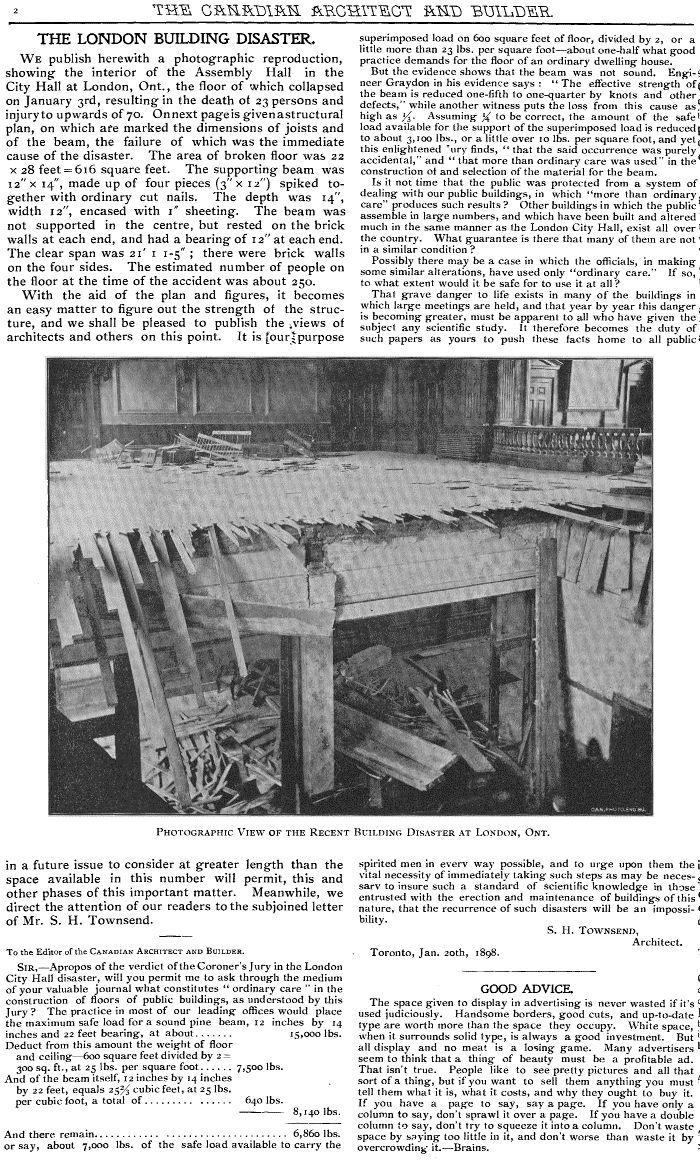
Great Lakes megalopolis as defined by the RPA | ||
|---|---|---|
Includes all metropolitan areas that have a population of 150,000 or greater according to the most recent national census. | ||
| Great Lakes region cities |  | |
| Surrounding cities |
| |
| Cities of states south of region | ||
| Other metro-regions | ||
| International | |
|---|---|
| National | |
| Geographic | |
| Other | |
London, Ontario
View on GrokipediaHistory
Indigenous presence and early European settlement
The region now known as London, Ontario, lies within the traditional territories of several Indigenous nations, including the Anishinaabe (encompassing groups such as the Ojibwe, Odawa, and Potawatomi) and Haudenosaunee (Iroquois Confederacy), as well as the Munsee-Delaware, with overlapping claims along the Thames River watershed.[11][12] Archaeological evidence from sites along the Thames, such as the Lawson Site—a large Late Woodland village dated approximately 500–700 years ago—demonstrates sustained Indigenous occupation by Iroquoian-speaking peoples, likely the Neutral (Attawandaron), who constructed longhouses, practiced maize agriculture, and engaged in trade networks before their dispersal amid 17th-century conflicts with Haudenosaunee and French-allied forces.[13] Excavations at Lawson have yielded over 20 longhouses, pottery, tools, and human remains, indicating a population of up to 2,000 and ritual practices including secondary burials, though interpretations of social organization remain debated due to limited ethnohistoric correlations.[13] Pre-contact habitation traces back further, with Paleo-Indian and Archaic period artifacts (circa 10,000–1,000 BCE) found in southwestern Ontario river valleys, reflecting hunter-gatherer adaptations to post-glacial environments, though specific Thames Valley sites near London are sparse compared to later Woodland settlements.[14] European fur traders and explorers began penetrating the upper Thames Valley in the late 18th century, following British acquisition of the region after the 1763 Treaty of Paris, with posts established for trade in beaver pelts and other furs amid competition with American interests.[15] British Lieutenant-Governor John Graves Simcoe formally named the forks of the Thames "London" on March 2, 1793, selecting the site as a potential capital for Upper Canada due to its strategic river confluence and defensibility, though the plan was abandoned in favor of Newark and later York owing to seasonal flooding and marshy terrain.[16][5] Post-War of 1812 military surveys, prompted by American invasion threats, mapped the area for strategic settlement and road networks, yet early colonization efforts stalled due to environmental hazards like malarial swamps and poor drainage until 1826, when Talbot District agent Colonel John Bostwick completed a formal town plot survey, enabling the arrival of initial permanent European settlers focused on agriculture and milling.[5][15]19th-century growth and incorporation
London was designated the administrative seat of the London District in Upper Canada shortly after its founding in 1826, with construction of the Middlesex County Courthouse commencing that year to serve judicial and governmental functions.[17] The structure, completed by 1829, facilitated the processing of legal matters and reinforced the settlement's centrality in regional governance amid sparse frontier infrastructure.[18] This administrative focus attracted officials, merchants, and settlers, laying groundwork for sustained expansion. Incorporated as a village in 1840 with a population of approximately 2,000, London benefited from proximity to fertile lands and the Thames River, which powered early economic activities.[19] Grist and flour mills emerged along the riverbanks, including Blackfriars Mill established in 1835 for grain processing, supporting local agriculture and trade.[20] Brewing also took root, as Thomas Carling founded a small operation in 1843 to supply beer to nearby military camps and residents.[21] The pivotal arrival of the Great Western Railway in 1853 linked London to Hamilton and broader networks, enabling efficient export of goods and influx of immigrants and capital.[22] This transportation breakthrough catalyzed demographic and commercial surges, prompting incorporation as a city effective January 1, 1855, to manage escalating urban demands.[5] Population climbed from around 2,000 in the early 1840s to over 10,000 by 1871, driven by these rail-enabled opportunities in milling, brewing, and ancillary services.[19]20th-century expansion and disasters
Following World War I, London's economy benefited from expanded manufacturing, including sectors like hosiery, abrasives, and food processing, which drew in-migrants and fueled urban and suburban expansion.[23][24] The city's population grew substantially through the interwar and postwar periods, supported by annexations of adjacent areas in the 1950s and a major 1961 expansion that incorporated surrounding suburbs and nearly doubled its land area.[5] This territorial growth accommodated residential and industrial development, though it strained infrastructure amid rapid urbanization. Key disasters marked the era's vulnerabilities, often tied to inadequate safeguards during hasty construction and environmental risks. On July 16, 1907, Reid's Crystal Hall, a three-story brick structure undergoing renovations on Dundas Street, collapsed due to structural instability, killing eight workers buried under debris and injuring others.[25][26] The incident exposed lapses in building oversight amid the city's industrial boom. The most severe calamity was the April 1937 Thames River flood, caused by prolonged heavy rains after spring thaw, which elevated water levels to a record 23 feet above normal in London.[27] This inundated low-lying areas, destroying over 1,100 homes, displacing thousands, and inflicting $3 million in property damage—primarily in the city—while claiming five lives through drowning and related hazards.[28][29][27] Lacking modern dikes or reservoirs at the time, the event demonstrated the Thames' flood-prone hydrology and prompted initial calls for enhanced river management, though systemic controls were not fully implemented until later decades.[29]Post-2000 developments and challenges
Following the 1998 amalgamation, which incorporated surrounding townships and doubled the city's land area, London's population continued to expand rapidly into the 21st century, driven primarily by immigration and regional economic pull factors. The 2021 Canadian census recorded a city population of 422,324, marking a 10% increase from 383,822 in 2016 and reflecting sustained post-amalgamation integration effects that facilitated suburban annexation and development.[30][2] This growth trajectory, exceeding 400,000 residents by the early 2020s, has imposed strains on municipal governance, as evidenced by persistent disparities in ward populations that undermine equitable representation.[31] A notable response to housing pressures has been a construction boom, with 3,723 new housing units initiated in 2024, surpassing Ontario's provincial targets under the Housing Supply Action Plan and securing nearly $12 million in Building Faster Fund incentives announced in August 2025.[32][33] However, this expansion has been uneven, concentrating in peripheral areas due to zoning preferences for low-density suburban formats over higher-density infill, which has channeled growth away from established cores and amplified infrastructure demands.[34] Rapid population influx, largely attributable to federal immigration policies adding tens of thousands annually to mid-sized Ontario cities, has causally intensified traffic gridlock, positioning London as the 12th-most congested urban area in North America by 2023 metrics, with drivers losing over 100 hours yearly to delays.[35] Local zoning regimes, by restricting urban densification and promoting sprawl, have exacerbated this by increasing average vehicle miles traveled on arterials ill-equipped for surge volumes, leading to chronic bottlenecks without corresponding transit scaling. Ward boundary adjustments approved in March 2025 aim to redress population imbalances ranging from 27,000 to nearly 50,000 residents per ward, but underlying policy drivers of unchecked growth continue to challenge sustainable urban equilibrium.[36][37]Geography
Topography and hydrology
London, Ontario, is located in southwestern Ontario, Canada, at the confluence of the North and South branches of the Thames River, known as the Forks.[38] This forked river system, draining a watershed of approximately 3,400 square kilometres upstream, has shaped the city's historical settlement patterns and urban development along its banks.[39] The terrain features flat plains of glacial till, primarily fine-grained silt and clay deposits from the Stratford Till Plain, extending across much of the city. Elevations in London average around 278 metres above sea level, with gentle undulations typical of post-glacial landscapes in the region.[40] The Thames River's hydrology is characterized by seasonal flows influenced by upstream tributaries, with peak discharges often occurring from January to April due to snowmelt and rainfall.[41] Historical flood data indicate significant events, such as the 1937 freshet triggered by heavy rainfall in the upper watershed, which inundated parts of the city and highlighted the river's flood risk potential.[42] The city's proximity to Lake Huron, approximately 100 kilometres to the northwest, and Lake Erie, about 120 kilometres to the south, contributes to regional hydrological dynamics through influences on precipitation patterns feeding the Thames watershed, though direct lake levels have minimal impact on local river hydrology.[41] Ongoing monitoring of river levels at multiple gauges along the North and South Thames provides data for flood forecasting, underscoring the river's role in managing urban flood risks via dams and conservation measures.[43]Climate patterns
London, Ontario, features a humid continental climate (Köppen Dfb), marked by four distinct seasons with significant temperature variation and moderate precipitation. Winters are cold and snowy, with the January mean temperature averaging -5.4°C and daily lows frequently dropping to -10°C or below, based on 1991–2020 normals from Environment and Climate Change Canada (ECCC).[44] Summers are warm and humid, with July mean highs around 27°C and occasional heat waves exceeding 30°C on about 11 days annually.[44] [45] Precipitation totals approximately 1,017 mm annually, evenly distributed but with higher summer rainfall from convective thunderstorms and lower winter amounts often falling as snow, averaging 120–150 cm seasonally.[44] Spring conditions frequently lead to Thames River flooding, driven by rapid snowmelt from upstream watersheds—typically 200–300 mm of water equivalent—exacerbated by freeze-thaw cycles and early rains, as documented by the Upper Thames River Conservation Authority.[46] Historical peaks, such as the 1937 event with river levels surpassing 5 meters, illustrate this pattern's recurrence every 10–50 years under natural variability.[45] Observational records show a warming trend of 1.2–1.5°C in annual mean temperatures since 1950, aligning with broader Great Lakes region increases from enhanced land-atmosphere heat exchange and reduced ice cover.[45] Extreme events, including heavy precipitation days (>25 mm), have risen modestly by 5–10% per decade in southern Ontario, causally linked to shifts in jet stream persistence and moisture transport rather than isolated urban effects.[45] These changes reflect empirical patterns in hemispheric circulation, with ECCC data confirming no acceleration beyond regional norms in recent decades.[47]Parks and natural areas
The City of London maintains approximately 220 municipal parks encompassing 909 hectares of dedicated parkland, supplemented by 1,856 hectares of open space, contributing to a broader network of green infrastructure.[48] These areas provide recreational opportunities such as walking, picnicking, and community gatherings, while supporting local biodiversity through woodlands and natural heritage features.[49] Major examples include Springbank Park, the city's largest at 140 hectares along the Thames River, which hosts seasonal events, playgrounds, and attractions like Storybook Gardens.[50] [48] Natural areas extend beyond municipal boundaries to include conservation lands managed by the Upper Thames River Conservation Authority, such as Fanshawe Conservation Area on the city's northeast fringe, featuring 23 kilometers of hiking trails and 20 kilometers of biking paths around the reservoir.[51] The Thames Valley Parkway, a multi-use trail system approximately 40 kilometers in length, links these parks and open spaces along the Thames River's forks, facilitating connectivity for non-motorized activities.[52] [48] Maintenance challenges persist due to funding constraints, with municipal assessments identifying London's per capita parks spending as the lowest among peer cities and projecting a $24 million shortfall over the next decade for infrastructure renewal.[48] [53] Reports note aging facilities, safety concerns including litter, needles, and vandalism, and closures of underused amenities like certain wading pools and arenas, reflecting pressures from deferred upkeep amid rising demand.[48] Despite these issues, the green spaces remain vital for public health and environmental resilience, with ongoing efforts to secure external partnerships and sponsorships totaling over $663,000 in 2022 to offset costs.[53]Demographics
Population dynamics and trends
The population of London, Ontario, reached 422,324 according to the 2021 Census of Population conducted by Statistics Canada, reflecting a 10.0% increase from 383,822 in the 2016 census.[54] This growth rate exceeded the national average of 5.2% over the same period, driven primarily by net international and interprovincial migration rather than natural increase, as births have consistently lagged behind deaths in the region.[54] The 1998 municipal amalgamation, which expanded the city's boundaries and incorporated adjacent suburban areas, added approximately 60,000 residents overnight and facilitated subsequent outward expansion, contributing to over 20% cumulative population growth in the city proper from 2001 to 2021.[55] Key causal factors include London's relative housing affordability compared to the Greater Toronto Area, attracting households seeking lower costs amid Toronto's escalating prices, with interprovincial inflows from Ontario's urban cores accounting for much of the post-2000 gains. Natural population change remains negative, as the city's total fertility rate aligns with Ontario's sub-replacement level of approximately 1.22 children per woman in recent years, well below the 2.1 threshold required for generational replacement absent migration.[56] This low fertility, coupled with an aging cohort, has elevated the median age to 38.8 years as of 2021, with the average age at 40.7, signaling a demographic structure increasingly reliant on external inflows to sustain growth.[2] Official projections from the Ontario Ministry of Finance anticipate the city reaching over 500,000 residents by the mid-2030s under reference growth scenarios, with longer-term estimates climbing to 880,000 by 2051, predicated on sustained migration patterns and modest boundary adjustments.[57] These forecasts incorporate updated 2024 data reflecting slower-than-expected post-pandemic inflows, yet they underscore potential strains from rapid expansion, including infrastructure demands, without assuming indefinite scalability.[58] Recent revisions have tempered earlier highs by over 55,000 for 2051, highlighting uncertainties in migration responsiveness to economic conditions.[59]Ethnic and cultural composition
According to the 2021 Canadian census, the population of London, Ontario, exhibited a majority of European ethnic origins, with approximately 71% of residents reporting ancestries such as English, Scottish, Irish, German, Dutch, Italian, or French, often in combination with Canadian.[54] This demographic reflects historical settlement patterns from Britain, continental Europe, and earlier Canadian-born generations. Visible minorities, defined by Statistics Canada as non-Caucasian, non-Indigenous persons in private households, constituted about 28% of the city's 422,324 residents, up from 22% in 2016, driven by recent immigration.[54] [60] The largest visible minority groups included South Asians at 6.4% (27,085 individuals), primarily from India; Black residents at 4.1% (17,450); Arabs at around 3-5%, reflecting Middle Eastern origins; and Chinese at 2.8% (11,955).[60] [54] Smaller groups encompassed Filipinos, Latin Americans, Southeast Asians, and West Asians. This composition stems from post-2000 immigration waves, with South Asian and Arab communities growing notably due to economic migration and family reunification from India, Pakistan, Syria, and Lebanon. Indigenous residents, at about 2.5%, reported origins tied to First Nations, Métis, or Inuit, but are categorized separately from visible minorities.[54]| Visible Minority Group | Population (2021) | Percentage of Total |
|---|---|---|
| South Asian | 27,085 | 6.4% |
| Black | 17,450 | 4.1% |
| Chinese | 11,955 | 2.8% |
| Arab | ~12,000-20,000 | ~3-5% |
| Filipino | ~5,000-7,000 | ~1-2% |
| Total Visible Minorities | 119,355 | 28.3% |
Language, religion, and immigration impacts
In the 2021 Census, English was the mother tongue of 82.4% of residents in the London census metropolitan area (CMA), reflecting its status as the dominant language in daily use and public administration. French accounted for 1.2% as a mother tongue, while non-official languages comprised 15.1% overall, driven by immigration patterns. Among non-official languages, Punjabi stood at 2.5%, Arabic at 1.8%, and Spanish at 1.2%, with these figures indicating a shift from predominantly European heritage languages toward those associated with South Asian, Middle Eastern, and Latin American source countries. This linguistic diversification has necessitated expanded multilingual services in education and healthcare, though English proficiency remains high at 95.8% among the population.[63] Religiously, Christianity remained the largest affiliation in the 2021 Census for the London CMA, encompassing 49.5% of the population, including Catholics at 21.3%, Protestants (such as Anglicans at 4.6% and Baptists at 1.8%), and other denominations. No religious affiliation rose to 34.6%, up from previous censuses, correlating with secularization trends among younger and native-born cohorts. Minority faiths included Muslims at 4.9%, Hindus at 2.0%, Sikhs at 1.5%, and Buddhists at 1.0%, with these groups concentrated in immigrant communities from India, Syria, and China. The growth in non-Christian religions mirrors immigration inflows, potentially influencing demands for faith-specific accommodations in public spaces and schools, though overall religious adherence has declined amid broader Canadian patterns.[64][65] Immigration accounted for 21.6% of the London CMA population in 2021, with 115,600 immigrants, including 20,490 recent arrivals from 2016 to 2021 primarily from India, Syria, and China. This influx has accelerated shifts in language and religious composition, introducing non-official tongues and faiths that challenge service delivery uniformity. However, rapid population growth—partly immigration-driven—has imposed fiscal strains, including heightened pressure on housing affordability and municipal infrastructure, as influxes outpace supply expansions. Empirical analyses link higher immigration rates to elevated housing prices across Ontario municipalities like London from 2006 to 2021, with reduced future admissions projected to ease demand and allow catch-up in construction. Local reports highlight overloads in settlement services and integration supports, where immigrant concentrations exacerbate wait times for language training and culturally sensitive healthcare, underscoring causal tensions between diversity gains and resource allocation limits.[66][67][68]Economy
Major industries and employment
London's economy features a labour force where the services sector predominates, accounting for the majority of employment, while manufacturing contributes about 9.2% of the workforce with 20,003 jobs in 2023.[69] The unemployment rate in the London census metropolitan area averaged approximately 5.8% throughout 2023, reflecting moderate stability amid broader Ontario trends of rising job counts but increasing joblessness in some periods.[70] Manufacturing focuses on advanced sectors including automotive parts, medical devices, and food and beverage processing, with southwestern Ontario's auto cluster supporting parts production vulnerable to external tariffs and supply chain disruptions.[71] [69] A notable strength lies in the brewing industry, where Labatt Breweries, originating in London in 1828, maintains operations as a resilient private-sector anchor producing beverages like London Ale, contrasting with more volatile dependencies in goods production.[69] Food processing more broadly, tied to regional agri-food capabilities, bolsters manufacturing employment projections through retirements and modest growth to 2031.[72] However, the economy shows a shift toward tech, digital media, and finance, with insurance firms like London Life providing higher-wage opportunities amid overall sectoral diversification.[73] Critics highlight overreliance on public-funded services, which inflate employment figures but expose the city to fiscal constraints and slower private innovation, alongside a prevalence of low-wage traps in retail and hospitality subsectors that hinder broader income growth.[74] [75] This structure contributes to London's second-highest low-income rate in southwestern Ontario, reinforcing cycles of discouraged participation and suboptimal skill alignment in entry-level roles.[76] Despite these challenges, manufacturing's projected job openings from retirements offer potential for upskilling, though services' dominance—expected to grow modestly—may perpetuate wage stagnation without policy interventions favoring private resilience.[77][78]Healthcare and education sectors
The London Health Sciences Centre (LHSC) operates Victoria Hospital and University Hospital, forming one of Canada's largest acute-care teaching hospital networks, serving as a regional referral center for complex cases including critically injured patients.[79][80] LHSC integrates with the Schulich School of Medicine and Dentistry at Western University, which provides medical education and training for hundreds of students annually, contributing to the city's role as a healthcare hub for southwestern Ontario.[81] This affiliation supports advanced clinical training but has faced capacity constraints, with provincial data indicating median wait times for specialist treatment in Ontario reached 23.6 weeks in 2024.[82] Educational services, including higher education institutions like Western University, employed 24,101 people in London in 2023, representing 11.1% of the local workforce and underscoring the sector's economic significance alongside healthcare.[83] Combined, health care and educational sectors drive regional specialization, yet post-COVID staffing shortages have intensified, with Ontario hospitals reporting persistent deficits in nursing and support roles, exacerbating operational strains in facilities like LHSC.[84][85] Research achievements bolster the sectors' profile, as exemplified by the Robarts Research Institute, affiliated with Western University, which advances work in neuroimaging, cardiovascular disease, and cancer diagnostics, awarding prestigious prizes like the J. Allyn Taylor International Prize in Medicine for breakthroughs in molecular imaging.[86][87] Despite these contributions, empirical indicators reveal systemic pressures, including elevated vacancy rates in healthcare roles and critiques of prolonged wait times reflecting broader public system limitations rather than isolated institutional failures.[88][89]Recent growth in housing and construction
In 2024, London, Ontario, recorded 3,723 housing starts, surpassing 95 percent of its provincial target of 3,917 units and marking a significant rebound in residential construction activity.[33][32] This achievement was driven by Ontario's Building Faster Fund, which incentivized municipalities to meet aggressive housing targets through financial rewards; as a result, the province awarded London $11.9 million in August 2025 to support further infrastructure and development.[33][90] The fund's structure, tying payments to construction outcomes rather than planning approvals, has been credited with accelerating actual builds amid broader provincial efforts to address housing shortages via policy reforms like streamlined approvals and reduced regulatory barriers.[33] Development charges, levied on new constructions to finance growth-related infrastructure such as roads, water systems, and parks, have played a key role in funding this expansion but have also heightened concerns over affordability.[91] These fees, calculated to offset the incremental costs imposed by additional residents, have risen in line with construction inflation and demand pressures, contributing to higher upfront costs for builders that are often passed to homebuyers.[91] Provincial initiatives, including proposed pilots to lower or defer these charges, aim to mitigate such barriers, though local implementation remains tied to municipal budgeting amid ongoing debates over balancing revenue needs with housing accessibility.[92] Rapid outward expansion has intensified urban sprawl, exacerbating traffic gridlock and straining existing infrastructure without proportionally expanding the municipal tax base, particularly from growth in adjacent areas outside city limits.[93] Critics argue that policy incentives favoring volume over density encourage low-density subdivisions, leading to higher per-capita infrastructure costs, increased vehicle dependency, and fiscal burdens on taxpayers through elevated maintenance demands for extended roadways and services.[93][94] Despite efforts to manage this via urban growth boundary expansions—such as the 2025 proposal to add 1,476 hectares for residential use—these patterns risk perpetuating inefficiencies unless paired with intensified investments in transit and compact development.[94]Government and politics
Municipal structure and council
London, Ontario, operates under a mayor-councillor form of municipal government, as established by the Ontario Municipal Act, featuring a mayor elected at large and one councillor elected from each of 14 wards, for a total of 15 voting members on council. Each member holds equal voting power on matters brought before council, which convenes regularly on Tuesdays to deliberate and vote on bylaws, budgets, and policies. The current council serves a four-year term from 2022 to 2026, with Josh Morgan as mayor following his election in October 2022.[95] Ward boundaries underwent a comprehensive review in 2024 to address population growth and ensure equitable representation, maintaining the structure of 14 wards while adjusting lines in select areas such as Wards 1, 4, 11, and 13 based on 2021 census data estimating the city's population at 446,750, including adjustments for post-secondary students. These revisions, approved by council on December 17, 2024, aim to balance voter distribution amid rapid expansion, with implementation set for the October 26, 2026, municipal election to align nominations and voter lists accordingly. The shift to 14 wards prior to the 2022 election sought to enhance localized representation in a growing urban area, though the larger council size has occasionally led to prolonged debates and points of order during sessions, as observed in extended meetings exceeding six hours.[96][97] The 2022-2026 council's strategic priorities, outlined in the 2023-2027 plan, emphasize fiscal management and sustainable growth, including annual budget updates to accommodate expansion while targeting property tax increases below five percent amid rising demands. Initiatives such as housing development have faced scrutiny for cost implications, including a projected $110 million over 10 years to address disrepair in nearly 70 percent of public housing units, highlighting challenges in executing mandates efficiently within budget constraints. Council committees, including the Strategic Priorities and Policy Committee, oversee these areas to mitigate overruns through rigorous review processes.[98][99]Electoral representation
London, Ontario, is divided among several federal electoral districts, including London Centre, London West, London—Fanshawe, and parts of Elgin—Middlesex—London.[100] In the April 28, 2025, federal election, results showed divided partisan support: the Liberal Party retained London Centre with Arielle Kayabaga and gained or held London—Fanshawe, while Conservatives won London West with Andrew Lawton and performed strongly in suburban-leaning areas like Elgin—Middlesex—London.[101] This split reflects intra-city divides, with urban core demographics favoring Liberals due to higher concentrations of younger voters and immigrants, contrasted by conservative swings in outer wards driven by family-oriented and working-class suburbs prioritizing economic policies over social programs.[102] Provincially, London falls into ridings such as London North Centre, London Centre, London West, and London—Fanshawe, with the New Democratic Party holding the three urban seats in the February 27, 2025, election despite a broader Progressive Conservative majority under Premier Doug Ford.[103] Terence Kernaghan (NDP) was re-elected in London North Centre, alongside NDP victories in the other core ridings, where policy preferences diverge from provincial trends due to denser populations of renters and public sector workers supporting NDP emphases on housing affordability and healthcare expansion.[104] Voter turnout in these provincial contests exceeded the Ontario average, reaching above 50% in three of four London ridings, attributed to localized issues like transit funding resonating with demographics in growth-affected areas.[105] Municipal representation occurs through 14 wards, but rapid population growth—particularly in northern and eastern suburbs—has created imbalances, with some wards like Ward 9 exceeding 20,000 residents while others like Ward 11 fall below 12,000 as of 2024 census data.[31] This disparity, stemming from uneven development since the 2010s, undermines equitable representation by overweighting votes in underpopulated wards, prompting City Council to approve boundary adjustments on March 3, 2025, redistributing populations to within 5% variance for the 2026 election.[36] Federal and provincial turnout in London for 2025 exceeded national figures by 2-5 percentage points, with suburban ridings showing higher participation linked to demographics emphasizing fiscal conservatism amid housing pressures.[106]Policy debates and fiscal management
The City of London's 2025 operating budget totals $1.4 billion in expenditures, comprising $882 million from property taxes and $532 million from non-tax revenues, reflecting a 7.4 percent tax levy increase approved to address rising service demands.[107] This adjustment, down from an initial projection of 8.7 percent, underscores ongoing fiscal pressures amid capital investments in maintenance and expansion, with critics arguing that such hikes prioritize spending growth over efficiency measures like procurement reforms or service prioritization.[107] Rapid population expansion has exacerbated these challenges, with forecasts projecting over 77,000 additional residents and 43,000 new jobs between 2015 and 2035, outpacing revenue generation and straining municipal finances through heightened demands on utilities, roads, and social services. Local analyses highlight uneven ward growth and conflicting provincial-city projections as complicating factors in long-term planning, leading to debates over whether tax base expansion via development can sustainably offset costs without proportional infrastructure funding.[108][93] Zoning policy debates have intensified around housing supply, pitting advocates for reforms to enable higher-density developments against "Not In My Backyard" (NIMBY) opposition from residents wary of traffic, aesthetic changes, and property value impacts from proposals like multi-unit infills.[109] Recent high-density applications have drawn vocal neighborhood resistance, delaying approvals and contributing to supply shortages amid provincial pressures for streamlined permitting, though empirical evidence suggests such reforms could alleviate affordability strains without the externalities feared by opponents.[110] Green initiatives, including the Community Energy and Emissions Plan targeting 55 percent emissions reductions by 2030, allocate significant budget portions to retrofits and renewable transitions, yet face scrutiny for high upfront costs—such as operational investments without quantified net savings—lacking robust return-on-investment data to justify diversions from core fiscal priorities like debt servicing.[111][112] Financial modeling for these efforts often emphasizes long-term environmental gains over immediate economic verification, prompting calls for independent audits to assess efficiency amid competing demands from growth-driven expenditures.[111]Public safety and crime
Law enforcement operations
The London Police Service (LPS) serves as the municipal law enforcement agency responsible for policing the city of London, Ontario, with an organizational structure divided into key divisions including the Uniform Division and the Criminal Investigation Division.[113] The Uniform Division encompasses Patrol Operations, Patrol Support, and the Community Mobilization and Support Branch, which facilitate frontline responses and community engagement initiatives.[113] As of 2024, the LPS employs 651 sworn officers alongside civilian staff, supported by an annual operating budget averaging $168 million as part of a four-year allocation of $672 million approved in 2024.[114] [115] Community policing models are integrated through units such as the Community Oriented Response Unit and the COAST (Crisis Outreach and Support Team) partner-led response initiative, which divert non-criminal mental health calls to specialized services to optimize police resources.[116] [117] Specialized units address targeted threats, including the Guns and Drugs Section, which investigates illegal firearms possession, sales, and drug distribution, as well as dedicated hate crime investigation capabilities within the Criminal Investigation Division.[118] [116] Additional tactical resources include the Emergency Response Unit, Canine Unit, Public Order Unit, and Bike/Foot Patrol Units for event management and proactive patrols.[116] The LPS maintains partnerships with provincial and federal agencies through joint forces operations, participating in 14 such initiatives in 2024 to address organized crime and cross-jurisdictional threats.[119] To enhance operational efficiency, the service introduced 19 special constables in 2024, aimed at handling lower-priority calls and freeing sworn officers for urgent matters.[120] Operational effectiveness is reflected in response time metrics, with priority 1 (life-threatening) calls averaging 9 minutes and 36 seconds in 2024, an improvement from 10 minutes and 2 seconds in 2023, alongside reductions across other priority levels.[121] These gains stem from strategic reallocations, including a new patrol operations investigative section to alleviate frontline burdens.[122]Crime rates and statistical analysis
In 2023, the London Police Service reported 27,044 Criminal Code violations in the city, down from 28,412 in 2022, yielding an overall crime rate of approximately 4,900 incidents per 100,000 population based on the census metropolitan area's estimated size.[123] This decline aligns with broader longitudinal trends, as total reported crimes reached their lowest levels in over 20 years per police assessments.[124] The city's Crime Severity Index (CSI) fell 14% in 2023—the steepest drop among all Canadian census metropolitan areas—reflecting reduced volume and weighted seriousness of offenses compared to the national CSI increase of 2% to 81.20.[124][125] London's overall CSI stood at 64.34, below the provincial and national averages, though its baseline remains elevated relative to smaller Ontario municipalities in non-violent categories.[126] Violent crimes totaled 4,668 in 2023, a decrease from 4,860 in 2022, with the violent CSI at 77.29 versus the national figure of 99.45; this category showed consistent downward pressure amid national stability in violent severity.[123][126] Property crimes, at 17,657 incidents, declined modestly from 19,155 the prior year but held steady as a proportion of total offenses, mirroring provincial patterns where property violations comprised the bulk of non-violent crime without significant year-over-year volatility.[123] Hate-motivated crimes rose 39% to 111 incidents in 2023 from 68 in 2022, outpacing national increases and correlating with expanded demographic diversity in the region, which empirical tracking attributes to heightened intergroup tensions without proportional rises in other bias categories.[127]| Category | 2022 Incidents | 2023 Incidents | % Change |
|---|---|---|---|
| Overall Criminal Code | 28,412 | 27,044 | -4.8% |
| Violent Crimes | 4,860 | 4,668 | -4.0% |
| Property Crimes | 19,155 | 17,657 | -7.8% |
| Hate Crimes | 68 | 111 | +39% |