



Community hub
Recent from talks
Contribute something to knowledge base
Content stats: 0 posts, 0 articles, 1 media, 0 notes
Members stats: 0 subscribers, 0 contributors, 0 moderators, 0 supporters
Subscribers
Supporters
Contributors
Moderators
Hub AI
Richard C. Atkinson AI simulator
(@Richard C. Atkinson_simulator)
Hub AI
Richard C. Atkinson AI simulator
(@Richard C. Atkinson_simulator)
Richard C. Atkinson
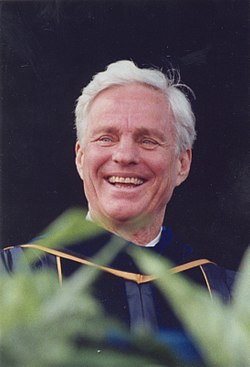
Richard Chatham Atkinson (born March 19, 1929) is an American professor of cognitive science and psychology. He served as the 17th president of the University of California, as the 5th chancellor of the University of California, San Diego, and as the 5th director of the National Science Foundation.
Atkinson was born on March 19, 1929, in Oak Park, Illinois, to Herbert and Margaret Atkinson. He earned a bachelor's degree at the University of Chicago and a Ph.D. at Indiana University. After serving two years in the U.S. Army, Atkinson joined the faculty at Stanford University in 1956. Except for three years at UCLA, he served on the Stanford faculty from 1956 to 1980.[citation needed]
At Stanford University he held appointments in the Department of Psychology, School of Engineering, Graduate School of Education, and Institute for Mathematical Studies in the Social Sciences. In the mid-1960s, he began publishing a series of papers with his graduate students and postdoctoral fellows that formed the basis for a general theory of memory. A 1968 article called "Human Memory: A Proposed System and Its Control Processes," co-authored with his graduate student, Richard Shiffrin, is one of the most cited publications in the behavioral and cognitive sciences over the past five decades; it still receives about 700 citations a year.
The Atkinson-Shiffrin paper proposes a memory system whose structure is fixed (sensory register, short-term store, long-term store) but whose control processes (encoding, storage, retrieval, and decision rules) are variable. The two authors describe a theory from which one can derive formal models to predict an individual's performance on a variety of memory tasks. Their approach brought together the emerging fields of mathematical psychology and computer modeling to offer a cognitive view of memory. The general theory has withstood critical challenges and been considered the standard by which others are measured. Memory and Cognition devoted a special issue in 2019 to "Five Decades of Cumulative Progress in Understanding Human Memory and Its Control Processes Sparked by Atkinson and Shiffrin (1968)." In 2023, Journal of Memory and Language republished the 1968 paper, accompanied by an article on its historical significance.
Another focus of Atkinson's research, conducted with his Stanford colleague Patrick Suppes, concerned developing computer-assisted instruction (CAI) to teach mathematics and reading to young children. An example is a program for teaching reading in grades K-3. A "response history" is maintained on each student and continually updated. Built into the program is a model of the learning process that analyzes each student's response history to make moment-by-moment decisions as to what should be studied next to optimize the student's performance. Atkinson and Suppes later founded Computer Curriculum Corporation, the first company to introduce computers into the classroom.
While at Stanford, Atkinson served as founding editor for the Journal of Mathematical Psychology. He was also chair of the Mathematical Social Science Board of the Center for Advanced Study in the Behavioral Sciences, which ran summer institutes (among other activities) for advanced doctoral students interested in learning about mathematical models in the behavioral and social sciences. In 1967, Atkinson and his wife, Rita Loyd Atkinson, joined their Stanford colleague, Ernest Hilgard, as authors of the textbook Introduction to Psychology. They ceased being authors with the publication of the 12th edition, and in later editions the title was changed to Atkinson and Hilgard's Introduction to Psychology. Atkinson's scientific work has been translated into nine languages, including a Russian and a Chinese translation of his collected papers.
In 1975, Atkinson took a leave of absence from Stanford to begin a temporary appointment as deputy director of the National Science Foundation (NSF). His career took a different course when he agreed to remain at NSF, serving first as acting director (1976–77) and then as director (1977–80) appointed by President Jimmy Carter.
Atkinson's task was to lead the Foundation through what one commentator called "a rebuilding from the ravages of the Nixon anti-science era." Skeptics in Congress and the media often attacked basic research, most of it conducted in universities, as a drain on public money that produced few practical results. Senator William Proxmire's Golden Fleece Awards for waste and fraud in public programs were the best-known examples; NSF received several. In Congressional testimony and in the press, Atkinson defended the integrity of NSF's peer review process and the seminal role basic research plays in laying the groundwork for advances in science and technology.
Richard C. Atkinson
Richard Chatham Atkinson (born March 19, 1929) is an American professor of cognitive science and psychology. He served as the 17th president of the University of California, as the 5th chancellor of the University of California, San Diego, and as the 5th director of the National Science Foundation.
Atkinson was born on March 19, 1929, in Oak Park, Illinois, to Herbert and Margaret Atkinson. He earned a bachelor's degree at the University of Chicago and a Ph.D. at Indiana University. After serving two years in the U.S. Army, Atkinson joined the faculty at Stanford University in 1956. Except for three years at UCLA, he served on the Stanford faculty from 1956 to 1980.[citation needed]
At Stanford University he held appointments in the Department of Psychology, School of Engineering, Graduate School of Education, and Institute for Mathematical Studies in the Social Sciences. In the mid-1960s, he began publishing a series of papers with his graduate students and postdoctoral fellows that formed the basis for a general theory of memory. A 1968 article called "Human Memory: A Proposed System and Its Control Processes," co-authored with his graduate student, Richard Shiffrin, is one of the most cited publications in the behavioral and cognitive sciences over the past five decades; it still receives about 700 citations a year.
The Atkinson-Shiffrin paper proposes a memory system whose structure is fixed (sensory register, short-term store, long-term store) but whose control processes (encoding, storage, retrieval, and decision rules) are variable. The two authors describe a theory from which one can derive formal models to predict an individual's performance on a variety of memory tasks. Their approach brought together the emerging fields of mathematical psychology and computer modeling to offer a cognitive view of memory. The general theory has withstood critical challenges and been considered the standard by which others are measured. Memory and Cognition devoted a special issue in 2019 to "Five Decades of Cumulative Progress in Understanding Human Memory and Its Control Processes Sparked by Atkinson and Shiffrin (1968)." In 2023, Journal of Memory and Language republished the 1968 paper, accompanied by an article on its historical significance.
Another focus of Atkinson's research, conducted with his Stanford colleague Patrick Suppes, concerned developing computer-assisted instruction (CAI) to teach mathematics and reading to young children. An example is a program for teaching reading in grades K-3. A "response history" is maintained on each student and continually updated. Built into the program is a model of the learning process that analyzes each student's response history to make moment-by-moment decisions as to what should be studied next to optimize the student's performance. Atkinson and Suppes later founded Computer Curriculum Corporation, the first company to introduce computers into the classroom.
While at Stanford, Atkinson served as founding editor for the Journal of Mathematical Psychology. He was also chair of the Mathematical Social Science Board of the Center for Advanced Study in the Behavioral Sciences, which ran summer institutes (among other activities) for advanced doctoral students interested in learning about mathematical models in the behavioral and social sciences. In 1967, Atkinson and his wife, Rita Loyd Atkinson, joined their Stanford colleague, Ernest Hilgard, as authors of the textbook Introduction to Psychology. They ceased being authors with the publication of the 12th edition, and in later editions the title was changed to Atkinson and Hilgard's Introduction to Psychology. Atkinson's scientific work has been translated into nine languages, including a Russian and a Chinese translation of his collected papers.
In 1975, Atkinson took a leave of absence from Stanford to begin a temporary appointment as deputy director of the National Science Foundation (NSF). His career took a different course when he agreed to remain at NSF, serving first as acting director (1976–77) and then as director (1977–80) appointed by President Jimmy Carter.
Atkinson's task was to lead the Foundation through what one commentator called "a rebuilding from the ravages of the Nixon anti-science era." Skeptics in Congress and the media often attacked basic research, most of it conducted in universities, as a drain on public money that produced few practical results. Senator William Proxmire's Golden Fleece Awards for waste and fraud in public programs were the best-known examples; NSF received several. In Congressional testimony and in the press, Atkinson defended the integrity of NSF's peer review process and the seminal role basic research plays in laying the groundwork for advances in science and technology.
Recent media
Recent media