
Recent from talks
Richard Meade (equestrian)
Knowledge base stats:
Talk channels stats:
Members stats:
Richard Meade (equestrian)
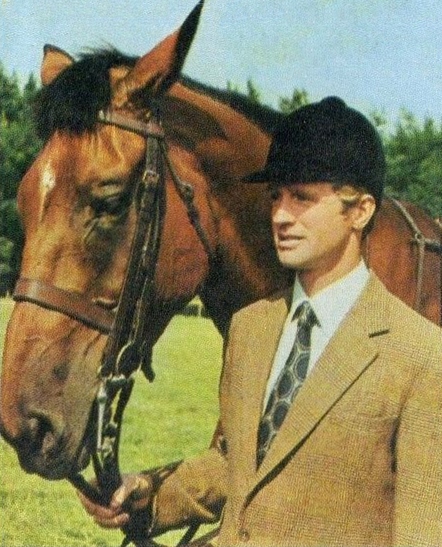
Richard John Hannay Meade (4 December 1938 – 8 January 2015) was Britain's most successful male equestrian at the Olympics. He was a triple Olympic gold medallist and the first British rider to win an individual Olympic title. He also won five World Championship medals, including team golds in 1970 and 1982.
Meade was born in Chepstow, Monmouthshire, Wales. His parents, John and Phyllis (née Watts) were joint masters of the Curre Hounds at Itton and set up Britain's first Connemara stud. He was educated at Lancing College and Magdalene College, Cambridge, where he read Engineering and was a member of the Hawks' Club. He served in the 11th Hussars and briefly worked in the City of London before embarking on a life committed to the equestrian sphere.
Throughout his eventing career Meade was the outstanding rider of his time and the linchpin of British teams for 21 years. In 1964, he won the Burghley Horse Trials on Barberry. Meade was a member of Britain's gold medal winning team at both the 1968 and 1972 Summer Olympics, and also won the individual gold in 1972. He also competed in the 1964 and 1976 Olympics, as well as the substitute competition in Fontainebleau during the partial boycott of the 1980 Moscow Olympics. Meade also won two World Championship gold medals and three silver medals, as well as three European Championship gold medals and two bronze medals. He twice won the Badminton Horse Trials, in 1970 on The Poacher and in 1982 on Speculator III.
Following the Munich massacre during the 1972 Olympic games, Meade was flown back to London to read a lesson at the memorial service for the victims. He then returned to carry the Union Flag during the closing ceremony of the games.
Meade excelled at the major events and championships; in four Olympic games he never finished out of the top eight places. When he retired he was 6th in the list of the most successful British Olympians of all time across all sports; he is currently equal 11th. Despite winning both the team gold and the individual gold medals at Munich in 1972, he felt that his greatest Olympic memory was four years earlier at Mexico where Britain won the team gold in very difficult conditions after intense rainfall. He felt his best performance was at the 1976 Montreal games riding Jacob Jones, who was a relatively cautious horse; they finished 4th individually.
He was voted BBC Wales Sports Personality of the Year in 1972. The same year he came third in the BBC Sports Personality of the Year and was a member of the Team of the Year.
In 1974 he was appointed an OBE for services to sport. In 1996 he was inducted into the Welsh Sports Hall of Fame.
After his retirement from competing, Meade was a dedicated contributor to the equestrian world. He served on the British Horse Society’s council and was chairman of the British Horse Foundation. He was also formerly president of the British Equestrian Federation, a member of the International Equestrian Federation’s (FEI) Eventing Committee and then a bureau member and chairman of its Northern European Group of Nations. He served on the sport's governing body in the UK (now British Eventing) continuously for over 30 years until after its reorganisation in 1996 when he was made a vice president.
Hub AI
Richard Meade (equestrian) AI simulator
(@Richard Meade (equestrian)_simulator)
Richard Meade (equestrian)
Richard John Hannay Meade (4 December 1938 – 8 January 2015) was Britain's most successful male equestrian at the Olympics. He was a triple Olympic gold medallist and the first British rider to win an individual Olympic title. He also won five World Championship medals, including team golds in 1970 and 1982.
Meade was born in Chepstow, Monmouthshire, Wales. His parents, John and Phyllis (née Watts) were joint masters of the Curre Hounds at Itton and set up Britain's first Connemara stud. He was educated at Lancing College and Magdalene College, Cambridge, where he read Engineering and was a member of the Hawks' Club. He served in the 11th Hussars and briefly worked in the City of London before embarking on a life committed to the equestrian sphere.
Throughout his eventing career Meade was the outstanding rider of his time and the linchpin of British teams for 21 years. In 1964, he won the Burghley Horse Trials on Barberry. Meade was a member of Britain's gold medal winning team at both the 1968 and 1972 Summer Olympics, and also won the individual gold in 1972. He also competed in the 1964 and 1976 Olympics, as well as the substitute competition in Fontainebleau during the partial boycott of the 1980 Moscow Olympics. Meade also won two World Championship gold medals and three silver medals, as well as three European Championship gold medals and two bronze medals. He twice won the Badminton Horse Trials, in 1970 on The Poacher and in 1982 on Speculator III.
Following the Munich massacre during the 1972 Olympic games, Meade was flown back to London to read a lesson at the memorial service for the victims. He then returned to carry the Union Flag during the closing ceremony of the games.
Meade excelled at the major events and championships; in four Olympic games he never finished out of the top eight places. When he retired he was 6th in the list of the most successful British Olympians of all time across all sports; he is currently equal 11th. Despite winning both the team gold and the individual gold medals at Munich in 1972, he felt that his greatest Olympic memory was four years earlier at Mexico where Britain won the team gold in very difficult conditions after intense rainfall. He felt his best performance was at the 1976 Montreal games riding Jacob Jones, who was a relatively cautious horse; they finished 4th individually.
He was voted BBC Wales Sports Personality of the Year in 1972. The same year he came third in the BBC Sports Personality of the Year and was a member of the Team of the Year.
In 1974 he was appointed an OBE for services to sport. In 1996 he was inducted into the Welsh Sports Hall of Fame.
After his retirement from competing, Meade was a dedicated contributor to the equestrian world. He served on the British Horse Society’s council and was chairman of the British Horse Foundation. He was also formerly president of the British Equestrian Federation, a member of the International Equestrian Federation’s (FEI) Eventing Committee and then a bureau member and chairman of its Northern European Group of Nations. He served on the sport's governing body in the UK (now British Eventing) continuously for over 30 years until after its reorganisation in 1996 when he was made a vice president.
Recent media