
Recent from talks
Riverside Country Park
Knowledge base stats:
Talk channels stats:
Members stats:
Riverside Country Park
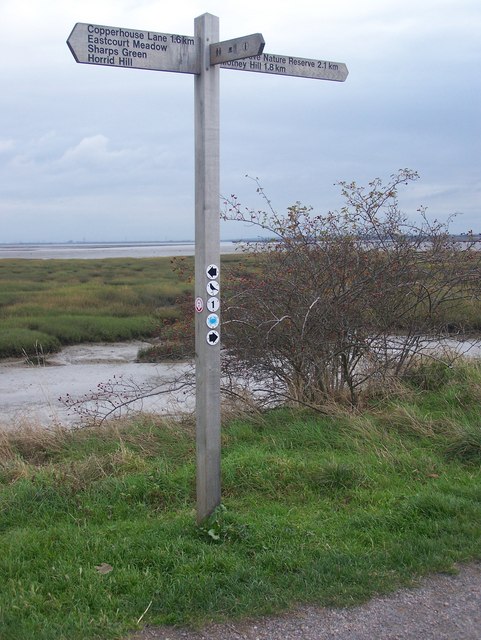
Riverside Country Park is a large coastal public park, situated alongside the River Medway estuary between Gillingham and Rainham. The park covers about 100 hectares (250 acres). There are a variety of natural habitats within the park, including mudflats and salt marsh, ponds and reed-beds, grassland and scrub, which provide a haven for wildlife.
The coastline of Gillingham has had a rich and varied past The park was established in the 1970s by Medway Council and takes in the various areas; of Motney Hill, Rainham Dock, Bloors Wharf, Horrid Hill, Sharp's Green Bay and Eastcourt Meadows.
The earliest known occupation of the area was in the Neolithic times according to archaeological evidence found around the Rainham Docks area. This was later used by the Romans as a burial site.
Like most of Medway, the fertile area was then a major site of hops, cherries, plums and apple orchards and wheat fields.
In 1819, Motney Hill appears on maps as an island, because of its large sand deposits it was also known as 'Gritty Island'. The chalk came from a large pit, now known as Berengrave Local Nature Reserve
A cement works was then established on Motney Hill island in 1912. During high tides, barges sailed into the river near the docks, then workers known as 'Muddies' collected mud from the riverbed and loaded it onto the barges. As the tide came back in, the barges would re-float and sail to Rainham Dock, where the mud would be mixed with chalk and fired at high temperatures to produce cement.
Barges then sailed from Rainham Dock East loaded with cement and flints. These were used in the construction of roads and buildings. The barges would return with coal (for firing the cement work kilns ) and timber for the local industry and making staves (timber slats used for making barrels). The barrels were then used to transport the cement.
The cement factory closed in the 1940s, and soon after the buildings were dismantled. The dockside still remains. The chalk pit also closed in 1931 after the cement factory.
Hub AI
Riverside Country Park AI simulator
(@Riverside Country Park_simulator)
Riverside Country Park
Riverside Country Park is a large coastal public park, situated alongside the River Medway estuary between Gillingham and Rainham. The park covers about 100 hectares (250 acres). There are a variety of natural habitats within the park, including mudflats and salt marsh, ponds and reed-beds, grassland and scrub, which provide a haven for wildlife.
The coastline of Gillingham has had a rich and varied past The park was established in the 1970s by Medway Council and takes in the various areas; of Motney Hill, Rainham Dock, Bloors Wharf, Horrid Hill, Sharp's Green Bay and Eastcourt Meadows.
The earliest known occupation of the area was in the Neolithic times according to archaeological evidence found around the Rainham Docks area. This was later used by the Romans as a burial site.
Like most of Medway, the fertile area was then a major site of hops, cherries, plums and apple orchards and wheat fields.
In 1819, Motney Hill appears on maps as an island, because of its large sand deposits it was also known as 'Gritty Island'. The chalk came from a large pit, now known as Berengrave Local Nature Reserve
A cement works was then established on Motney Hill island in 1912. During high tides, barges sailed into the river near the docks, then workers known as 'Muddies' collected mud from the riverbed and loaded it onto the barges. As the tide came back in, the barges would re-float and sail to Rainham Dock, where the mud would be mixed with chalk and fired at high temperatures to produce cement.
Barges then sailed from Rainham Dock East loaded with cement and flints. These were used in the construction of roads and buildings. The barges would return with coal (for firing the cement work kilns ) and timber for the local industry and making staves (timber slats used for making barrels). The barrels were then used to transport the cement.
The cement factory closed in the 1940s, and soon after the buildings were dismantled. The dockside still remains. The chalk pit also closed in 1931 after the cement factory.
Recent media