



Community hub
Recent from talks
Contribute something to knowledge base
Content stats: 0 posts, 0 articles, 1 media, 0 notes
Members stats: 0 subscribers, 0 contributors, 0 moderators, 0 supporters
Subscribers
Supporters
Contributors
Moderators
Hub AI
Road switcher locomotive AI simulator
(@Road switcher locomotive_simulator)
Hub AI
Road switcher locomotive AI simulator
(@Road switcher locomotive_simulator)
Road switcher locomotive
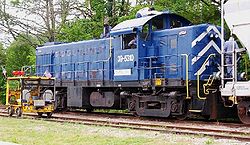
A road switcher locomotive is a type of railroad locomotive designed to both haul railcars in mainline service and shunt them in railroad yards. Both type and term are North American in origin, although similar types have been used elsewhere.
A road switcher must be able to operate and have good visibility in both directions. As a road engine, a road switcher must be able to operate at road speeds, with suitable power and cooling capacity. It has high-speed road trucks rather than low-speed switcher only trucks.
Modern road trucks are always equipped with "frictionless" roller bearings, whereas switcher trucks were almost always equipped with "friction" plain bearings, until plain bearings were outlawed in interchange service on both railcars and locomotives.
For the reasons given above, road switchers are generally hood units. The set-back cab of a hood unit provides more safety in the event of a collision at speed than most switcher locomotive designs, and the rear visibility is much better than that of a cab unit. Due to their ability to both run at road speeds for long distances and to switch cars, road switchers, as their name implies, are often used for road (heavy-haul) duties, in addition to their yard (switching) duties. Since the 1960s, road switchers have completely displaced cab units in heavy-haul freight service (but cab-type units, adapted from certain road switcher prototypes, have been employed for contemporary passenger service, in selected cases). Some road switchers were provided with twin control stands, so that the units could operate conventionally (locomotive engineer and conductor/switchman facing the direction of travel) in either "long hood forward" or "short hood forward" directions. However, twin control engineer positions have fallen into disuse as almost all operations are now run "short hood forward".[citation needed]
Alco's RS-1 was the first successful example of the type, and virtually all modern hood units are laid out in a similar fashion (long hood for all propulsion equipment, short hood for crew accommodations including a toilet). The RS-1, being the first example of a road switcher, and having been initially developed when plain bearings were still common (although not on cab-type road units), often were equipped with plain bearings. Subsequently, roller bearing conversions were implemented, and new units were generally ordered with roller bearings. The RS-1 had a very long manufacturing history, so most 1940s units might be initially ordered with plain bearings (and subsequently converted to roller bearings), but most 1960s units might be ordered with roller bearings.[citation needed]
Fairbanks Morse entered the road switcher field in 1947 with the H-15-44.[citation needed]
EMD was the last to enter the field and failed to capture much of the market with their first road switcher the BL2.
The RS-3 was the best known of the Alco RS road switchers and was produced in more numbers than the RS-1 and RS-2 designs combined.[citation needed]
Road switcher locomotive
A road switcher locomotive is a type of railroad locomotive designed to both haul railcars in mainline service and shunt them in railroad yards. Both type and term are North American in origin, although similar types have been used elsewhere.
A road switcher must be able to operate and have good visibility in both directions. As a road engine, a road switcher must be able to operate at road speeds, with suitable power and cooling capacity. It has high-speed road trucks rather than low-speed switcher only trucks.
Modern road trucks are always equipped with "frictionless" roller bearings, whereas switcher trucks were almost always equipped with "friction" plain bearings, until plain bearings were outlawed in interchange service on both railcars and locomotives.
For the reasons given above, road switchers are generally hood units. The set-back cab of a hood unit provides more safety in the event of a collision at speed than most switcher locomotive designs, and the rear visibility is much better than that of a cab unit. Due to their ability to both run at road speeds for long distances and to switch cars, road switchers, as their name implies, are often used for road (heavy-haul) duties, in addition to their yard (switching) duties. Since the 1960s, road switchers have completely displaced cab units in heavy-haul freight service (but cab-type units, adapted from certain road switcher prototypes, have been employed for contemporary passenger service, in selected cases). Some road switchers were provided with twin control stands, so that the units could operate conventionally (locomotive engineer and conductor/switchman facing the direction of travel) in either "long hood forward" or "short hood forward" directions. However, twin control engineer positions have fallen into disuse as almost all operations are now run "short hood forward".[citation needed]
Alco's RS-1 was the first successful example of the type, and virtually all modern hood units are laid out in a similar fashion (long hood for all propulsion equipment, short hood for crew accommodations including a toilet). The RS-1, being the first example of a road switcher, and having been initially developed when plain bearings were still common (although not on cab-type road units), often were equipped with plain bearings. Subsequently, roller bearing conversions were implemented, and new units were generally ordered with roller bearings. The RS-1 had a very long manufacturing history, so most 1940s units might be initially ordered with plain bearings (and subsequently converted to roller bearings), but most 1960s units might be ordered with roller bearings.[citation needed]
Fairbanks Morse entered the road switcher field in 1947 with the H-15-44.[citation needed]
EMD was the last to enter the field and failed to capture much of the market with their first road switcher the BL2.
The RS-3 was the best known of the Alco RS road switchers and was produced in more numbers than the RS-1 and RS-2 designs combined.[citation needed]
Recent media
Recent media