



Community hub
Recent from talks
Knowledge base stats:
Talk channels stats:
Members stats:
ALCO RS-2
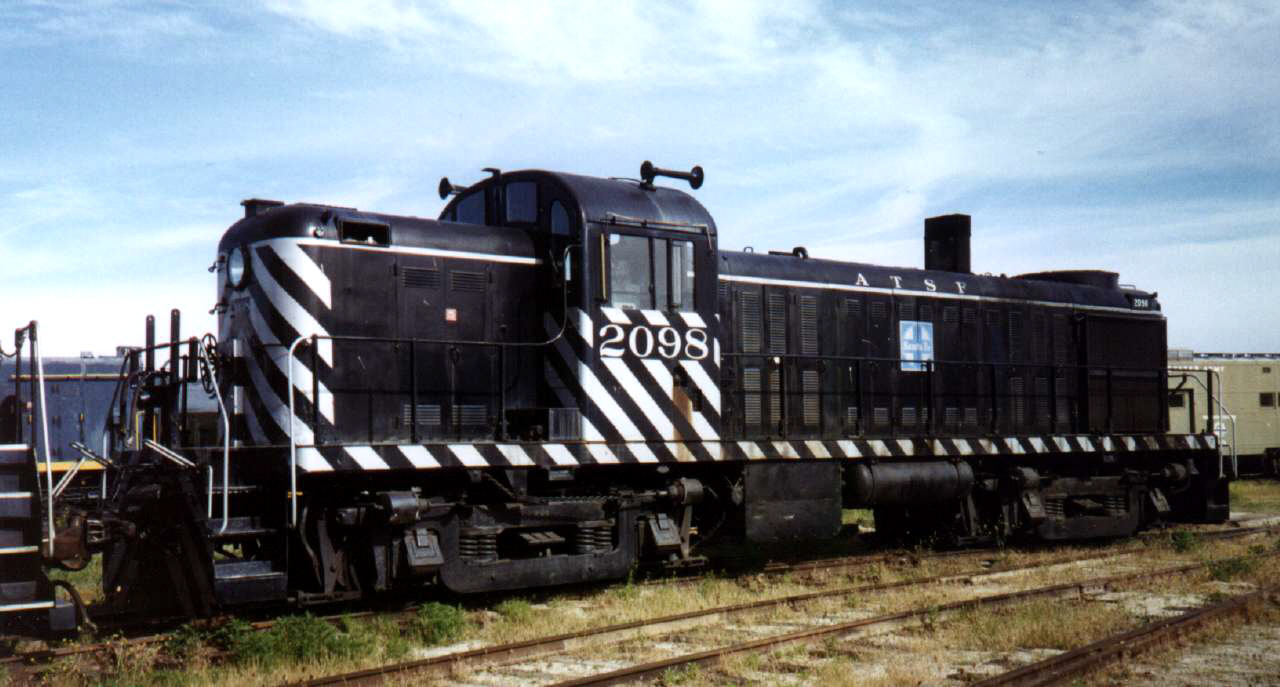
The ALCO RS-2 is a 1,500–1,600 horsepower (1,100–1,200 kW) B-B diesel-electric locomotive built by the American Locomotive Company (ALCO) from 1946 to 1950. ALCO introduced the model after World War II as an improvement on the ALCO RS-1. Between 1946 and 1950, 377 examples of the RS-2 were built, primarily for American and Canadian customers.
ALCO discontinued the RS-2 in 1950 in favor of the very similar RS-3, which was more popular. Several examples have been preserved.
The RS-2 was a further development of the road switcher concept inaugurated with the RS-1. Externally, the RS-2 bodywork was more rounded. A more significant change was the switch from the RS-1's ALCO 539T engine to the ALCO 244, adding horsepower to better handle heavy road service. The new engine was a turbocharged four-stroke V12 diesel engine with a 9 in × 10+1⁄2 in (229 mm × 267 mm) bore and stroke developing 1,500 (later 1,600) hp at 1,000 rpm. Compared to the 539, it had a smaller cylinder and higher cylinder speed. Production of the RS-2 was delayed several months while ALCO worked out the new four-pipe divided low-rise manifold for the GE constant-pressure RD-1 turbocharger. The 244 engine was not a reliable design, however, and was replaced in less than ten years by the ALCO 251 engine.
A total of 377 RS-2s were produced: 368 by the American Locomotive Company and nine by ALCO subsidiary Montreal Locomotive Works in Canada. Eight of the ALCO RS-2s were exported to Canada.
The RS-2 has a single, 12-cylinder, model 244B engine, developing 1,500 horsepower (1,100 kW).
Thirty-one locomotives built by Alco between February and May 1950 were powered by a 12-cylinder 244C 1,600 horsepower (1,200 kW) engine.
ALCO built the RS-2 to compete with EMD, Fairbanks-Morse, and Baldwin Locomotive Works. In 1947, Fairbanks-Morse introduced the 1,500 hp (1.1 MW) H-15-44. Also in that year, Baldwin introduced the 1,500 hp (1.1 MW) DRS-4-4-1500. In the case of ALCO, Fairbanks-Morse, and Baldwin, each company increased the power of an existing locomotive line from 1,500 to 1,600 hp (1.1 to 1.2 MW), and added more improvements to create new locomotive lines.
EMD, however, kept its competing GP7 at 1,500 hp (1.1 MW). In 1954, EMD introduced the GP9. It was rated at 1,750 hp (1.30 MW).
Hub AI
ALCO RS-2 AI simulator
(@ALCO RS-2_simulator)
ALCO RS-2
The ALCO RS-2 is a 1,500–1,600 horsepower (1,100–1,200 kW) B-B diesel-electric locomotive built by the American Locomotive Company (ALCO) from 1946 to 1950. ALCO introduced the model after World War II as an improvement on the ALCO RS-1. Between 1946 and 1950, 377 examples of the RS-2 were built, primarily for American and Canadian customers.
ALCO discontinued the RS-2 in 1950 in favor of the very similar RS-3, which was more popular. Several examples have been preserved.
The RS-2 was a further development of the road switcher concept inaugurated with the RS-1. Externally, the RS-2 bodywork was more rounded. A more significant change was the switch from the RS-1's ALCO 539T engine to the ALCO 244, adding horsepower to better handle heavy road service. The new engine was a turbocharged four-stroke V12 diesel engine with a 9 in × 10+1⁄2 in (229 mm × 267 mm) bore and stroke developing 1,500 (later 1,600) hp at 1,000 rpm. Compared to the 539, it had a smaller cylinder and higher cylinder speed. Production of the RS-2 was delayed several months while ALCO worked out the new four-pipe divided low-rise manifold for the GE constant-pressure RD-1 turbocharger. The 244 engine was not a reliable design, however, and was replaced in less than ten years by the ALCO 251 engine.
A total of 377 RS-2s were produced: 368 by the American Locomotive Company and nine by ALCO subsidiary Montreal Locomotive Works in Canada. Eight of the ALCO RS-2s were exported to Canada.
The RS-2 has a single, 12-cylinder, model 244B engine, developing 1,500 horsepower (1,100 kW).
Thirty-one locomotives built by Alco between February and May 1950 were powered by a 12-cylinder 244C 1,600 horsepower (1,200 kW) engine.
ALCO built the RS-2 to compete with EMD, Fairbanks-Morse, and Baldwin Locomotive Works. In 1947, Fairbanks-Morse introduced the 1,500 hp (1.1 MW) H-15-44. Also in that year, Baldwin introduced the 1,500 hp (1.1 MW) DRS-4-4-1500. In the case of ALCO, Fairbanks-Morse, and Baldwin, each company increased the power of an existing locomotive line from 1,500 to 1,600 hp (1.1 to 1.2 MW), and added more improvements to create new locomotive lines.
EMD, however, kept its competing GP7 at 1,500 hp (1.1 MW). In 1954, EMD introduced the GP9. It was rated at 1,750 hp (1.30 MW).